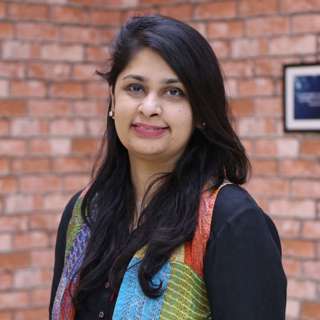

#114 – Maha Rehman on working with governments to rapidly deliver masks to millions of people

#114 – Maha Rehman on working with governments to rapidly deliver masks to millions of people

It’s hard to believe, but until recently there had never been a large field trial that addressed these simple and obvious questions:

1. When ordinary people wear face masks, does it actually reduce the spread of respiratory diseases?
2. And if so, how do you get people to wear masks more often?

It turns out the first question is remarkably challenging to answer, but it's well worth doing nonetheless. Among other reasons, the first good trial of this prompted Maha Rehman — Policy Director at the Mahbub Ul Haq Research Centre — as well as a range of others to immediately use the findings to help tens of millions of people across South Asia, even before the results were public.

Links to learn more, summary and full transcript.

The groundbreaking Bangladesh RCT that inspired her to take action found that:

• A 30% increase in mask wearing reduced total infections by 10%.
• The effect was more pronounced for surgical masks compared to cloth masks (plus ~50% effectiveness).
• Mask wearing also led to an increase in social distancing.
• Of all the incentives tested, the only thing that impacted mask wearing was their colour (people preferred blue over green, and red over purple!).

The research was done by social scientists at Yale, Berkeley, and Stanford, among others. It applied a program they called ‘NORM’ in half of 600 villages in which about 350,000 people lived. NORM has four components, which the researchers expected would work well for the general public:

N: no-cost distribution
O: offering information
R: reinforcing the message and the information in the field
M: modeling

Basically you make sure a community has enough masks and you tell them why it’s important to wear them. You also reinforce the message periodically in markets and mosques, and via role models and promoters in the community itself.

Tipped off that these positive findings were on the way, Maha took this program and rushed to put it into action in Lahore, Pakistan, a city with a population of about 13 million, before the Delta variant could sweep through the region.

Maha had already been doing a lot of data work on COVID policy over the past year, and that allowed her to quickly reach out to the relevant stakeholders — getting them interested and excited.

Governments aren’t exactly known for being super innovative, but in March and April Lahore was going through a very deadly third wave of COVID — so the commissioner quickly jumped on this approach, providing an endorsement as well as resources.

Together with the original researchers, Maha and her team at LUMS collected baseline data that allowed them to map the mask-wearing rate in every part of Lahore, in both markets and mosques. And then based on that data, they adapted the original rural-focused model to a very different urban setting.

The scale of this project was daunting, and in today’s episode Maha tells Rob all about the day-to-day experiences and stresses required to actually make it happen.

They also discuss:

• The challenges of data collection in this context
• Disasters and emergencies she had to respond to in the middle of the project
• What she learned from working closely with the Lahore Commissioner's Office
• How to get governments to provide you with large amounts of data for your research
• How she adapted from a more academic role to a ‘getting stuff done’ role
• How to reduce waste in government procurement
• And much more

Chapters:

  • Rob’s intro (00:00:00)
  • The interview begins (00:01:33)
  • Bangladesh RCT (00:06:24)
  • The NORM model (00:08:34)
  • Results of the experiment (00:10:46)
  • Experimental design (00:20:35)
  • Adapting the findings from Bangladesh to Lahore (00:23:55)
  • Collecting data (00:34:09)
  • Working with governments (00:38:38)
  • Coordination (00:44:53)
  • Disasters and emergencies (00:56:01)
  • Sending out masks to every single person in Lahore (00:59:15)
  • How Maha adapted to her role (01:07:17)
  • Logistic aptitude (01:11:45)
  • Disappointments (01:14:13)
  • Procurement RCT (01:16:51)
  • What we can learn (01:31:18)

Producer: Keiran Harris
Audio mastering: Ben Cordell
Transcriptions: Katy Moore

Avsnitt(333)

'95% of AI Pilots Fail': The hidden agenda behind the viral stat that misled millions

'95% of AI Pilots Fail': The hidden agenda behind the viral stat that misled millions

You might have heard that '95% of corporate AI pilots' are failing. It was one of the most widely cited AI statistics of 2025, parroted by media outlets everywhere. It helped trigger a Nasdaq selloff ...

28 Apr 10min

#242 – Will MacAskill on how we survive the 'intelligence explosion,' AI character, and the case for 'viatopia'

#242 – Will MacAskill on how we survive the 'intelligence explosion,' AI character, and the case for 'viatopia'

Hundreds of millions already turn to AI on the most personal of topics — therapy, political opinions, and how to treat others. And as AI takes over more of the economy, the character of these systems ...

22 Apr 3h 9min

Risks from power-seeking AI systems (article narration by Zershaaneh Qureshi)

Risks from power-seeking AI systems (article narration by Zershaaneh Qureshi)

Hundreds of prominent AI scientists and other notable figures signed a statement in 2023 saying that mitigating the risk of extinction from AI should be a global priority. At 80,000 Hours, we’ve consi...

16 Apr 1h 29min

How scary is Claude Mythos? 303 pages in 21 minutes

How scary is Claude Mythos? 303 pages in 21 minutes

With Claude Mythos we have an AI that knows when it's being tested, can obscure its reasoning when it wants, and is better at breaking into (and out of) computers than any human alive. Rob Wiblin work...

10 Apr 21min

Village gossip, pesticide bans, and gene drives: 17 experts on the future of global health

Village gossip, pesticide bans, and gene drives: 17 experts on the future of global health

What does it really take to lift millions out of poverty and prevent needless deaths?In this special compilation episode, 17 past guests — including economists, nonprofit founders, and policy advisors...

7 Apr 4h 6min

What everyone is missing about Anthropic vs the Pentagon. And: The Meta leaks are worse than you think.

What everyone is missing about Anthropic vs the Pentagon. And: The Meta leaks are worse than you think.

When the Pentagon tried to strong-arm Anthropic into dropping its ban on AI-only kill decisions and mass domestic surveillance, the company refused. Its critics went on the attack: Anthropic and its s...

3 Apr 20min

#241 – Richard Moulange on how now AI codes viable genomes from scratch and outperforms virologists at lab work — what could go wrong?

#241 – Richard Moulange on how now AI codes viable genomes from scratch and outperforms virologists at lab work — what could go wrong?

Last September, scientists used an AI model to design genomes for entirely new bacteriophages (viruses that infect bacteria). They then built them in a lab. Many were viable. And despite being entirel...

31 Mars 3h 7min

#240 – Samuel Charap on how a Ukraine ceasefire could accidentally set Europe up for a bigger war

#240 – Samuel Charap on how a Ukraine ceasefire could accidentally set Europe up for a bigger war

Many people believe a ceasefire in Ukraine will leave Europe safer. But today's guest lays out how a deal could potentially generate insidious new risks — leaving us in a situation that's equally dang...

24 Mars 1h 12min

Populärt inom Utbildning

rss-bara-en-till-om-missbruk-medberoende-2
historiepodden-se
det-skaver
harrisons-dramatiska-historia
nu-blir-det-historia
roda-vita-rosen
johannes-hansen-podcast
allt-du-velat-veta
rss-viktmedicinpodden
sektledare
i-vantan-pa-katastrofen
not-fanny-anymore
rss-foraldramotet-bring-lagercrantz
rss-max-tant-med-max-villman
rss-sjalsligt-avkladd
rikatillsammans-om-privatekonomi-rikedom-i-livet
sa-in-i-sjalen
rss-npf-podden
rss-basta-livet
rss-traningsklubben