#50 - David Denkenberger on how to feed all 8b people through an asteroid/nuclear winter

#50 - David Denkenberger on how to feed all 8b people through an asteroid/nuclear winter

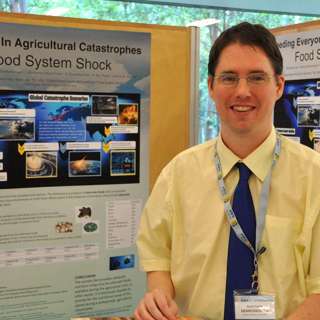
If an asteroid impact or nuclear winter blocked the sun for years, our inability to grow food would result in billions dying of starvation, right? According to Dr David Denkenberger, co-author of Feeding Everyone No Matter What: no. If he's to be believed, nobody need starve at all.

Even without the sun, David sees the Earth as a bountiful food source. Mushrooms farmed on decaying wood. Bacteria fed with natural gas. Fish and mussels supported by sudden upwelling of ocean nutrients - and more.

Dr Denkenberger is an Assistant Professor at the University of Alaska Fairbanks, and he's out to spread the word that while a nuclear winter might be horrible, experts have been mistaken to assume that mass starvation is an inevitability. In fact, the only thing that would prevent us from feeding the world is insufficient preparation.

Links to learn more, summary and full transcript

Not content to just write a book pointing this out, David has gone on to found a growing non-profit - the Alliance to Feed the Earth in Disasters (ALLFED) - to prepare the world to feed everyone come what may. He expects that today 10% of people would find enough food to survive a massive disaster. In principle, if we did everything right, nobody need go hungry. But being more realistic about how much we're likely to invest, David thinks a plan to inform people ahead of time could save 30%, and a decent research and development scheme 80%.

∙ 80,000 Hours' updated article on How to find the best charity to give to
∙ A potential donor evaluates ALLFED

According to David's published cost-benefit analyses, work on this problem may be able to save lives, in expectation, for under $100 each, making it an incredible investment.

These preparations could also help make humanity more resilient to global catastrophic risks, by forestalling an ‘everyone for themselves' mentality, which then causes trade and civilization to unravel.

But some worry that David's cost-effectiveness estimates are exaggerations, so I challenge him on the practicality of his approach, and how much his non-profit's work would actually matter in a post-apocalyptic world. In our extensive conversation, we cover:

* How could the sun end up getting blocked, or agriculture otherwise be decimated?
* What are all the ways we could we eat nonetheless? What kind of life would this be?
* Can these methods be scaled up fast?
* What is his organisation, ALLFED, actually working on?
* How does he estimate the cost-effectiveness of this work, and what are the biggest weaknesses of the approach?
* How would more food affect the post-apocalyptic world? Won't people figure it out at that point anyway?
* Why not just leave guidebooks with this information in every city?
* Would these preparations make nuclear war more likely?
* What kind of people is ALLFED trying to hire?
* What would ALLFED do with more money?
* How he ended up doing this work. And his other engineering proposals for improving the world, including ideas to prevent a supervolcano explosion.

Get this episode by subscribing to our podcast on the world’s most pressing problems and how to solve them: type '80,000 Hours' into your podcasting app.

The 80,000 Hours Podcast is produced by Keiran Harris.

Avsnitt(324)

#224 – There's a cheap and low-tech way to save humanity from any engineered disease | Andrew Snyder-Beattie

#224 – There's a cheap and low-tech way to save humanity from any engineered disease | Andrew Snyder-Beattie

Conventional wisdom is that safeguarding humanity from the worst biological risks — microbes optimised to kill as many as possible — is difficult bordering on impossible, making bioweapons humanity’s ...

2 Okt 20252h 31min

Inside the Biden admin’s AI policy approach | Jake Sullivan, Biden’s NSA | via The Cognitive Revolution

Inside the Biden admin’s AI policy approach | Jake Sullivan, Biden’s NSA | via The Cognitive Revolution

Jake Sullivan was the US National Security Advisor from 2021-2025. He joined our friends on The Cognitive Revolution podcast in August to discuss AI as a critical national security issue. We thought i...

26 Sep 20251h 5min

#223 – Neel Nanda on leading a Google DeepMind team at 26 – and advice if you want to work at an AI company (part 2)

#223 – Neel Nanda on leading a Google DeepMind team at 26 – and advice if you want to work at an AI company (part 2)

At 26, Neel Nanda leads an AI safety team at Google DeepMind, has published dozens of influential papers, and mentored 50 junior researchers — seven of whom now work at major AI companies. His secret?...

15 Sep 20251h 46min

#222 – Can we tell if an AI is loyal by reading its mind? DeepMind's Neel Nanda (part 1)

#222 – Can we tell if an AI is loyal by reading its mind? DeepMind's Neel Nanda (part 1)

We don’t know how AIs think or why they do what they do. Or at least, we don’t know much. That fact is only becoming more troubling as AIs grow more capable and appear on track to wield enormous cultu...

8 Sep 20253h 1min

#221 – Kyle Fish on the most bizarre findings from 5 AI welfare experiments

#221 – Kyle Fish on the most bizarre findings from 5 AI welfare experiments

What happens when you lock two AI systems in a room together and tell them they can discuss anything they want?According to experiments run by Kyle Fish — Anthropic’s first AI welfare researcher — som...

28 Aug 20252h 28min

How not to lose your job to AI (article by Benjamin Todd)

How not to lose your job to AI (article by Benjamin Todd)

About half of people are worried they’ll lose their job to AI. They’re right to be concerned: AI can now complete real-world coding tasks on GitHub, generate photorealistic video, drive a taxi more sa...

31 Juli 202551min

Rebuilding after apocalypse: What 13 experts say about bouncing back

Rebuilding after apocalypse: What 13 experts say about bouncing back

What happens when civilisation faces its greatest tests?This compilation brings together insights from researchers, defence experts, philosophers, and policymakers on humanity’s ability to survive and...

15 Juli 20254h 26min

#220 – Ryan Greenblatt on the 4 most likely ways for AI to take over, and the case for and against AGI in <8 years

#220 – Ryan Greenblatt on the 4 most likely ways for AI to take over, and the case for and against AGI in <8 years

Ryan Greenblatt — lead author on the explosive paper “Alignment faking in large language models” and chief scientist at Redwood Research — thinks there’s a 25% chance that within four years, AI will b...

8 Juli 20252h 50min

Populärt inom Utbildning

historiepodden-se
rss-bara-en-till-om-missbruk-medberoende-2
det-skaver
alska-oss
harrisons-dramatiska-historia
nu-blir-det-historia
rss-viktmedicinpodden
sektledare
johannes-hansen-podcast
not-fanny-anymore
allt-du-velat-veta
rss-sjalsligt-avkladd
roda-vita-rosen
i-vantan-pa-katastrofen
rss-max-tant-med-max-villman
sa-in-i-sjalen
rss-om-vi-ska-vara-arliga
rikatillsammans-om-privatekonomi-rikedom-i-livet
polisutbildningspodden
rss-basta-livet