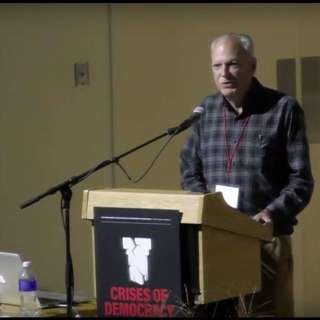

#51 - Martin Gurri on the revolt of the public & crisis of authority in the information age

#51 - Martin Gurri on the revolt of the public & crisis of authority in the information age

Politics in rich countries seems to be going nuts. What's the explanation? Rising inequality? The decline of manufacturing jobs? Excessive immigration?

Martin Gurri spent decades as a CIA analyst and in his 2014 book The Revolt of The Public and Crisis of Authority in the New Millennium, predicted political turbulence for an entirely different reason: new communication technologies were flipping the balance of power between the public and traditional authorities.

In 1959 the President could control the narrative by leaning on his friends at four TV stations, who felt it was proper to present the nation's leader in a positive light, no matter their flaws. Today, it's impossible to prevent someone from broadcasting any grievance online, whether it's a contrarian insight or an insane conspiracy theory.

Links to learn more, summary and full transcript.

According to Gurri, trust in society's institutions - police, journalists, scientists and more - has been undermined by constant criticism from outsiders, and exposed to a cacophony of conflicting opinions on every issue, the public takes fewer truths for granted. We are now free to see our leaders as the flawed human beings they always have been, and are not amused.

Suspicious they are being betrayed by elites, the public can also use technology to coordinate spontaneously and express its anger. Keen to 'throw the bastards out' protesters take to the streets, united by what they don't like, but without a shared agenda or the institutional infrastructure to figure out how to fix things. Some popular movements have come to view any attempt to exercise power over others as suspect.

If Gurri is to be believed, protest movements in Egypt, Spain, Greece and Israel in 2011 followed this script, while Brexit, Trump and the French yellow vests movement subsequently vindicated his theory.

In this model, politics won't return to its old equilibrium any time soon. The leaders of tomorrow will need a new message and style if they hope to maintain any legitimacy in this less hierarchical world. Otherwise, we're in for decades of grinding conflict between traditional centres of authority and the general public, who doubt both their loyalty and competence.

But how much should we believe this theory? Why do Canada and Australia remain pools of calm in the storm? Aren't some malcontents quite concrete in their demands? And are protest movements actually more common (or more nihilistic) than they were decades ago?

In today's episode we ask these questions and add an hour-long discussion with two of Rob's colleagues - Keiran Harris and Michelle Hutchinson - to further explore the ideas in the book.

The conversation covers:

* How do we know that the internet is driving this rather than some other phenomenon?
* How do technological changes enable social and political change?
* The historical role of television
* Are people also more disillusioned now with sports heroes and actors?
* Which countries are finding good ways to make politics work in this new era?
* What are the implications for the threat of totalitarianism?
* What is this is going to do to international relations? Will it make it harder for countries to cooperate and avoid conflict?

Get this episode by subscribing to our podcast on the world’s most pressing problems and how to solve them: type '80,000 Hours' into your podcasting app.

The 80,000 Hours Podcast is produced by Keiran Harris.

Avsnitt(326)

#21 - Holden Karnofsky on times philanthropy transformed the world & Open Phil’s plan to do the same

#21 - Holden Karnofsky on times philanthropy transformed the world & Open Phil’s plan to do the same

The Green Revolution averted mass famine during the 20th century. The contraceptive pill gave women unprecedented freedom in planning their own lives. Both are widely recognised as scientific breakthr...

27 Feb 20182h 35min

#20 - Bruce Friedrich on inventing outstanding meat substitutes to end speciesism & factory farming

#20 - Bruce Friedrich on inventing outstanding meat substitutes to end speciesism & factory farming

Before the US Civil War, it was easier for the North to morally oppose slavery. Why? Because unlike the South they weren’t profiting much from its existence. The fight for abolition was partly won bec...

19 Feb 20181h 18min

#19 - Samantha Pitts-Kiefer on working next to the White House trying to prevent nuclear war

#19 - Samantha Pitts-Kiefer on working next to the White House trying to prevent nuclear war

Rogue elements within a state’s security forces enrich dozens of kilograms of uranium. It’s then assembled into a crude nuclear bomb. The bomb is transported on a civilian aircraft to Washington D.C, ...

14 Feb 20181h 4min

#18 - Ofir Reich on using data science to end poverty & the spurious action-inaction distinction

#18 - Ofir Reich on using data science to end poverty & the spurious action-inaction distinction

Ofir Reich started out doing math in the military, before spending 8 years in tech startups - but then made a sharp turn to become a data scientist focussed on helping the global poor. At UC Berkeley...

31 Jan 20181h 18min

#17 - Will MacAskill on moral uncertainty, utilitarianism & how to avoid being a moral monster

#17 - Will MacAskill on moral uncertainty, utilitarianism & how to avoid being a moral monster

Immanuel Kant is a profoundly influential figure in modern philosophy, and was one of the earliest proponents for universal democracy and international cooperation. He also thought that women have no ...

19 Jan 20181h 52min

#16 - Michelle Hutchinson on global priorities research & shaping the ideas of intellectuals

#16 - Michelle Hutchinson on global priorities research & shaping the ideas of intellectuals

In the 40s and 50s neoliberalism was a fringe movement within economics. But by the 80s it had become a dominant school of thought in public policy, and achieved major policy changes across the Englis...

22 Dec 201755min

#15 - Phil Tetlock on how chimps beat Berkeley undergrads and when it’s wise to defer to the wise

#15 - Phil Tetlock on how chimps beat Berkeley undergrads and when it’s wise to defer to the wise

Prof Philip Tetlock is a social science legend. Over forty years he has researched whose predictions we can trust, whose we can’t and why - and developed methods that allow all of us to be better at p...

20 Nov 20171h 24min
#14 - Sharon Nunez & Jose Valle on going undercover to expose animal abuse

#14 - Sharon Nunez & Jose Valle on going undercover to expose animal abuse

What if you knew that ducks were being killed with pitchforks? Rabbits dumped alive into containers? Or pigs being strangled with forklifts? Would you be willing to go undercover to expose the crime? ...

13 Nov 20171h 25min

Populärt inom Utbildning

rss-bara-en-till-om-missbruk-medberoende-2
historiepodden-se
det-skaver
alska-oss
harrisons-dramatiska-historia
nu-blir-det-historia
not-fanny-anymore
rss-foraldramotet-bring-lagercrantz
roda-vita-rosen
johannes-hansen-podcast
rss-viktmedicinpodden
sektledare
sa-in-i-sjalen
i-vantan-pa-katastrofen
rss-max-tant-med-max-villman
rss-sjalsligt-avkladd
rib-podcast
rikatillsammans-om-privatekonomi-rikedom-i-livet
allt-du-velat-veta
rss-relationsrevolutionen