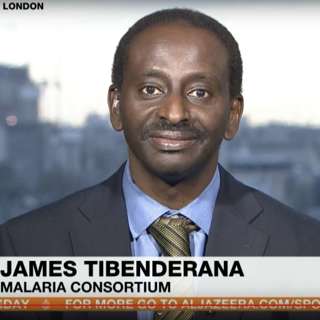

#129 – James Tibenderana on the state of the art in malaria control and elimination

#129 – James Tibenderana on the state of the art in malaria control and elimination

The good news is deaths from malaria have been cut by a third since 2005. The bad news is it still causes 250 million cases and 600,000 deaths a year, mostly among young children in sub-Saharan Africa.

We already have dirt-cheap ways to prevent and treat malaria, and the fraction of the Earth's surface where the disease exists at all has been halved since 1900. So why is it such a persistent problem in some places, even rebounding 15% since 2019?

That's one of many questions I put to today's guest, James Tibenderana — doctor, medical researcher, and technical director at a major global health nonprofit known as Malaria Consortium. James studies the cutting edge of malaria control and treatment in order to optimise how Malaria Consortium spends £100 million a year across countries like Uganda, Nigeria, and Chad.

Links to learn more, summary and full transcript.

In sub-Saharan Africa, where 90% of malaria deaths occur, the infection is spread by a few dozen species of mosquito that are ideally suited to the local climatic conditions and have thus been impossible to eliminate so far.

While COVID-19 may have an 'R' (reproduction number) of 5, in some situations malaria has a reproduction number in the 1,000s. A single person with malaria can pass the parasite to hundreds of mosquitoes, which themselves each go on to bite dozens of people each, allowing cases to quickly explode.

The nets and antimalarial drugs Malaria Consortium distributes have been highly effective where distributed, but there are tens of millions of young children who are yet to be covered simply due to a lack of funding.

Despite the success of these approaches, given how challenging it will be to create a malaria-free world, there's enthusiasm to find new approaches to throw at the problem. Two new interventions have recently generated buzz: vaccines and genetic approaches to control the mosquito species that carry malaria.

The RTS,S vaccine is the first-ever vaccine that attacks a protozoa as opposed to a virus or bacteria. It's a great scientific achievement. But James points out that even after three doses, it's still only about 30% effective. Unless future vaccines are substantially more effective, they will remain just a complement to nets and antimalarial drugs, which are cheaper and each cut mortality by more than half.

On the other hand, the latest mosquito-control technologies are almost too effective. It is possible to insert genes into specific mosquito populations that reduce their ability to reproduce. By using a 'gene drive,' you can ensure mosquitoes hand these detrimental genes down to 100% of their offspring. If deployed, these genes would spread and ultimately eliminate the mosquitoes that carry malaria at low cost, thereby largely ridding the world of the disease.

Because a single country embracing this method would have global effects, James cautions that it's important to get buy-in from all the countries involved, and to have a way of reversing the intervention if we realise we've made a mistake.

In this comprehensive conversation, Rob and James discuss all of the above, as well as most of what you could reasonably want to know about the state of the art in malaria control today, including:
• How malaria spreads and the symptoms it causes
• The use of insecticides and poison baits
• How big a problem insecticide resistance is
• How malaria was eliminated in North America and Europe
• The key strategic choices faced by Malaria Consortium in its efforts to create a malaria-free world
• And much more

Chapters:

  • Rob’s intro (00:00:00)
  • The interview begins (00:02:06)
  • Malaria basics (00:06:56)
  • Malaria vaccines (00:12:37)
  • Getting rid of mosquitos (00:32:20)
  • Gene drives (00:38:06)
  • Symptoms (00:58:00)
  • Preventing the spread (01:06:00)
  • Why we haven’t gotten rid of malaria yet (01:15:07)
  • What James is responsible for as technical director (01:30:52)
  • Malaria Consortium's current strategy (01:39:59)
  • Elimination vs. control (02:01:49)
  • Delivery and practicalities (02:16:23)
  • Relationships with governments (02:26:38)
  • Funding gap (02:31:03)
  • Access and use gap (02:39:10)
  • The value of local researchers (02:49:26)
  • Past research findings (02:57:10)
  • How to help (03:06:30)
  • How James ended up where he is today (03:13:45)

Producer: Keiran Harris
Audio mastering: Ryan Kessler
Transcriptions: Katy Moore

Det här avsnittet är hämtat från ett öppet RSS-flöde och publiceras inte av Podme. Det kan innehålla reklam.

Avsnitt(334)

I Now See a Path to Safe Superintelligent AI | Yoshua Bengio, most-cited AI researcher

I Now See a Path to Safe Superintelligent AI | Yoshua Bengio, most-cited AI researcher

The co-inventor of modern AI and the most cited living scientist believes he's figured out how to ensure AI is honest, incapable of deception, and never goes rogue. Yoshua Bengio – Turing Award Winner...

7 Maj 2h 33min

'95% of AI Pilots Fail': The hidden agenda behind the viral stat that misled millions

'95% of AI Pilots Fail': The hidden agenda behind the viral stat that misled millions

You might have heard that '95% of corporate AI pilots' are failing. It was one of the most widely cited AI statistics of 2025, parroted by media outlets everywhere. It helped trigger a Nasdaq selloff ...

28 Apr 10min

#242 – Will MacAskill on how we survive the 'intelligence explosion,' AI character, and the case for 'viatopia'

#242 – Will MacAskill on how we survive the 'intelligence explosion,' AI character, and the case for 'viatopia'

Hundreds of millions already turn to AI on the most personal of topics — therapy, political opinions, and how to treat others. And as AI takes over more of the economy, the character of these systems ...

22 Apr 3h 9min

Risks from power-seeking AI systems (article narration by Zershaaneh Qureshi)

Risks from power-seeking AI systems (article narration by Zershaaneh Qureshi)

Hundreds of prominent AI scientists and other notable figures signed a statement in 2023 saying that mitigating the risk of extinction from AI should be a global priority. At 80,000 Hours, we’ve consi...

16 Apr 1h 29min

How scary is Claude Mythos? 303 pages in 21 minutes

How scary is Claude Mythos? 303 pages in 21 minutes

With Claude Mythos we have an AI that knows when it's being tested, can obscure its reasoning when it wants, and is better at breaking into (and out of) computers than any human alive. Rob Wiblin work...

10 Apr 21min

Village gossip, pesticide bans, and gene drives: 17 experts on the future of global health

Village gossip, pesticide bans, and gene drives: 17 experts on the future of global health

What does it really take to lift millions out of poverty and prevent needless deaths?In this special compilation episode, 17 past guests — including economists, nonprofit founders, and policy advisors...

7 Apr 4h 6min

What everyone is missing about Anthropic vs the Pentagon. And: The Meta leaks are worse than you think.

What everyone is missing about Anthropic vs the Pentagon. And: The Meta leaks are worse than you think.

When the Pentagon tried to strong-arm Anthropic into dropping its ban on AI-only kill decisions and mass domestic surveillance, the company refused. Its critics went on the attack: Anthropic and its s...

3 Apr 20min

#241 – Richard Moulange on how now AI codes viable genomes from scratch and outperforms virologists at lab work — what could go wrong?

#241 – Richard Moulange on how now AI codes viable genomes from scratch and outperforms virologists at lab work — what could go wrong?

Last September, scientists used an AI model to design genomes for entirely new bacteriophages (viruses that infect bacteria). They then built them in a lab. Many were viable. And despite being entirel...

31 Mars 3h 7min

Populärt inom Utbildning

historiepodden-se
rss-bara-en-till-om-missbruk-medberoende-2
det-skaver
nu-blir-det-historia
johannes-hansen-podcast
harrisons-dramatiska-historia
not-fanny-anymore
allt-du-velat-veta
roda-vita-rosen
rss-viktmedicinpodden
sektledare
i-vantan-pa-katastrofen
sa-in-i-sjalen
rss-foraldramotet-bring-lagercrantz
rss-dr-bjorklund
rss-basta-livet
rss-sjalsligt-avkladd
rikatillsammans-om-privatekonomi-rikedom-i-livet
rss-max-tant-med-max-villman
rss-om-vi-ska-vara-arliga