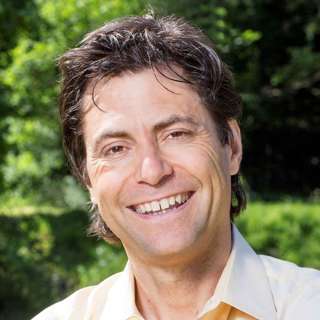

#133 – Max Tegmark on how a 'put-up-or-shut-up' resolution led him to work on AI and algorithmic news selection

#133 – Max Tegmark on how a 'put-up-or-shut-up' resolution led him to work on AI and algorithmic news selection

On January 1, 2015, physicist Max Tegmark gave up something most of us love to do: complain about things without ever trying to fix them.

That “put up or shut up” New Year’s resolution led to the first Puerto Rico conference and Open Letter on Artificial Intelligence — milestones for researchers taking the safe development of highly-capable AI systems seriously.

Links to learn more, summary and full transcript.

Max's primary work has been cosmology research at MIT, but his energetic and freewheeling nature has led him into so many other projects that you would be forgiven for forgetting it. In the 2010s he wrote two best-selling books, Our Mathematical Universe: My Quest for the Ultimate Nature of Reality, and Life 3.0: Being Human in the Age of Artificial Intelligence, and in 2014 founded a non-profit, the Future of Life Institute, which works to reduce all sorts of threats to humanity's future including nuclear war, synthetic biology, and AI.

Max has complained about many other things over the years, from killer robots to the impact of social media algorithms on the news we consume. True to his 'put up or shut up' resolution, he and his team went on to produce a video on so-called ‘Slaughterbots’ which attracted millions of views, and develop a website called 'Improve The News' to help readers separate facts from spin.

But given the stunning recent advances in capabilities — from OpenAI’s DALL-E to DeepMind’s Gato — AI itself remains top of his mind.

You can now give an AI system like GPT-3 the text: "I'm going to go to this mountain with the faces on it. What is the capital of the state to the east of the state that that's in?" And it gives the correct answer (Saint Paul, Minnesota) — something most AI researchers would have said was impossible without fundamental breakthroughs just seven years ago.

So back at MIT, he now leads a research group dedicated to what he calls “intelligible intelligence.” At the moment, AI systems are basically giant black boxes that magically do wildly impressive things. But for us to trust these systems, we need to understand them.

He says that training a black box that does something smart needs to just be stage one in a bigger process. Stage two is: “How do we get the knowledge out and put it in a safer system?”

Today’s conversation starts off giving a broad overview of the key questions about artificial intelligence: What's the potential? What are the threats? How might this story play out? What should we be doing to prepare?

Rob and Max then move on to recent advances in capabilities and alignment, the mood we should have, and possible ways we might misunderstand the problem.

They then spend roughly the last third talking about Max's current big passion: improving the news we consume — where Rob has a few reservations.

They also cover:

• Whether we could understand what superintelligent systems were doing
• The value of encouraging people to think about the positive future they want
• How to give machines goals
• Whether ‘Big Tech’ is following the lead of ‘Big Tobacco’
• Whether we’re sleepwalking into disaster
• Whether people actually just want their biases confirmed
• Why Max is worried about government-backed fact-checking
• And much more

Chapters:

  • Rob’s intro (00:00:00)
  • The interview begins (00:01:19)
  • How Max prioritises (00:12:33)
  • Intro to AI risk (00:15:47)
  • Superintelligence (00:35:56)
  • Imagining a wide range of possible futures (00:47:45)
  • Recent advances in capabilities and alignment (00:57:37)
  • How to give machines goals (01:13:13)
  • Regulatory capture (01:21:03)
  • How humanity fails to fulfil its potential (01:39:45)
  • Are we being hacked? (01:51:01)
  • Improving the news (02:05:31)
  • Do people actually just want their biases confirmed? (02:16:15)
  • Government-backed fact-checking (02:37:00)
  • Would a superintelligence seem like magic? (02:49:50)


Producer: Keiran Harris
Audio mastering: Ben Cordell
Transcriptions: Katy Moore

Avsnitt(320)

#66 – Peter Singer on being provocative, effective altruism, & how his moral views have changed

#66 – Peter Singer on being provocative, effective altruism, & how his moral views have changed

In 1989, the professor of moral philosophy Peter Singer was all over the news for his inflammatory opinions about abortion. But the controversy stemmed from Practical Ethics — a book he’d actually rel...

5 Dec 20192h 1min

#65 – Ambassador Bonnie Jenkins on 8 years pursuing WMD arms control, & diversity in diplomacy

#65 – Ambassador Bonnie Jenkins on 8 years pursuing WMD arms control, & diversity in diplomacy

"…it started when the Soviet Union fell apart and there was a real desire to ensure security of nuclear materials and pathogens, and that scientists with [WMD-related] knowledge could get paid so that...

19 Nov 20191h 40min
#64 – Bruce Schneier on how insecure electronic voting could break the United States — and surveillance without tyranny

#64 – Bruce Schneier on how insecure electronic voting could break the United States — and surveillance without tyranny

November 3 2020, 10:32PM: CNN, NBC, and FOX report that Donald Trump has narrowly won Florida, and with it, re-election.  November 3 2020, 11:46PM: The NY Times and Wall Street Journal report that so...

25 Okt 20192h 11min
Rob Wiblin on plastic straws, nicotine, doping, & whether changing the long-term is really possible

Rob Wiblin on plastic straws, nicotine, doping, & whether changing the long-term is really possible

Today's episode is a compilation of interviews I recently recorded for two other shows, Love Your Work and The Neoliberal Podcast.  If you've listened to absolutely everything on this podcast feed, y...

25 Sep 20193h 14min

Have we helped you have a bigger social impact? Our annual survey, plus other ways we can help you.

Have we helped you have a bigger social impact? Our annual survey, plus other ways we can help you.

1. Fill out our annual impact survey here. 2. Find a great vacancy on our job board. 3. Learn about our key ideas, and get links to our top articles. 4. Join our newsletter for an email about what's n...

16 Sep 20193min

#63 – Vitalik Buterin on better ways to fund public goods, blockchain's failures, & effective giving

#63 – Vitalik Buterin on better ways to fund public goods, blockchain's failures, & effective giving

Historically, progress in the field of cryptography has had major consequences. It has changed the course of major wars, made it possible to do business on the internet, and enabled private communicat...

3 Sep 20193h 18min
#62 – Paul Christiano on messaging the future, increasing compute, & how CO2 impacts your brain

#62 – Paul Christiano on messaging the future, increasing compute, & how CO2 impacts your brain

Imagine that – one day – humanity dies out. At some point, many millions of years later, intelligent life might well evolve again. Is there any message we could leave that would reliably help them out...

5 Aug 20192h 11min

#61 - Helen Toner on emerging technology, national security, and China

#61 - Helen Toner on emerging technology, national security, and China

From 1870 to 1950, the introduction of electricity transformed life in the US and UK, as people gained access to lighting, radio and a wide range of household appliances for the first time. Electricit...

17 Juli 20191h 54min

Populärt inom Utbildning

historiepodden-se
rss-bara-en-till-om-missbruk-medberoende-2
det-skaver
nu-blir-det-historia
harrisons-dramatiska-historia
rss-viktmedicinpodden
johannes-hansen-podcast
roda-vita-rosen
not-fanny-anymore
allt-du-velat-veta
sektledare
alska-oss
rss-sjalsligt-avkladd
i-vantan-pa-katastrofen
sa-in-i-sjalen
rss-beratta-alltid-det-har
rss-max-tant-med-max-villman
rss-basta-livet
dumforklarat
rikatillsammans-om-privatekonomi-rikedom-i-livet