
#141 – Richard Ngo on large language models, OpenAI, and striving to make the future go well

#141 – Richard Ngo on large language models, OpenAI, and striving to make the future go well

Large language models like GPT-3, and now ChatGPT, are neural networks trained on a large fraction of all text available on the internet to do one thing: predict the next word in a passage. This simple technique has led to something extraordinary — black boxes able to write TV scripts, explain jokes, produce satirical poetry, answer common factual questions, argue sensibly for political positions, and more. Every month their capabilities grow.

But do they really 'understand' what they're saying, or do they just give the illusion of understanding?

Today's guest, Richard Ngo, thinks that in the most important sense they understand many things. Richard is a researcher at OpenAI — the company that created ChatGPT — who works to foresee where AI advances are going and develop strategies that will keep these models from 'acting out' as they become more powerful, are deployed and ultimately given power in society.

Links to learn more, summary and full transcript.

One way to think about 'understanding' is as a subjective experience. Whether it feels like something to be a large language model is an important question, but one we currently have no way to answer.

However, as Richard explains, another way to think about 'understanding' is as a functional matter. If you really understand an idea you're able to use it to reason and draw inferences in new situations. And that kind of understanding is observable and testable.

Richard argues that language models are developing sophisticated representations of the world which can be manipulated to draw sensible conclusions — maybe not so different from what happens in the human mind. And experiments have found that, as models get more parameters and are trained on more data, these types of capabilities consistently improve.

We might feel reluctant to say a computer understands something the way that we do. But if it walks like a duck and it quacks like a duck, we should consider that maybe we have a duck, or at least something sufficiently close to a duck it doesn't matter.

In today's conversation we discuss the above, as well as:

• Could speeding up AI development be a bad thing?
• The balance between excitement and fear when it comes to AI advances
• What OpenAI focuses its efforts where it does
• Common misconceptions about machine learning
• How many computer chips it might require to be able to do most of the things humans do
• How Richard understands the 'alignment problem' differently than other people
• Why 'situational awareness' may be a key concept for understanding the behaviour of AI models
• What work to positively shape the development of AI Richard is and isn't excited about
The AGI Safety Fundamentals course that Richard developed to help people learn more about this field

Get this episode by subscribing to our podcast on the world’s most pressing problems and how to solve them: type 80,000 Hours into your podcasting app.

Producer: Keiran Harris
Audio mastering: Milo McGuire and Ben Cordell
Transcriptions: Katy Moore

Det här avsnittet är hämtat från ett öppet RSS-flöde och publiceras inte av Podme. Det kan innehålla reklam.

Avsnitt(346)

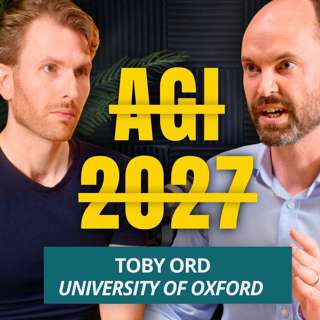
Where AGI timelines go wrong | Toby Ord, Oxford University

Where AGI timelines go wrong | Toby Ord, Oxford University

Both Silicon Valley and the public can’t get enough of ‘AGI timelines.’ But Toby Ord, senior researcher at Oxford’s AI Governance Initiative and author of The Precipice, believes we consistently make ...

6 Aug 2h 46min

What the hell happened with AGI timelines in 2026? – Rob Wiblin

What the hell happened with AGI timelines in 2026? – Rob Wiblin

Last October, famed coder Andrej Karpathy called AI agents “slop.” Two months later he completely reversed his view, describing them as “alien tools” that are “rocking the profession.”He was far from ...

4 Aug 49min

#249 – Spencer Greenberg on staying sane while trying to save the world

#249 – Spencer Greenberg on staying sane while trying to save the world

If you genuinely believe that humanity could be wiped out by AI or a pandemic, what is the appropriate amount of fear to feel?“As much as possible” can seem like the only reasonable answer. If the wor...

28 Juli 2h 9min

#248 – Jasmine Sun on what the people building AI really believe

#248 – Jasmine Sun on what the people building AI really believe

Many AI researchers believe mass job displacement is coming — and some even think there’s a chance their technology will kill everyone. But they’re building it anyway. Writer and journalist Jasmine Su...

21 Juli 1h 6min

#247 – Anton Leicht on how middle powers avoid losing everything in a post-AI world

#247 – Anton Leicht on how middle powers avoid losing everything in a post-AI world

In a post-AGI world, can a country without access to frontier AI even be considered sovereign anymore?Anton Leicht says once frontier AI becomes a core economic input, the countries that own it will p...

14 Juli 1h 33min

#246 – Sneha Revanur on how a small team of activists helped pass America's landmark AI safety laws

#246 – Sneha Revanur on how a small team of activists helped pass America's landmark AI safety laws

Six years ago, aged just 15, Sneha Revanur founded the AI advocacy nonprofit Encode AI — back when AI felt like a niche issue. Now the world’s caught up with her, and she’s ready to share everything s...

8 Juli 52min

We can guess what intergalactic war would look like. And strangely, it matters.

We can guess what intergalactic war would look like. And strangely, it matters.

Intergalactic war is probably billions of years away — yet physics can already tell us how it ends. And strangely that conclusion is relevant to decisions people have to make today.In this video, Rob ...

18 Juni 15min

How AI could create the world’s biggest problems (article by Zershaaneh Qureshi)

How AI could create the world’s biggest problems (article by Zershaaneh Qureshi)

Imagine you’re living 15,000 years ago. Your people are hunter-gatherers and you sleep under the stars. If someone told you humans would one day build cities with millions of people, fly through the a...

11 Juni 1h 29min

Populärt inom Utbildning

historiepodden-se
rss-bara-en-till-om-missbruk-medberoende-2
det-skaver
nu-blir-det-historia
harrisons-dramatiska-historia
not-fanny-anymore
johannes-hansen-podcast
allt-du-velat-veta
rss-viktmedicinpodden
roda-vita-rosen
sa-in-i-sjalen
rikatillsammans-om-privatekonomi-rikedom-i-livet
rss-max-tant-med-max-villman
rss-autismandan
i-vantan-pa-katastrofen
rss-basta-livet
psykologsnack
sektledare
rss-traningsklubben
vi-gar-till-historien