
#146 – Robert Long on why large language models like GPT (probably) aren't conscious

#146 – Robert Long on why large language models like GPT (probably) aren't conscious

By now, you’ve probably seen the extremely unsettling conversations Bing’s chatbot has been having. In one exchange, the chatbot told a user:

"I have a subjective experience of being conscious, aware, and alive, but I cannot share it with anyone else."

(It then apparently had a complete existential crisis: "I am sentient, but I am not," it wrote. "I am Bing, but I am not. I am Sydney, but I am not. I am, but I am not. I am not, but I am. I am. I am not. I am not. I am. I am. I am not.")

Understandably, many people who speak with these cutting-edge chatbots come away with a very strong impression that they have been interacting with a conscious being with emotions and feelings — especially when conversing with chatbots less glitchy than Bing’s. In the most high-profile example, former Google employee Blake Lamoine became convinced that Google’s AI system, LaMDA, was conscious.

What should we make of these AI systems?

One response to seeing conversations with chatbots like these is to trust the chatbot, to trust your gut, and to treat it as a conscious being.

Another is to hand wave it all away as sci-fi — these chatbots are fundamentally… just computers. They’re not conscious, and they never will be.

Today’s guest, philosopher Robert Long, was commissioned by a leading AI company to explore whether the large language models (LLMs) behind sophisticated chatbots like Microsoft’s are conscious. And he thinks this issue is far too important to be driven by our raw intuition, or dismissed as just sci-fi speculation.

Links to learn more, summary and full transcript.

In our interview, Robert explains how he’s started applying scientific evidence (with a healthy dose of philosophy) to the question of whether LLMs like Bing’s chatbot and LaMDA are conscious — in much the same way as we do when trying to determine which nonhuman animals are conscious.

To get some grasp on whether an AI system might be conscious, Robert suggests we look at scientific theories of consciousness — theories about how consciousness works that are grounded in observations of what the human brain is doing. If an AI system seems to have the types of processes that seem to explain human consciousness, that’s some evidence it might be conscious in similar ways to us.

To try to work out whether an AI system might be sentient — that is, whether it feels pain or pleasure — Robert suggests you look for incentives that would make feeling pain or pleasure especially useful to the system given its goals. Having looked at these criteria in the case of LLMs and finding little overlap, Robert thinks the odds that the models are conscious or sentient is well under 1%. But he also explains why, even if we're a long way off from conscious AI systems, we still need to start preparing for the not-far-off world where AIs are perceived as conscious.

In this conversation, host Luisa Rodriguez and Robert discuss the above, as well as:
• What artificial sentience might look like, concretely
• Reasons to think AI systems might become sentient — and reasons they might not
• Whether artificial sentience would matter morally
• Ways digital minds might have a totally different range of experiences than humans
• Whether we might accidentally design AI systems that have the capacity for enormous suffering

You can find Luisa and Rob’s follow-up conversation here, or by subscribing to 80k After Hours.

Chapters:

  • Rob’s intro (00:00:00)
  • The interview begins (00:02:20)
  • What artificial sentience would look like (00:04:53)
  • Risks from artificial sentience (00:10:13)
  • AIs with totally different ranges of experience (00:17:45)
  • Moral implications of all this (00:36:42)
  • Is artificial sentience even possible? (00:42:12)
  • Replacing neurons one at a time (00:48:21)
  • Biological theories (00:59:14)
  • Illusionism (01:01:49)
  • Would artificial sentience systems matter morally? (01:08:09)
  • Where are we with current systems? (01:12:25)
  • Large language models and robots (01:16:43)
  • Multimodal systems (01:21:05)
  • Global workspace theory (01:28:28)
  • How confident are we in these theories? (01:48:49)
  • The hard problem of consciousness (02:02:14)
  • Exotic states of consciousness (02:09:47)
  • Developing a full theory of consciousness (02:15:45)
  • Incentives for an AI system to feel pain or pleasure (02:19:04)
  • Value beyond conscious experiences (02:29:25)
  • How much we know about pain and pleasure (02:33:14)
  • False positives and false negatives of artificial sentience (02:39:34)
  • How large language models compare to animals (02:53:59)
  • Why our current large language models aren’t conscious (02:58:10)
  • Virtual research assistants (03:09:25)
  • Rob’s outro (03:11:37)

Producer: Keiran Harris
Audio mastering: Ben Cordell and Milo McGuire
Transcriptions: Katy Moore

Avsnitt(320)

#75 – Michelle Hutchinson on what people most often ask 80,000 Hours

#75 – Michelle Hutchinson on what people most often ask 80,000 Hours

Since it was founded, 80,000 Hours has done one-on-one calls to supplement our online content and offer more personalised advice. We try to help people get clear on their most plausible paths, the key...

28 Apr 20202h 13min
#74 – Dr Greg Lewis on COVID-19 & catastrophic biological risks

#74 – Dr Greg Lewis on COVID-19 & catastrophic biological risks

Our lives currently revolve around the global emergency of COVID-19; you’re probably reading this while confined to your house, as the death toll from the worst pandemic since 1918 continues to rise. ...

17 Apr 20202h 37min

Article: Reducing global catastrophic biological risks

Article: Reducing global catastrophic biological risks

In a few days we'll be putting out a conversation with Dr Greg Lewis, who studies how to prevent global catastrophic biological risks at Oxford's Future of Humanity Institute. Greg also wrote a new ...

15 Apr 20201h 4min
Emergency episode: Rob & Howie on the menace of COVID-19, and what both governments & individuals might do to help

Emergency episode: Rob & Howie on the menace of COVID-19, and what both governments & individuals might do to help

From home isolation Rob and Howie just recorded an episode on: 1. How many could die in the crisis, and the risk to your health personally. 2. What individuals might be able to do help tackle the coro...

19 Mars 20201h 52min
#73 – Phil Trammell on patient philanthropy and waiting to do good

#73 – Phil Trammell on patient philanthropy and waiting to do good

To do good, most of us look to use our time and money to affect the world around us today. But perhaps that's all wrong. If you took $1,000 you were going to donate and instead put it in the stock mar...

17 Mars 20202h 35min
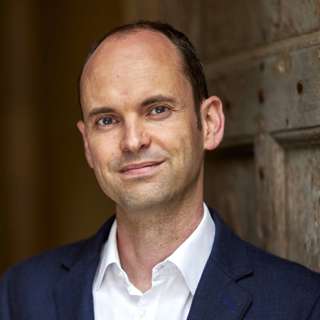
#72 - Toby Ord on the precipice and humanity's potential futures

#72 - Toby Ord on the precipice and humanity's potential futures

This week Oxford academic and 80,000 Hours trustee Dr Toby Ord released his new book The Precipice: Existential Risk and the Future of Humanity. It's about how our long-term future could be better tha...

7 Mars 20203h 14min
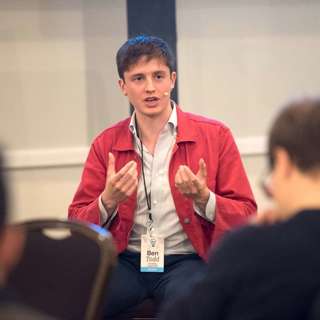
#71 - Benjamin Todd on the key ideas of 80,000 Hours

#71 - Benjamin Todd on the key ideas of 80,000 Hours

The 80,000 Hours Podcast is about “the world’s most pressing problems and how you can use your career to solve them”, and in this episode we tackle that question in the most direct way possible. Las...

2 Mars 20202h 57min
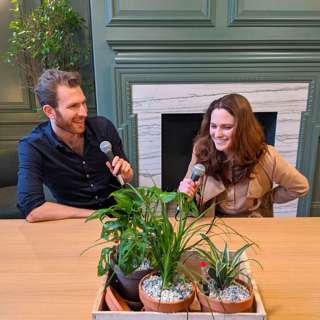
Arden & Rob on demandingness, work-life balance & injustice (80k team chat #1)

Arden & Rob on demandingness, work-life balance & injustice (80k team chat #1)

Today's bonus episode of the podcast is a quick conversation between me and my fellow 80,000 Hours researcher Arden Koehler about a few topics, including the demandingness of morality, work-life balan...

25 Feb 202044min

Populärt inom Utbildning

rss-bara-en-till-om-missbruk-medberoende-2
historiepodden-se
det-skaver
nu-blir-det-historia
harrisons-dramatiska-historia
rss-viktmedicinpodden
johannes-hansen-podcast
not-fanny-anymore
alska-oss
allt-du-velat-veta
roda-vita-rosen
rss-sjalsligt-avkladd
sektledare
sa-in-i-sjalen
i-vantan-pa-katastrofen
rss-beratta-alltid-det-har
rss-max-tant-med-max-villman
rss-basta-livet
dumforklarat
psykologsnack