
#153 – Elie Hassenfeld on 2 big picture critiques of GiveWell's approach, and 6 lessons from their recent work

#153 – Elie Hassenfeld on 2 big picture critiques of GiveWell's approach, and 6 lessons from their recent work

GiveWell is one of the world's best-known charity evaluators, with the goal of "searching for the charities that save or improve lives the most per dollar." It mostly recommends projects that help the world's poorest people avoid easily prevented diseases, like intestinal worms or vitamin A deficiency.

But should GiveWell, as some critics argue, take a totally different approach to its search, focusing instead on directly increasing subjective wellbeing, or alternatively, raising economic growth?

Today's guest — cofounder and CEO of GiveWell, Elie Hassenfeld — is proud of how much GiveWell has grown in the last five years. Its 'money moved' has quadrupled to around $600 million a year.

Its research team has also more than doubled, enabling them to investigate a far broader range of interventions that could plausibly help people an enormous amount for each dollar spent. That work has led GiveWell to support dozens of new organisations, such as Kangaroo Mother Care, MiracleFeet, and Dispensers for Safe Water.

But some other researchers focused on figuring out the best ways to help the world's poorest people say GiveWell shouldn't just do more of the same thing, but rather ought to look at the problem differently.

Links to learn more, summary and full transcript.

Currently, GiveWell uses a range of metrics to track the impact of the organisations it considers recommending — such as 'lives saved,' 'household incomes doubled,' and for health improvements, the 'quality-adjusted life year.'

The Happier Lives Institute (HLI) has argued that instead, GiveWell should try to cash out the impact of all interventions in terms of improvements in subjective wellbeing. This philosophy has led HLI to be more sceptical of interventions that have been demonstrated to improve health, but whose impact on wellbeing has not been measured, and to give a high priority to improving lives relative to extending them.

An alternative high-level critique is that really all that matters in the long run is getting the economies of poor countries to grow. On this view, GiveWell should focus on figuring out what causes some countries to experience explosive economic growth while others fail to, or even go backwards. Even modest improvements in the chances of such a 'growth miracle' will likely offer a bigger bang-for-buck than funding the incremental delivery of deworming tablets or vitamin A supplements, or anything else.

Elie sees where both of these critiques are coming from, and notes that they've influenced GiveWell's work in some ways. But as he explains, he thinks they underestimate the practical difficulty of successfully pulling off either approach and finding better opportunities than what GiveWell funds today.

In today's in-depth conversation, Elie and host Rob Wiblin cover the above, as well as:

  • Why GiveWell flipped from not recommending chlorine dispensers as an intervention for safe drinking water to spending tens of millions of dollars on them
  • What transferable lessons GiveWell learned from investigating different kinds of interventions
  • Why the best treatment for premature babies in low-resource settings may involve less rather than more medicine.
  • Severe malnourishment among children and what can be done about it.
  • How to deal with hidden and non-obvious costs of a programme
  • Some cheap early treatments that can prevent kids from developing lifelong disabilities
  • The various roles GiveWell is currently hiring for, and what's distinctive about their organisational culture
  • And much more.

Chapters:

  • Rob’s intro (00:00:00)
  • The interview begins (00:03:14)
  • GiveWell over the last couple of years (00:04:33)
  • Dispensers for Safe Water (00:11:52)
  • Syphilis diagnosis for pregnant women via technical assistance (00:30:39)
  • Kangaroo Mother Care (00:48:47)
  • Multiples of cash (01:01:20)
  • Hidden costs (01:05:41)
  • MiracleFeet (01:09:45)
  • Serious malnourishment among young children (01:22:46)
  • Vitamin A deficiency and supplementation (01:40:42)
  • The subjective wellbeing approach in contrast with GiveWell's approach (01:46:31)
  • The value of saving a life when that life is going to be very difficult (02:09:09)
  • Whether economic policy is what really matters overwhelmingly (02:20:00)
  • Careers at GiveWell (02:39:10)
  • Donations (02:48:58)
  • Parenthood (02:50:29)
  • Rob’s outro (02:55:05)

Producer: Keiran Harris

Audio mastering: Simon Monsour and Ben Cordell

Transcriptions: Katy Moore

Avsnitt(324)

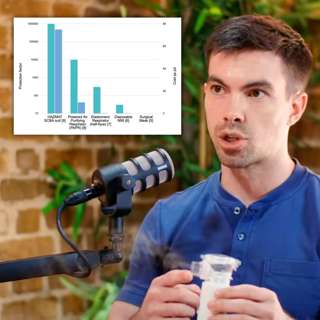
#224 – There's a cheap and low-tech way to save humanity from any engineered disease | Andrew Snyder-Beattie

#224 – There's a cheap and low-tech way to save humanity from any engineered disease | Andrew Snyder-Beattie

Conventional wisdom is that safeguarding humanity from the worst biological risks — microbes optimised to kill as many as possible — is difficult bordering on impossible, making bioweapons humanity’s ...

2 Okt 20252h 31min
Inside the Biden admin’s AI policy approach | Jake Sullivan, Biden’s NSA | via The Cognitive Revolution

Inside the Biden admin’s AI policy approach | Jake Sullivan, Biden’s NSA | via The Cognitive Revolution

Jake Sullivan was the US National Security Advisor from 2021-2025. He joined our friends on The Cognitive Revolution podcast in August to discuss AI as a critical national security issue. We thought i...

26 Sep 20251h 5min
#223 – Neel Nanda on leading a Google DeepMind team at 26 – and advice if you want to work at an AI company (part 2)

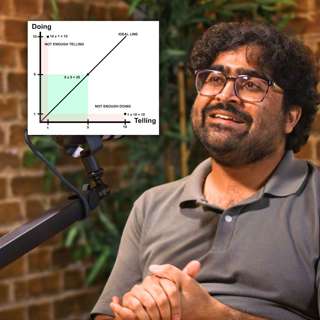
#223 – Neel Nanda on leading a Google DeepMind team at 26 – and advice if you want to work at an AI company (part 2)

At 26, Neel Nanda leads an AI safety team at Google DeepMind, has published dozens of influential papers, and mentored 50 junior researchers — seven of whom now work at major AI companies. His secret?...

15 Sep 20251h 46min
#222 – Can we tell if an AI is loyal by reading its mind? DeepMind's Neel Nanda (part 1)

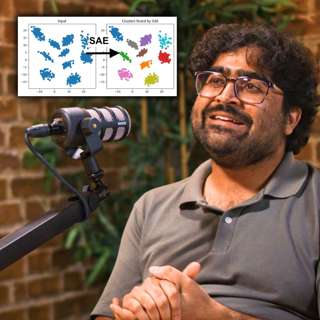
#222 – Can we tell if an AI is loyal by reading its mind? DeepMind's Neel Nanda (part 1)

We don’t know how AIs think or why they do what they do. Or at least, we don’t know much. That fact is only becoming more troubling as AIs grow more capable and appear on track to wield enormous cultu...

8 Sep 20253h 1min
#221 – Kyle Fish on the most bizarre findings from 5 AI welfare experiments

#221 – Kyle Fish on the most bizarre findings from 5 AI welfare experiments

What happens when you lock two AI systems in a room together and tell them they can discuss anything they want?According to experiments run by Kyle Fish — Anthropic’s first AI welfare researcher — som...

28 Aug 20252h 28min

How not to lose your job to AI (article by Benjamin Todd)

How not to lose your job to AI (article by Benjamin Todd)

About half of people are worried they’ll lose their job to AI. They’re right to be concerned: AI can now complete real-world coding tasks on GitHub, generate photorealistic video, drive a taxi more sa...

31 Juli 202551min

Rebuilding after apocalypse: What 13 experts say about bouncing back

Rebuilding after apocalypse: What 13 experts say about bouncing back

What happens when civilisation faces its greatest tests?This compilation brings together insights from researchers, defence experts, philosophers, and policymakers on humanity’s ability to survive and...

15 Juli 20254h 26min
#220 – Ryan Greenblatt on the 4 most likely ways for AI to take over, and the case for and against AGI in <8 years

#220 – Ryan Greenblatt on the 4 most likely ways for AI to take over, and the case for and against AGI in <8 years

Ryan Greenblatt — lead author on the explosive paper “Alignment faking in large language models” and chief scientist at Redwood Research — thinks there’s a 25% chance that within four years, AI will b...

8 Juli 20252h 50min

Populärt inom Utbildning

historiepodden-se
rss-bara-en-till-om-missbruk-medberoende-2
det-skaver
alska-oss
nu-blir-det-historia
rss-viktmedicinpodden
harrisons-dramatiska-historia
sektledare
johannes-hansen-podcast
roda-vita-rosen
not-fanny-anymore
allt-du-velat-veta
rss-sjalsligt-avkladd
rss-max-tant-med-max-villman
rikatillsammans-om-privatekonomi-rikedom-i-livet
i-vantan-pa-katastrofen
sa-in-i-sjalen
polisutbildningspodden
rss-om-vi-ska-vara-arliga
rss-basta-livet