To Dye For: Making a Documentary About Synthetic Dyes

To Dye For: Making a Documentary About Synthetic Dyes

What happens when two parents who have never made a film decide the world needs to see what changed their child's life?

Whitney and Brandon Cawood took synthetic food dyes out of their child's diet and watched the change with their own eyes. Whitney says it was so dramatic she would have struggled to believe it if another parent had told her the same story. She wanted to understand the science, so she asked the researchers herself, and Brandon, a commercial photographer and videographer, agreed to film it. The result is To Dye For: The Documentary, made by a husband-and-wife crew of two.

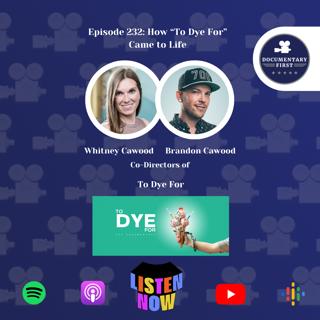
In Episode 232, Christian Taylor sits down with Whitney and Brandon Cawood, the first-time filmmakers behind To Dye For. Whitney is a former teacher and digital marketer who set up every interview and asked the questions on camera. Brandon is a former touring musician who was working as a third-shift security guard, doing photography on the side, when Whitney met him; his movie-poster-style photo series of first responders, Not All Wear Capes, went viral. He shot, edited and animated the film and composed its score.

They talk about choosing to put their own family on screen, borrowing a vlog style from the YouTube channel Yes Theory to make heavy science easy to watch, and casting friends and family for the reenactments. They explain how a dye-free Facebook group Whitney started grew to about 570,000 members in two years, and how its audience, almost all women aged 24 to 44, showed them exactly who the film was for. They also talk about faith, the strain of a two-person production on a young family, and why test screenings changed the film. Christian, who admits she came in skeptical, tells them, "I think this is an incredibly important film."

WATCH THE FILM

To Dye For: The Documentary is available to rent on Kinema: https://kinema.com/films/to-dye-for-the-documentary-ks9yoj

In this episode, you'll learn:

  • How one family's experience with synthetic dyes became a documentary
  • How a married couple split the work on a two-person crew
  • How a viral photo series turned Brandon into a working photographer
  • Why the Cawoods decided to put their own family in the film
  • How a vlog style can make a science documentary easy to watch
  • How Brandon made the animation and the score himself on a tight budget
  • How a Facebook group of about 570,000 members became the film's audience
  • How the Cawoods paid for the film with savings, crowdfunding and a grant
  • Why test screenings made To Dye For a better film
  • How Kinema and Splice help independent filmmakers

CHAPTERS

0:00 When Food Dye Changed Their Child's Life

5:48 Who Does What on a Two-Person Crew

11:17 From Security Guard to Photographer

16:45 Should You Be in Your Own Documentary?

22:36 A Vlog Style Inspired by Yes Theory

27:43 Reenactments, Animation and Music

31:14 Faith and Psalm 107

37:40 Building an Audience Before Release

43:20 Budget, Grants and Test Screenings

50:21 Kinema, Splice and Distribution Plans

55:30 Not So Pretty and Other Picks

FREQUENTLY ASKED QUESTIONS

What is To Dye For: The Documentary about?

To Dye For: The Documentary follows Whitney and Brandon Cawood after they removed synthetic food dyes from their child's diet and saw a dramatic change. The film mixes the family's own story, told in a vlog style, with interviews with dye researchers and with other families, and uses reenactments to bring those families' stories to the screen.

Who made To Dye For?

To Dye For was made by Whitney and Brandon Cawood, a married couple making their first documentary. Whitney set up the interviews, asked the questions and led the marketing. Brandon, a commercial photographer and videographer, shot, edited and animated the film and composed its score, building the music from loops in Splice.

How do you make a documentary with a two-person crew and a small budget?

The Cawoods did nearly every job themselves, including animation, music and casting. They say they put in about $20,000 of their own money, ran two crowdfunding campaigns and received a small local grant. They say the film would have cost about $250,000 on paper if they had paid for all the work they did themselves.

How can a documentary build an audience before it is released?

Whitney Cawood started a Facebook group about living dye-free that grew to about 570,000 members in two years, and offered free resources in exchange for email sign-ups, building a list of about 150,000. The group's data showed the audience was almost all women aged 24 to 44, which shaped how the Cawoods planned to market and screen the film.

DOCUVIEW DÉJÀ VU PICKS

Whitney's pick:


Brandon's picks:


Christian's picks:


SPONSORED BY ARTILLERY SPORTS

This episode is brought to you by Artillery Sports, which makes durable sports equipment and uses a portion of its profits to help care for the nation's veterans. Use the code DocFirst for 10% off your first order. https://artillerysports.com

LISTEN AND FOLLOW

Listen and subscribe wherever you get podcasts: https://pod.fo/e/4a7fd3

Watch on YouTube: https://www.youtube.com/@documentaryfirst

SUPPORT THE SHOW

Join our community on Patreon: https://www.patreon.com/c/DocumentaryFirst

CONNECT WITH DOCUMENTARY FIRST

All platforms: https://linktr.ee/doc1st

Christian Taylor on LinkedIn: https://www.linkedin.com/in/meetchristiantaylor

ABOUT THE GUESTS

Whitney Cawood

Co-director, To Dye For: The Documentary

Whitney Cawood has a degree in education and taught school before leaving teaching to start a family. She has run an e-commerce business with Brandon and worked as a freelance digital marketer.

Brandon Cawood

Co-director, To Dye For: The Documentary

Brandon Cawood is a commercial photographer and videographer who toured in a band in his 20s. His photo series Not All Wear Capes, movie-poster-style portraits of first responders, went viral and launched his photography business.

ABOUT DOCUMENTARY FIRST

Documentary First is a weekly podcast about the people behind documentaries and how the work changed them. Host Christian Taylor, director of the award-winning The Girl Who Wore Freedom, talks with filmmakers from Ken Burns to first-time directors. Listen Notes ranks the show in the top 5% of all podcasts worldwide.

RESOURCES MENTIONED


Det här avsnittet är hämtat från ett öppet RSS-flöde och publiceras inte av Podme. Det kan innehålla reklam.

Avsnitt(298)

The Velveteen Rabbit and Old Home Movies: What Is Real?

The Velveteen Rabbit and Old Home Movies: What Is Real?

What does The Velveteen Rabbit, a 1922 children's book about a stuffed toy, have to do with old home movies and AI?In Margery Williams' classic story, an old toy called the Skin Horse tells a stuffed ...

15 Okt 16min
Archival Footage: Why Use Home Movies?

Archival Footage: Why Use Home Movies?

What happens to a family's home movies when no one knows what to do with them?Phil Maher was a software engineer looking for a sense of purpose when he started watching his grandfather's family reels ...

8 Okt 49min
How Do You Get a Documentary Made? Ask the Woman Who Co-Runs RKO

How Do You Get a Documentary Made? Ask the Woman Who Co-Runs RKO

Do you have a documentary, or do you have a Wikipedia entry?Somebody decides whether your documentary gets made. Sophia Dilley is one of those people. She runs Concord Originals, the division behind S...

10 Sep 53min
Beyond Banners: How to Make a Documentary With No Film School

Beyond Banners: How to Make a Documentary With No Film School

Who finishes your film if you can't?Andre N. Jackson had never made a film. He had twenty years in technology and security, an idea that arrived while he was sitting in a barber's chair, and no way in...

21 Aug 40min
Why Can't Your Documentary Find an Audience? l Deep Dive on Ep. 284

Why Can't Your Documentary Find an Audience? l Deep Dive on Ep. 284

When did your audience stop being people and become a number?Most independent films and podcasts do not fail because the work is bad. They fail because no one ever felt like they belonged to them. Thi...

13 Aug 13min
Ep. 284 I How to Fund a Documentary Without the Industry

Ep. 284 I How to Fund a Documentary Without the Industry

How do you fund a documentary when the whole industry says no?How do you fund a documentary without film funds, grants, or a commissioning broadcaster, and still reach a huge audience? Dutch filmmaker...

6 Aug 51min
Who Believed in You First?

Who Believed in You First?

Who believed in you before you could believe in yourself? In this Deep Dive, documentary filmmaker Christian Taylor makes a quiet case that we rarely overcome self-doubt on our own. Almost no one fini...

30 Juli 13min
Cold War in Philly: Joe Amodei Directs His First Documentary

Cold War in Philly: Joe Amodei Directs His First Documentary

What happens when a film distributor with more than 40 years in the business finally makes his own documentary?Joe Amodei grew up in Philadelphia watching the Flyers with his parents, sisters and brot...

23 Juli 54min
Populärt inom Samhälle & Kultur

podme-dokumentar
gynning-berg
aftonbladet-krim
svenska-fall
p3-dokumentar
husmodern-med-amanda-schulman
rss-creepypodden
en-mork-historia
hor-har
rss-kansli-med-jessica-sebastian
killradet
p1-dokumentar
flashback-forever
rss-schyffert-sundin-ar-det-har-nat
rss-hemlispodden
aftonbladet-daily
vad-blir-det-for-mord
mardromsgasten
kod-katastrof
rss-mer-an-bara-morsa