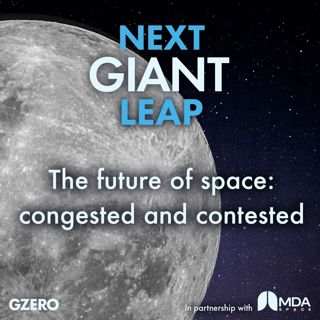
The future of space: congested and contested

The future of space: congested and contested

Space might be a big place but the United Nations regards it as ‘congested, contested and competitive’.

This latest episode of Next Giant Leap, a podcast produced by GZERO Media in partnership with the space company MDA Space, explores the threats and tensions as space becomes busier and of greater strategic importance for an increasing number of countries.

“We have to avoid, by all means, that it becomes a Wild West,” says Tanja Masson-Zwaan, a space law expert at Leiden University in the Netherlands. She adds, “We have regulations, laws and treaties that have been in place for the last fifty years, but we need more to govern this new frontier of space utilization, because the rules that we have are basic principles and do not go into the details.”

Satellites are now being deployed to Low Earth Orbit at a rate of thousands every year. This zone of space is already littered with old defunct satellites and the remains of discarded sections of rockets which have accumulated over more than five decades. The risk of collisions is increasing, raising fears of a runaway cascade of space debris.

Tests of anti-satellite (ASAT) weapons have showered still more debris into Low Earth Orbit. Since 2007, China, the United States, India and Russia have conducted ASAT tests. Last year the United States announced its own moratorium on ASAT tests and, through a United Nations resolution, it has called for other nations to follow suit. So far China, Russia and India have not signed up. So is space set to become a new theater for conflict and weapons proliferation?

“Look at how satellites have become embedded in our way of life,” says Kevin Whale, senior director of defense strategy at MDA Space. “If we wreck space, it’s almost one step down from nuclear catastrophe”.

Within a few years, a new phase of the space race will begin. Both the United States and China will be competing to get people to the moon and exploit its resources, particularly water ice in craters at the lunar south pole.

According to Scott Pace, director of the Space Policy Institute at George Washington University, “The Outer Space Treaty says space is the province of all mankind, meaning it's open to usage really by everybody. On the other hand, the principles say we should avoid harmful interference. And so the question is, how do we go about balancing those two imperatives: open to everybody but avoid harmful interference?”

Host: Kevin Fong

Guests: Tanja Masson-Zwaan, Scott Pace, Kevin Whale

Subscribe to the GZERO World with Ian Bremmer Podcast on Apple Podcasts, Spotify, or your preferred podcast platform, to receive new episodes as soon as they're published.


Hosted by Simplecast, an AdsWizz company. See pcm.adswizz.com for information about our collection and use of personal data for advertising.

Avsnitt(420)

Singapore's global moment, with President Tharman Shanmugaratnam

Singapore's global moment, with President Tharman Shanmugaratnam

How does a small country like Singapore, strategically positioned between the US and China, navigate a world of growing uncertainty? On the GZERO World Podcast, Ian Bremmer sits down with Singapore’s ...

31 Jan 21min

Europe's wake-up call, with Alexander Stubb and Kristalina Georgieva

Europe's wake-up call, with Alexander Stubb and Kristalina Georgieva

The GZERO World Podcast heads to Davos, Switzerland for the World Economic Forum this week for a look at transatlantic relations and how President Trump’s second term is reshaping the global order. Un...

24 Jan 33min
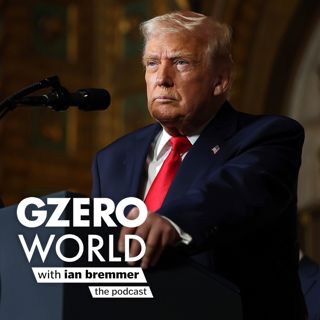
Trump's second term–one year in, with Stephen Walt

Trump's second term–one year in, with Stephen Walt

It’s been a year since President Trump returned to office, this time with fewer constraints, a better understanding of how government works, and a much more muscular view of US foreign policy. This we...

17 Jan 22min

Venezuela after Maduro with Senator Gallego and Frank Fukuyama

Venezuela after Maduro with Senator Gallego and Frank Fukuyama

Ian Bremmer unpacks the fallout from the Trump administration’s dramatic operation in Caracas that captured Venezuelan strongman Nicolás Maduro and brought him to the US to face federal charges. The r...

10 Jan 35min

The biggest geopolitical risks of 2026 revealed

The biggest geopolitical risks of 2026 revealed

With the global order under increasing strain, 2026 is shaping up to be a tipping point for geopolitics. From political upheaval in the United States to widening conflicts abroad, the risks facing gov...

8 Jan 1h 1min

War and Peace in 2025, with Clarissa Ward and Comfort Ero

War and Peace in 2025, with Clarissa Ward and Comfort Ero

This week, instead of zooming in on a single conflict, the GZERO World Podcast looks back on 2025 and takes stock of a world increasingly defined by conflict. Ian Bremmer sits down with CNN Chief Inte...

20 Dec 202550min

Why we still trust Wikipedia, with cofounder Jimmy Wales

Why we still trust Wikipedia, with cofounder Jimmy Wales

At a moment when Americans can’t agree on much of anything, one unlikely institution still commands broad trust: Wikipedia. Ian Bremmer sits down with Wikipedia cofounder Jimmy Wales to ask why the cr...

13 Dec 202537min

The human cost of AI, with Geoffrey Hinton

The human cost of AI, with Geoffrey Hinton

Computer scientist and Nobel laureate Geoffrey Hinton joins Ian Bremmer on the GZERO World podcast to talk about artificial intelligence, the technology transforming our society faster than anything h...

6 Dec 202525min

Populärt inom Politik & nyheter

aftonbladet-krim
motiv
p3-krim
rss-krimstad
fordomspodden
flashback-forever
rss-viva-fotboll
svenska-fall
rss-sanning-konsekvens
aftonbladet-daily
svd-dokumentara-berattelser-2
spar
rss-vad-fan-hande
rss-krimreportrarna
rss-frandfors-horna
krimmagasinet
olyckan-inifran
grans
rss-aftonbladet-krim
dagens-eko