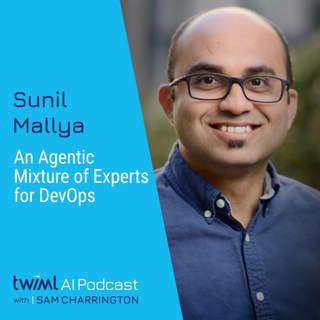
An Agentic Mixture of Experts for DevOps with Sunil Mallya - #708

An Agentic Mixture of Experts for DevOps with Sunil Mallya - #708

Today we're joined by Sunil Mallya, CTO and co-founder of Flip AI. We discuss Flip’s incident debugging system for DevOps, which was built using a custom mixture of experts (MoE) large language model (LLM) trained on a novel "CoMELT" observability dataset which combines traditional MELT data—metrics, events, logs, and traces—with code to efficiently identify root failure causes in complex software systems. We discuss the challenges of integrating time-series data with LLMs and their multi-decoder architecture designed for this purpose. Sunil describes their system's agent-based design, focusing on clear roles and boundaries to ensure reliability. We examine their "chaos gym," a reinforcement learning environment used for testing and improving the system's robustness. Finally, we discuss the practical considerations of deploying such a system at scale in diverse environments and much more. The complete show notes for this episode can be found at https://twimlai.com/go/708.

Avsnitt(778)

Mining the Vatican Secret Archives with TensorFlow w/ Elena Nieddu - TWiML Talk #243

Mining the Vatican Secret Archives with TensorFlow w/ Elena Nieddu - TWiML Talk #243

Today we’re joined by Elena Nieddu, Phd Student at Roma Tre University, who presented on her project “In Codice Ratio” at the TF Dev Summit. In our conversation, Elena provides an overview of the project, which aims to annotate and transcribe Vatican secret archive documents via machine learning. We discuss the many challenges associated with transcribing this vast archive of handwritten documents, including overcoming the high cost of data annotation.

27 Mars 201943min

Exploring TensorFlow 2.0 with Paige Bailey - TWiML Talk #242

Exploring TensorFlow 2.0 with Paige Bailey - TWiML Talk #242

Today we're joined by Paige Bailey, TensorFlow developer advocate at Google, to discuss the TensorFlow 2.0 alpha release. Paige and I talk through the latest TensorFlow updates, including the evolution of the TensorFlow APIs and the role of eager mode, tf.keras and tf.function, the evolution of TensorFlow for Swift and its inclusion in the new fast.ai course, new updates to TFX (or TensorFlow Extended), Google’s end-to-end ML platform, the emphasis on community collaboration with TF 2.0, and more.

25 Mars 201939min

Privacy-Preserving Decentralized Data Science with Andrew Trask - TWiML Talk #241

Privacy-Preserving Decentralized Data Science with Andrew Trask - TWiML Talk #241

Today we’re joined by Andrew Trask, PhD student at the University of Oxford and Leader of the OpenMined Project, an open-source community focused on researching, developing, and promoting tools for secure, privacy-preserving, value-aligned artificial intelligence. We dig into why OpenMined is important, exploring some of the basic research and technologies supporting Private, Decentralized Data Science, including ideas such as Differential Privacy,and Secure Multi-Party Computation.

21 Mars 201933min

The Unreasonable Effectiveness of the Forget Gate with Jos Van Der Westhuizen - TWiML Talk #240

The Unreasonable Effectiveness of the Forget Gate with Jos Van Der Westhuizen - TWiML Talk #240

Today we’re joined by Jos Van Der Westhuizen, PhD student in Engineering at Cambridge University. Jos’ research focuses on applying LSTMs, or Long Short-Term Memory neural networks, to biological data for various tasks. In our conversation, we discuss his paper "The unreasonable effectiveness of the forget gate," in which he explores the various “gates” that make up an LSTM module and the general impact of getting rid of gates on the computational intensity of training the networks.

18 Mars 201932min

Building a Recommendation Agent for The North Face with Andrew Guldman - TWiML Talk #239

Building a Recommendation Agent for The North Face with Andrew Guldman - TWiML Talk #239

Today we’re joined by Andrew Guldman, VP of Product Engineering and R&D at Fluid to discuss Fluid XPS, a user experience built to help the casual shopper decide on the best product choices during online retail interactions. We specifically discuss its origins as a product to assist outerwear retailer The North Face. In our conversation, we discuss their use of heat-sink algorithms and graph databases, challenges associated with staying on top of a constantly changing landscape, and more!

14 Mars 201947min
Active Learning for Materials Design with Kevin Tran - TWiML Talk #238

Active Learning for Materials Design with Kevin Tran - TWiML Talk #238

Today we’re joined by Kevin Tran, PhD student at Carnegie Mellon University. In our conversation, we explore the challenges surrounding the creation of renewable energy fuel cells, which is discussed in his recent Nature paper “Active learning across intermetallics to guide discovery of electrocatalysts for CO2 reduction and H2 evolution.” The AI Conference is returning to New York in April and we have one FREE conference pass for a lucky listener! Visit twimlai.com/ainygiveaway to enter!

11 Mars 201933min

Deep Learning in Optics with Aydogan Ozcan - TWiML Talk #237

Deep Learning in Optics with Aydogan Ozcan - TWiML Talk #237

Today we’re joined by Aydogan Ozcan, Professor of Electrical and Computer Engineering at UCLA, exploring his group's research into the intersection of deep learning and optics, holography and computational imaging. We specifically look at a really interesting project to create all-optical neural networks which work based on diffraction, where the printed pixels of the network are analogous to neurons. We also explore practical applications for their research and other areas of interest.

7 Mars 201942min

Scaling Machine Learning on Graphs at LinkedIn with Hema Raghavan and Scott Meyer - TWiML Talk #236

Scaling Machine Learning on Graphs at LinkedIn with Hema Raghavan and Scott Meyer - TWiML Talk #236

Today we’re joined by Hema Raghavan and Scott Meyer of LinkedIn to discuss the graph database and machine learning systems that power LinkedIn features such as “People You May Know” and second-degree connections. Hema shares her insight into the motivations for LinkedIn’s use of graph-based models and some of the challenges surrounding using graphical models at LinkedIn’s scale, while Scott details his work on the software used at the company to support its biggest graph databases.

4 Mars 201946min

Populärt inom Politik & nyheter

p3-krim
svenska-fall
rss-krimstad
flashback-forever
rss-viva-fotboll
motiv
rss-sanning-konsekvens
rss-vad-fan-hande
aftonbladet-daily
aftonbladet-krim
krimmagasinet
rss-krimreportrarna
dagens-eko
olyckan-inifran
fordomspodden
grans
spar
svd-nyhetsartiklar
rss-frandfors-horna
rss-flodet