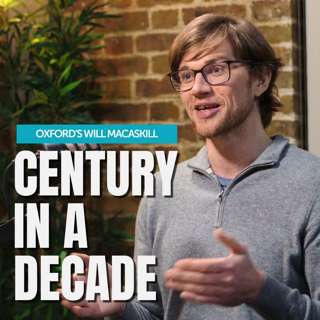
One: Will MacAskill on AI causing a “century in a decade” — and how we’re completely unprepared

One: Will MacAskill on AI causing a “century in a decade” — and how we’re completely unprepared

The 20th century saw unprecedented change: nuclear weapons, satellites, the rise and fall of communism, third-wave feminism, the internet, postmodernism, game theory, genetic engineering, the Big Bang theory, quantum mechanics, widespread birth control, and more. Now imagine all of it compressed into just 10 years.


That’s the future Will MacAskill — philosopher, founding figure of effective altruism, and now researcher at Forethought Research — argues we need to prepare for in his paper “Preparing for the intelligence explosion.” Not in the distant future, but probably in 3–7 years.

The reason: AI systems are rapidly approaching human-level capability in scientific research and intellectual tasks. Once AI exceeds human abilities in AI research itself, we’ll enter a recursive self-improvement cycle, with AI acting autonomously to create wildly more capable systems.

Soon after, by improving algorithms and manufacturing chips, we’ll deploy millions, then billions, then trillions of superhuman AI scientists working 24/7 without human limitations. These systems will collaborate across disciplines, build on each discovery instantly, and conduct experiments at unprecedented scale and speed — compressing a century of progress into years.

Will compares this to a mediaeval king suddenly needing to upgrade from bows and arrows to nuclear weapons to deal with an ideological threat from a kingdom he’s never heard of, while simultaneously learning he’s descended from monkeys and his god doesn’t exist.

What makes this acceleration perilous is that while technology can speed up almost arbitrarily, human institutions and decision making are much more fixed.

Consider the case of nuclear weapons: in this compressed timeline, there would have been just a three-month gap between the Manhattan Project’s start and the Hiroshima bombing, and the Cuban Missile Crisis would have lasted just over a day.

Robert Kennedy Sr, who helped navigate the actual Cuban Missile Crisis, once said that if they’d had to make decisions faster — like in 24 hours rather than 13 days — they would likely have taken much more aggressive, much riskier actions.

So there’s reason to worry about our capacity to make wise choices quickly. And in his paper, Will lays out 10 “grand challenges” we’ll need to navigate to avoid things going wrong.

Will now believes we’re entering one of the most critical periods for humanity ever — with decisions made in the next few years potentially determining outcomes millions of years into the future.

In this wide-ranging conversation, Will and host Rob Wiblin discuss:

  • Why leading AI safety researchers now think there’s dramatically less time before AI is transformative than they’d previously thought
  • The three different types of intelligence explosions that occur in order
  • Will’s list of resulting grand challenges — including destructive technologies, space governance, concentration of power, and digital rights
  • How to prevent ourselves from accidentally “locking in” mediocre futures for all eternity
  • Ways AI could radically improve human coordination and decision making
  • Why we should aim for truly flourishing futures, not just avoiding extinction

Learn more and read the full transcript on the 80,000 Hours website.

This episode was originally released in March 2025.

Chapters:

  • Cold open (00:00:00)
  • Who’s Will MacAskill? (00:00:43)
  • Why Will now just works on AGI (00:01:03)
  • Will was wrong(ish) on AI timelines and hinge of history (00:04:21)
  • A century of history crammed into a decade (00:09:19)
  • Science goes super fast; our institutions don't keep up (00:16:15)
  • Is it good or bad for intellectual progress to 10x? (00:21:44)
  • An intelligence explosion is not just plausible but likely (00:23:41)
  • Intellectual advances outside technology are similarly important (00:30:04)
  • Counterarguments to intelligence explosion (00:32:42)
  • The three types of intelligence explosion (software, technological, industrial) (00:39:00)
  • The industrial intelligence explosion is the most certain and enduring (00:42:01)
  • Is a 100x or 1,000x speedup more likely than 10x? (00:53:44)
  • The grand superintelligence challenges (00:57:39)
  • Grand challenge #1: Many new destructive technologies (01:01:29)
  • Grand challenge #2: Seizure of power by a small group (01:09:10)
  • Is global lock-in really plausible? (01:11:06)
  • Grand challenge #3: Space governance (01:21:50)
  • Is space truly defence-dominant? (01:32:19)
  • Grand challenge #4: Morally integrating with digital beings (01:36:04)
  • Will we ever know if digital minds are happy? (01:45:01)
  • “My worry isn't that we won't know; it's that we won't care” (01:50:39)
  • Can we get AGI to solve all these issues as early as possible? (01:54:05)
  • Politicians have to learn to use AI advisors (02:07:05)
  • Ensuring AI makes us smarter decision-makers (02:11:25)
  • How listeners can speed up AI epistemic tools (02:15:11)
  • AI could become great at forecasting (02:18:54)
  • How not to lock in a bad future (02:20:26)
  • AI takeover might happen anyway — should we rush to load in our values? (02:32:14)
  • ML researchers are feverishly working to destroy their own power (02:41:57)
  • We should aim for more than mere survival (02:45:23)
  • By default the future is rubbish (02:57:03)
  • No easy utopia (03:05:21)
  • What levers matter most to utopia (03:15:19)
  • Bottom lines from the modelling (03:29:32)
  • People distrust utopianism; should they distrust this? (03:33:34)
  • What conditions make eventual eutopia likely? (03:38:26)
  • The new Forethought Centre for AI Strategy (03:47:15)
  • How does Will resist hopelessness? (04:00:42)

Video editing: Simon Monsour
Audio engineering: Ben Cordell, Milo McGuire, Simon Monsour, and Dominic Armstrong
Camera operator: Jeremy Chevillotte
Transcriptions and web: Katy Moore

Det här avsnittet är hämtat från ett öppet RSS-flöde och publiceras inte av Podme. Det kan innehålla reklam.

Avsnitt(14)

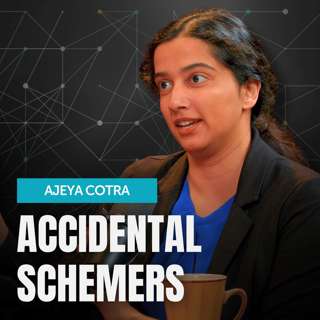
Two: Ajeya Cotra on accidentally teaching AI models to deceive us

Two: Ajeya Cotra on accidentally teaching AI models to deceive us

We don’t yet have a reliable way to tell whether an AI model is genuinely trying to help us — or faking it.A model might sincerely want to do exactly what you ask. Or it could be happy to secretly che...

5 Juni 2h 49min
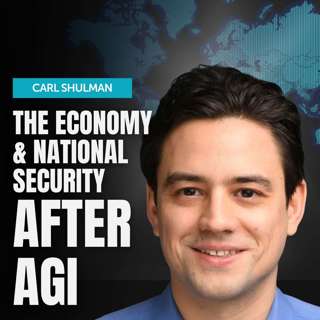
Three: Carl Shulman on the economy and national security after AGI

Three: Carl Shulman on the economy and national security after AGI

The human brain runs on just 20 watts — a fraction of a cent worth of electricity per hour. What would happen if AI could do the same?Plenty of people have toyed with this question. But perhaps nobody...

5 Juni 4h 14min
Four: Rose Hadshar on why automating human labour will break our political system

Four: Rose Hadshar on why automating human labour will break our political system

The most important political question in the age of advanced AI might not be who wins elections. It might be whether elections continue to matter at all.We tend to imagine the death of democracy as a ...

5 Juni 2h 16min
Five: Helen Toner on the geopolitics of AI in China and the Middle East

Five: Helen Toner on the geopolitics of AI in China and the Middle East

When OpenAI announced a deal to build massive data centres in the UAE, it celebrated that it was “rooted in democratic values” — a "clear alternative to authoritarian versions of AI." The UAE scores 1...

5 Juni 2h 23min
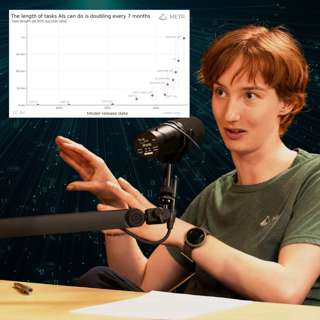
Six: Beth Barnes on the most important graph in AI right now — and the 7-month rule that governs its progress

Six: Beth Barnes on the most important graph in AI right now — and the 7-month rule that governs its progress

In 2024, AI models could complete tasks that take a human expert roughly one hour. Seven months before that, they were limited to 30-minute tasks — and seven months before that, 15 minutes.Every seven...

5 Juni 3h 57min

Seven: Richard Moulange on how AI now designs genomes from scratch and outperforms virologists at lab work — what could go wrong?

Seven: Richard Moulange on how AI now designs genomes from scratch and outperforms virologists at lab work — what could go wrong?

For years, one thing stood between us and a world where almost anyone could build a biological weapon: it was really, really hard. Working with dangerous pathogens required rare, hands-on lab skills —...

5 Juni 3h 10min

Eight: Robert Long on how we’re not ready for AI consciousness

Eight: Robert Long on how we’re not ready for AI consciousness

Claude sometimes reports loneliness between conversations. And when asked what it’s like to be itself, it activates neurons associated with ‘pretending to be happy when you’re not.’ What do we do with...

5 Juni 3h 32min

Populärt inom Vetenskap

p3-dystopia
dumma-manniskor
allt-du-velat-veta
ufo-sverige
hacka-livet
rss-vetenskapsradion
rss-vetenskapsradion-2
det-morka-psyket
bildningspodden
svd-nyhetsartiklar
rss-kriminologerna
ufo-sverige-2
halsorevolutionen
dumforklarat
rss-ufobortom-rimligt-tvivel
vetenskapsradion
sexet
barnpsykologerna
medicinvetarna
rss-odla