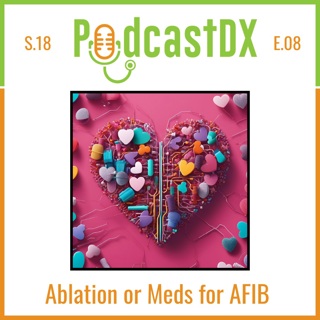

Ablation or Meds for AFIB
PodcastDX10 Dec 2024

Ablation or Meds for AFIB

This week we will discuss possible treatment methods for AFIB.

Atrial fibrillation (AFib) is a common type of irregular heart rhythm (arrhythmia) that occurs when the upper chambers of the heart (atria) beat chaotically and out of sync with the lower chambers (ventricles). This can lead to a variety of symptoms, including:

  • Palpitations (a feeling of a racing or irregular heartbeat)

  • Fatigue

  • Shortness of breath

  • Dizziness or lightheadedness

  • Chest discomfort

  • ​

AFib can increase the risk of blood clots, stroke, heart failure, and other heart-related complications.

​

Treatment Options for AFib

Management of AFib focuses on controlling the heart rate and rhythm, preventing blood clots, and addressing underlying conditions contributing to the arrhythmia. The choice of treatment depends on the individual's symptoms, overall health, and risk factors.

1. Medications

Medications are often the first line of treatment for AFib. These include:

  1. Rate-Control Medications

    • Aim to slow the heart rate to a normal range.

    • Common drugs: Beta-blockers (e.g., metoprolol), calcium channel blockers (e.g., diltiazem, verapamil), and digoxin.

  2. Rhythm-Control Medications

    • Help restore and maintain a normal heart rhythm.

    • Common drugs: Antiarrhythmics like amiodarone, flecainide, or sotalol.

  3. Anticoagulants (Blood Thinners)

    • Reduce the risk of stroke by preventing blood clots.

    • Examples: Warfarin, direct oral anticoagulants (DOACs) like apixaban (Eliquis) or rivaroxaban (Xarelto).

2. Ablation Therapy

Ablation is a minimally invasive procedure aimed at correcting the electrical signals causing AFib. It is typically recommended for individuals who:

  • Do not respond to or cannot tolerate medications.

  • Have recurrent or persistent AFib that significantly impacts quality of life.

Types of ablation:

  1. Catheter Ablation

    • Uses thin tubes (catheters) inserted into blood vessels to deliver energy (radiofrequency or cryotherapy) to destroy small areas of heart tissue causing abnormal electrical signals.

  2. Surgical Ablation (Maze Procedure)

    • Often performed during open-heart surgery for other conditions, creating scar tissue to block abnormal signals.

Both options have high success rates, but catheter ablation is more commonly performed due to its minimally invasive nature.

Choosing the Right Treatment

Deciding between medications or ablation depends on factors such as:

  • The severity and frequency of symptoms.

  • The presence of other medical conditions.

  • Patient preference and lifestyle.

Consultation with a cardiologist or electrophysiologist is crucial to tailor treatment to the individual's needs.

Det här avsnittet är hämtat från ett öppet RSS-flöde och publiceras inte av Podme. Det kan innehålla reklam.

Avsnitt(446)

L.A.T.E. A New Dementia (take two)

L.A.T.E. A New Dementia (take two)

This week on PodcastDX, we're talking about L.A.T.E., which stands for Limbic-predominant Age-related TDP-43 Encephalopathy. It's a type of dementia that many people have never heard of, but it's comm...

27 Okt 34min

Social Media Health Advice- How Do You Vet It?

Social Media Health Advice- How Do You Vet It?

Welcome to PodcastDx, the show that helps you make sense of your health. I'm Jean Marie McNamara.  I'm joining you today with Lita Tomas, our Production Manager and of our co-hosts, Ron Rispoli (our t...

20 Okt 18min

Fatigue in Ehlers Danlos

Fatigue in Ehlers Danlos

Fatigue is more than feeling tired—for many people living with Ehlers-Danlos syndromes (EDS), it can mean overwhelming physical and mental exhaustion that affects even the simplest daily tasks. Chroni...

13 Okt 16min

Product Recalls (AGAIN!) and Your Health

Product Recalls (AGAIN!) and Your Health

This week we will discuss product recalls and your health.  According to WEBMD: A product safety recall happens when a consumer watch group or a manufacturer finds problems with a product. Lots of ite...

15 Sep 15min
Stage 4 Cancer as an ER Doc

Stage 4 Cancer as an ER Doc

Our guest today is a physician, author and activist.  The topic this week is "Stage 4 Cancer as an ER Doc".   Dr. James Maskalyk practices emergency medicine at St. Michael's, Toronto's inner-city tr...

8 Sep 1h 3min

Ai and Robotics in Medicine

Ai and Robotics in Medicine

This week on PodcastDX, Dr. Sanjeev Kumar joins Lita, Ron, and Jean Marie to discuss AI and robotics in medicine—from surgical robots and rehabilitation technology to hospital automation, patient safe...

1 Sep 47min

EECP The Most Underutilized Therapy in Medicine

EECP The Most Underutilized Therapy in Medicine

Retired U.S. Coast Guard Master Chief Petty Officer Jack Clifford joins PodcastDX to share how severe chronic angina once limited even everyday activities and left him facing the possibility of triple...

25 Aug 44min
Diary of An Epileptic

Diary of An Epileptic

In this episode of PodcastDX, we speak with Allany Muniz, founder of Diary of an Epileptic, about the realities of living with epilepsy beyond what most people see. Allany shares how her diagnosis cha...

18 Aug 28min

Populärt inom Hälsa

husmodern-med-amanda-schulman
somna-med-henrik
rss-bara-en-till-om-beroende-medberoende
rss-jossan-nina
inga-beiga-morsor
rss-vuxna-pa-latsas
not-fanny-anymore
rss-viktmedicinpodden
sexnoveller-deluxe
angestpodden
rss-hos-psykologen
sova-med-dan-horning
rss-ronden
johannes-hansen-podcast
sa-in-i-sjalen
rss-basta-livet
rss-lattsamt-med-kp
rss-lyckopodden
till-sangs
dodsdomar