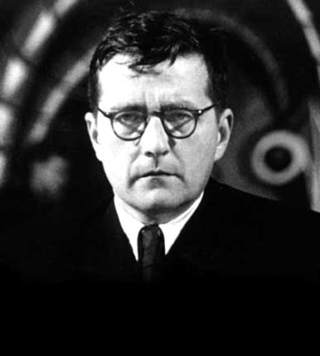

Shostakovich Symphony No. 8

Shostakovich Symphony No. 8

Here are two statements by Dmitri Shostakovich about the same piece, the 8th symphony that we are talking about today:

Statement No. 1, Shostakovich's published comments about the symphony when it was first performed in 1943: The 8th Symphony reflects my…elevated creative mood, influenced by the joyful news of the Red Army's victories….
"The Eighth Symphony contains tragic and dramatic inner conflicts. But on the whole it is optimistic and life-asserting. The first movement is a long adagio, with a dramatically tense climax. The second movement is a march, with scherzo elements, and the third is a dynamic march. The fourth movement, in spite of its march form, is sad in mood. The fifth and final movement is bright and gay, like a pastoral, with dance elements and folk motifs.
"The philosophical conception of my new work can be summed up in these words: life is beautiful. All that is dark and evil rots away, and beauty triumphs."

Statement No. 2, from the disputed book Testimony, published in the 1970s: 'And then the war came and the sorrow became a common one. We could talk about it, we could cry openly, cry for our lost ones. People stopped fearing tears. Before the war there probably wasn't a single family who hadn't lost someone, a father, a brother, or if not a relative, then a close friend. Everyone had someone to cry over, but you had to cry silently, under the blanket, so no one would see. Everyone feared everyone else, and the sorrow oppressed and suffocated us. It suffocated me too. I had to write about it. I had to write a Requiem for all those who died, who had suffered. I had to describe the horrible extermination machine and express protest against it. The Seventh and Eighth Symphonies are my Requiems.

I don't know of a more profound example of Shostakovich's doublespeak, or of his ability to make diametrically opposing statements about the meaning behind his music. Shostakovich's 8th symphony premiered at the height of World War II, and it was not a hit, unlike his 7th symphony which had swept the world with its seeming patriotic fervor and its devastating condemnation of the Nazis. Shostakovich's 8th is a very different piece, darker, edgier, less catchy, less simple, and certainly less optimistic. It was panned in the Soviet Union by the official critics and was effectively banned from performance in teh Soviet Union from 1948 until the late 1950s. It was also not particularly popular outside of the Soviet Union, as the 7th's popularity and accessibility dwarfed the 8th, though this equation has now flipped, with the 8th symphony now probably becoming slightly more often played than the 7th. As always with Shostakovich, he mixes tradition with his own Shostakovich-ian innovations. The symphony has a Sonata Form first movement, but that movement is longer than the following three movements combined. It has a darkness to light theme from C Minor to C Major, like in Beethoven's 5th and Mahler's 2nd, but whether the ending is optimistic is subject to furious debate. It has not 1 but 2 scherzos, but they are among the least funny scherzos ever written, and it has a slow movement that is surprisingly un-emotional. The requiem Shostakovich speaks of seems to happen slowly over the course of this 1 hour symphony. It is perhaps Shostakovich's most ambiguous mature symphony, and it is also thought of as one of his greatest masterpieces. Today on this Patreon Sponsored episode, we'll dive into this remarkable work, trying to create a framework to understand this huge and demanding symphony. Join us!

Avsnitt(282)

Franck Symphony in D Minor

Franck Symphony in D Minor

In the 1960s, Leonard Bernstein famously helped to popularize the music of a then relatively obscure composer, Gustav Mahler. His work, as well as the work of other conductors, made Mahler into a clas...

20 Nov 202559min
Ravel and Falla: Echoes of Spain

Ravel and Falla: Echoes of Spain

Nowadays it's hard to imagine Maurice Ravel as a "bad-boy" revolutionary, a member of a group whose name can be loosely translated as The Hooligans. To most listeners today, Ravel's music is the very ...

6 Nov 202557min

Shostakovich Symphony No. 10 LIVE w/ The Aalborg Symphony

Shostakovich Symphony No. 10 LIVE w/ The Aalborg Symphony

Longtime listeners of Sticky Notes know that Shostakovich's 10 symphony was the inaugural piece covered on the show. It's been 8 years(!) since that show, so I've totally re-written the episode and ha...

27 Okt 202559min
Barber Violin Concerto

Barber Violin Concerto

There are so many great apocryphal stories in the long history of classical music, from the reason Tchaikovsky wrote his Sixth Symphony to what famous composers supposedly said on their deathbeds, to ...

9 Okt 202547min
100 Years of Beethoven's Eroica (recordings)

100 Years of Beethoven's Eroica (recordings)

One of my favorite things about having Patreon sponsors is that they often suggest the most fascinating pieces and topics for shows. Adrian, who sponsored a show last year, gave me one of my favorite ...

25 Sep 202555min

The Life and Music of Grazyna Bacewicz

The Life and Music of Grazyna Bacewicz

The great Polish composer Witold Lutoslawski said this after the premature death of his contemporary Grazyna Bacewicz: "She was born with an incredible wealth of musical talent, which she succeeded to...

6 Sep 202557min

Sticky Notes meets You'll Hear It

Sticky Notes meets You'll Hear It

I had such a wonderful time joining the jazz podcast You'll Hear It! We talked about the meeting of jazz and classical music, a topic I've explored before, but never in this much depth and never with ...

22 Aug 20251h 10min
Impressions in Blue: Ravel & Gershwin

Impressions in Blue: Ravel & Gershwin

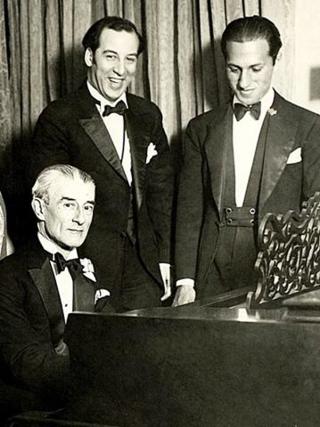
In the mid-1920s, Maurice Ravel wrote a letter to the legendary composition teacher Nadia Boulanger. Boulanger's class was a mecca for composers, both young and old, and musicians from all over the wo...

7 Aug 202544min

Populärt inom Nöje

mellan-himmel-och-jord-med-jlc
filip-fredrik-svarar
mardromsgasten
fordomspodden
badfluence
dialogiskt
chilla-med-de-vet-du
rss-p3-musikdokumentar
schulman-show
hemma-hos-strage
mannen-utan-spar
fem-i-topp
gott-snack-med-fredrik-soderholm
skandal
rss-rockpodden
sexet
skivsnack
karatefylla
podme-bio-4
parterapi