Samuel Stroschein on the Challenges and Opportunities of Localization

Samuel Stroschein on the Challenges and Opportunities of Localization

Samuel Stroschein is the CEO and Founder of inlang, an open-source company that is looking to not only make localization easy for developers, but also to help companies achieve revenue growth through localization.

I was particularly excited to talk to Samuel because, back in my way back past, I was a translator, so I’m always interested in solutions that exist to facilitate translation; but also because localizing software is a good example of the intersection between business problems and technical problems. Inlang also strikes me as a company that could see its primary market as developers, or could see its market as CMOs — because of the way localization is both a technical and business problem. And Samuel is clear about this: He says “What we're basically saying is if you want to make more money, you've got to localize.”

Lastly, another thing that stuck out to me about our conversation was that, as we talked about Inlang’s future monetization strategy, Samuel said he thinks that it will likely be around services — which I hadn’t heard from anyone before. His reason: That the software will ultimately become commoditized.

Listen in to learn why localization is such a challenge for developers, what impact it has on revenue growth, and how Samuel took inlang from an open-source project to an open-source company.

Highlights:

  • Samuel introduces himself, describes his background and explains what inlang is solving for (00:37)
  • Why localization is such a challenge and how it led Samuel to create inlang (01:21)
  • The circumstances that pushed Samuel to turn inlang into an open-source project (04:30)
  • Why Samuel decided to take inlang from an open-source project to an open-source company (05:43)
  • Samuel explains how localization is a growth opportunity, and how that impacts inlang’s market (09:00)
  • The way Samuel and his team are thinking about monetizing inlang (13:22)
  • Why being an open-source company is important to Samuel (15:15)
  • The collaboration that open-source brings and why it’s so valuable to Samuel (19:00)
  • How financial stability, problem-solving, and the nature of building software all contribute to the success of open source in tech (26:06)
  • Samuel explains how he views mistakes as stepping stones to positive outcomes (28:41)
  • The learnings that Samuel has gathered when hiring for inlang (30:13)
  • How you can connect with Samuel and learn more about inlang (31:22)

Links:

Samuel

Det här avsnittet är hämtat från ett öppet RSS-flöde och publiceras inte av Podme. Det kan innehålla reklam.

Avsnitt(275)

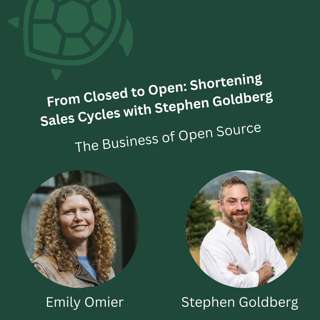
From Closed to Open: Shortening Sales Cycles with Stephen Goldberg

From Closed to Open: Shortening Sales Cycles with Stephen Goldberg

This week on The Business of Open Source, I chatted with Stephen Goldberg, co-founder of Harper, about the process of taking Harper from a closed-source software company to a open source company. I al...

6 Juli 33min
Does AI Make Open Core Models More Difficult? with Sam Alba

Does AI Make Open Core Models More Difficult? with Sam Alba

Today on The Business of Open Source I spoke with Sam Alba, co-founder of Mendral, formerly of Dagger, and the first hire at Docker. We talked a lot about about how AI is changing the developer tools ...

2 Juli 39min
Closed to Open Source Series: Doing Open Source "Right" with Ethan Arrowood

Closed to Open Source Series: Doing Open Source "Right" with Ethan Arrowood

One of the myths that swirl around the open source company ecosystem is that all open source companies started as an open source project that then suddenly got traction, and followed by the founders f...

22 Juni 40min
The Value of Code is Dropping to Zero with Yann Lechelle

The Value of Code is Dropping to Zero with Yann Lechelle

In this episode of The Business of Open Source, I talked with Yann Lechelle, Executive President of :Probabl.Perhaps the most interesting part of the conversation was about whether or not there is a r...

15 Juni 42min

Why the World Needs the Agentic AI Foundation with Manik Surtani

Why the World Needs the Agentic AI Foundation with Manik Surtani

In this episode of The Business of Open Source, I spoke with Manik Surtani, one of the co-founders of the Agentic AI Foundation and the CTO at the foundation. This is part of the series I’m working on...

8 Juni 34min

The AI-Induced Death of A Bug Bounty Program with Glauber Costa

The AI-Induced Death of A Bug Bounty Program with Glauber Costa

The Business of Open Source is back! I’m starting a series about AI and open source this week. I reached out to Glauber Costa, founder of Turso, after reading a post of his on LinkedIn about how bot-w...

1 Juni 43min

Changing Your Price Anchor with Anais Concepcion

Changing Your Price Anchor with Anais Concepcion

There’s a new episode of The Business of Open Source today! It’s been a while. I talked with Anais Concepcion about a program she’s been testing at Grist to give free activation codes for the enterpri...

11 Feb 32min

Earning Trust with Tom Hacohen

Earning Trust with Tom Hacohen

This week on The Business of Open Source, I spoke with Tom Hacohen, CEO and founder at Svix. We kicked off the conversation by talking about why Svix is an open core company… but Tom still initially d...

8 Okt 202535min

Populärt inom Business & ekonomi

badfluence
framgangspodden
varvet
dynastin
uppgang-och-fall
rss-borsens-finest
avanzapodden
svd-tech-brief
rss-inga-dumma-fragor-om-pengar
bathina-en-podcast
fill-or-kill
tabberaset
rikatillsammans-om-privatekonomi-rikedom-i-livet
borslunch-2
rss-veckans-trade
rss-dagen-med-di
rss-hos-psykologen
rss-borslunch
rss-dominoeffekten
rss-dr-bjorklund