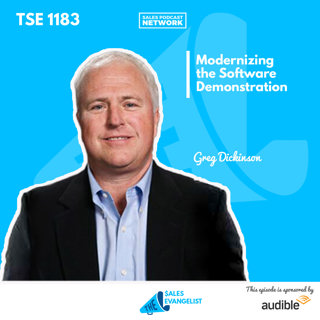
TSE 1183: Modernizing the Software Demonstration

TSE 1183: Modernizing the Software Demonstration

Modernizing the software demonstration can help prospects better understand your product value and keep your digital buyers connected to your product throughout the buying process.

Greg Dickinson is the CEO and founder of Omedym, which is “my demo” spelled backward. He’s trying to help businesses utilize today’s latest and greatest technologies to augment and improve the digital demo process.

Product experience

Most sellers can point to a personal experience in which a bad product experience eliminated a vendor from consideration in the buying process.

You won’t necessarily win the deal on the first demo, but you can unequivocally lose it. #SalesDemo

People tend to have different processes and sometimes the more junior players are the ones that are giving the top-of-the-funnel demos. If you ask your team members to each give a demo, you might find yourself wondering if each person is selling the same product. The demos can be that different.

Digital buyers

Buyers are more digital than they were five years ago, which is the biggest challenge in the software demo industry. The average software buyer spends 5 percent of the buying process with the sales team. So if you think about the “request a demo” button on your website, it’s your first interaction with a potential buyer. For most companies, that button generates a pop-up form, and the bounce rate in the industry is 85 percent.

People at the top of the funnel want to learn a little more about your product. Maybe they read some content about your product and they want to see a video. When a form pops up, your digital buyer leaves your website.

Sellers, ask yourself as a buyer whether you tend to fill out forms in this situation. If the answer is no, why do you expect your own buyers to do so? Instead, websites tend to hold demos hostage by scheduling them or exchanging them for an email.

Your prospects want to engage and understand your product. Modernizing the software demonstration can help your prospects get the information they need to make a decision.

Inside sales

The going research suggests that buyers want to see the product you’re offering within the first two minutes of an interaction. Your solution sounds great, and it solves a problem they are struggling with, so they want to see the product. Typically, the inside salesperson will insist on asking a bunch of questions and booking a discovery call and then a demo. By the end of that 3-week period, you’ve lost the buyers’ attention.

In response, some companies have allowed the inside sales rep to give the demo, but that usually doesn’t work. The inside sales rep wasn’t trained to do demos, and she may not have the skillset to do them.

Demos are more than a “show up and throw up” proposition. They are hard.

Your customer wants to feel like he’s in control of the sales process. He wants to see what he’s buying.

Video demos

Greg said that even the companies who are posting one- or two-minute videos to demonstrate their products aren’t getting a good response because they are effectively spraying-and-praying. They generate four or five snippets that they hope will address their buyers’ questions.

Greg’s technology allows you to create your best demonstrations, and then interact with the software to get a personalized demonstration.

If you want to know whether the software can do parallel workflow, the software will bring you to the right asset and the right section to find that answer. Instead of searching through 10 or 15 separate posts, the user can find the content he needs.

The average watch time for a business tech buyer is just over two-and-a-half minutes, so allow them to ask a question and see a relevant demo.

Build a picture

Think of your typical buyer’s team. It isn’t just one person. It’s usually multiple people with different points of view and different ideas of what’s important in the software.

If you can allow your customers to ask questions and then have the streaming of the video and the demo to that person at that moment, it’s much more impactful. Perhaps more importantly, Greg’s software records all the activity so that the marketing and sales teams know the buyer’s intent.

  • What was Donald’s interest?
  • What did he watch?
  • How long did he watch?
  • What questions and follow-up questions did he ask?

Once you gather this information, you begin to build a picture of Donald. The self-guided demo allows the seller to understand what Donald’s interests are so he knows what to talk to Donald about.

New world

Your customer wants to talk specifically about how you can help ease his pain. Whether you call it the consumerization of the business buyer or the Amazon effect, people are used to buying things a certain way. That attitude doesn’t change when we’re at work.

Buyers want a certain part of the sales cycle to be self-guided. Then, when they are ready to engage with sales, they want to begin with the topic that interests them rather than starting all over again.

Digital footprint

Buyers can get their data in a million different places just like sellers can use the Internet to learn about buyers. We’re losing the ability to influence buyers because we’re spending less time with them.

If you don’t provide a digital means for the disconnected independent buyer to stay engaged with you in the digital world, when it comes time to make the purchase, he may not remember all the aspects of your software.

If you’re selling software, keep it in front of your prospect. Give him the opportunity to constantly validate your value as he’s making the decision criteria.

These tools don’t replace sellers, but they augment them by creating a digital footprint that helps the buyer stay connected with you. He can get the information he needs based upon where he is in the buyer’s journey.

Uber, for example, provides the same service as a taxi cab, but it created a better buying experience. Uber made it easier and removed the friction, so it won the market.

The challenge for digital buyers is the same: your sales process hasn’t changed so we’re making the buying process harder. It’s why our win-rates aren’t as high. The buyer doesn’t have the information he needs to make a decision.

Buying team

In many cases, you’ll never meet with the entire buying team. It might be true that you only met with about half of them, so they are anonymous to you.

Now, those buyers are in a Friday meeting and someone is presenting all the information about your product. Wouldn’t it be great if that buyer had seen portions of the demo on his own? You can’t always be last.

Instead of figuring out whether to be the first impression or the last impression, strive to be the impression. Give that buyer a chance to consume your demo content. Record that demo, make it available to the buying team, and use a technology that allows them to find topics within the demo.

The team isn’t going to spend 90 minutes watching, so help them find the topics that are pertinent so they can spend 10 minutes learning about your product. You’ve had a chance to touch a buyer you never would have touched.

Buyer’s perspective

Greg’s tool works for anyone who sells a product, and Omedym believes that the product experience, the demo, and the product engagement are part of the buyer’s journey. It’s one of the most important aspects of the buying process.

Starting with the top-of-the-funnel demo to the sales demo and the scripted demo, video is playing a very pertinent role. Omedym focuses on software because you truly can’t be everything to everyone.

Take a different perspective and figure out how modernizing the software demonstration can help your buyers buy.

“Modernizing the Software Demonstration” episode resources

You can connect with Greg at Omedym.com, or on his LinkedIn. He welcomes feedback and conversations because he learns from the information.

If you’re a sales rep looking to hone your craft and learn from the top 1% of sellers, make plans to attend the Sales Success Summit in Austin, Tx, October 14-15. Scheduled on a Monday and Tuesday to limit the impact to the sales week, the Sales Success Summit connects sellers with top-level performers who have appeared on the podcast. Visit Top1Summit.com to learn more and register!

You can also connect with me at donald@thesalesevangelist.com or try our first module of TSE Certified Sales Training Program for free. This episode has been made possible with the help of TSE Certified Sales Training Program, a training course designed to help sellers in...

Det här avsnittet är hämtat från ett öppet RSS-flöde och publiceras inte av Podme. Det kan innehålla reklam.

Avsnitt(2000)

Practical Ways Sales and Marketing Can Work to Increase Revenue in 2026 | Mark Kapczynski - 2023

Practical Ways Sales and Marketing Can Work to Increase Revenue in 2026 | Mark Kapczynski - 2023

Sales and marketing are supposed to work together, but in most companies, they don't. Not to the level your revenue actually needs. In this episode, I sat down with Mark Kapczynski, co-founder of Kont...

27 Juli 28min
LinkedIn Response Series - Messages That Generate Responses | Donald C. Kelly - 2022

LinkedIn Response Series - Messages That Generate Responses | Donald C. Kelly - 2022

This wraps up our four part LinkedIn Response Series. Over the last few episodes, I covered your headline, your banner, and how to turn profile views into real conversations. In this final episode, I'...

24 Juli 16min
LinkedIn Response Series - LinkedIn Connection Requests | Donald C. Kelly - 2021

LinkedIn Response Series - LinkedIn Connection Requests | Donald C. Kelly - 2021

show notes

20 Juli 16min
LinkedIn Response Series - LinkedIn Profile Views To Appointments | Donald C. Kelly - 2020

LinkedIn Response Series - LinkedIn Profile Views To Appointments | Donald C. Kelly - 2020

Getting a notification that someone viewed your LinkedIn profile can be exciting, but most sellers don't know what to do next. In this episode of the LinkedIn Response Series, I am sharing how to turn...

17 Juli 16min

LinkedIn Response Series - Your LinkedIn Headline | Donald C. Kelly - 2019

LinkedIn Response Series - Your LinkedIn Headline | Donald C. Kelly - 2019

Your LinkedIn headline is one of the first things prospects see, yet many salespeople waste it by listing their job title and company name. In this first episode of the LinkedIn Response Series, I exp...

13 Juli 25min
How to Ensure That Admin Tasks Don't Overwhelm Your Day | Anthony Iannarino - 2018

How to Ensure That Admin Tasks Don't Overwhelm Your Day | Anthony Iannarino - 2018

Administrative tasks are part of every sales role, but they should never take priority over selling. I'm revisiting a conversation from the archive with Anthony Iannarino to share practical ways to ke...

10 Juli 33min

Bad Mouthing Your Competitor | Donald C. Kelly - 2017

Bad Mouthing Your Competitor | Donald C. Kelly - 2017

How do you handle competitor questions without sounding defensive, desperate, or unprofessional?In this solo episode, Donald C. Kelly shares three practical strategies for talking about competitors wi...

6 Juli 14min
7 Steps to Making 7 Figures in Enterprise SaaS Sales | Brandon Fluharty - 2016

7 Steps to Making 7 Figures in Enterprise SaaS Sales | Brandon Fluharty - 2016

What separates sales professionals who earn six figures from those who consistently earn seven?In this episode, Donald sits down with Brandon Fluharty, enterprise SaaS sales leader, speaker, and autho...

3 Juli 42min

Populärt inom Business & ekonomi

framgangspodden
badfluence
dynastin
varvet
svd-tech-brief
uppgang-och-fall
avanzapodden
rss-inga-dumma-fragor-om-pengar
fill-or-kill
tabberaset
rikatillsammans-om-privatekonomi-rikedom-i-livet
rss-kort-lang-analyspodden-fran-di
rss-borslunch
market-makers
rss-veckans-trade
rss-dagen-med-di
bathina-en-podcast
borslunch-2
rss-dominoeffekten
rss-borssurr-med-mitelman-och-mellqvist