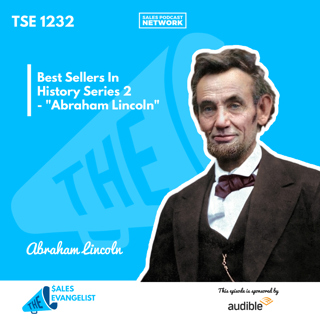
TSE 1232: Best Sellers In History Series 2 - "Abraham Lincoln"

TSE 1232: Best Sellers In History Series 2 - "Abraham Lincoln"

Best Sellers In History Series 2 - "Abraham Lincoln"

This is the second episode from the Best Sellers in History series. This series talks about some of the most successful people and sellers in history. We’ll talk about who they are and what made them so successful.

Abraham Lincoln was the 16th President of the United States of America and led the nation during some of the most turbulent times in American history, such as the Civil War. It was the bloodiest war and the greatest constitutional and political crisis faced by the U.S. at that time. President Lincoln persevered and was able to abolish slavery, strengthen the federal government and modernized the U.S. economy. Despite humble beginnings, Abraham Lincoln became one of the greatest statesmen leaders in our nation’s history.

Sales Spotlight - Abraham Lincoln

A half-hour long episode isn’t enough time to discuss what made Abraham Lincoln persuasive and successful in his career. However, we can highlight The Gettysburg Address to illustrate how President Abraham Lincoln had the power of persuasion. Here are the four points we’ll be looking at in this episode:

  • He had the ability to tell stories
  • He sought common ground
  • He was empathetic
  • He had the ability to give compelling reasons

In the era of Abraham Lincoln

In the early 1800s, slavery in the United States was a very common thing. At its height, there were 700,000 individuals who were slaves. The first slaves came into the country as early as 1619 and slavery was finally abolished in the year 1865. For 246 years slavery was entrenched in the U.S. economy and modern society. It was a fact of life and it brought in so much money that by today’s standards, slavery would account for roughly $6 billion. It’s been 154 years since Abraham Lincoln abolished slavery and still, slavery lasted almost a hundred years longer than we’ve known our country without it!

Abraham Lincoln was raised in Kentucky and eventually, it became a slave state. His father who was a farmer but they eventually had to leave their smaller farm. Larger farms had slaves and they couldn’t compete with the manpower. In addition, his father was a Christian and didn’t believe in slavery. Thomas Lincoln took his family and would move several more times before eventually settling in Illinois where Abraham Lincoln grew into adulthood. Lincoln married and his wife’s father had his own slaves. Through this exposure, Lincoln came to know how slavery operated and he didn’t like it.

Changing the system

Slavery was big business and everywhere. It was a system where some of the most influential people were involved. It would be a difficult system to change but Lincoln didn’t believe that people should be property. It became his passionate to reverse slavery. When he became a president in 1860, many from the southern states weren’t happy about it. They looked at it as the North trying to impose their rights over their way of life and their economy. This eventually led to the bloodiest war in U.S., the Civil War. The nation was divided. Family members who fought on different sides killed each other. This went on from 1861 to 1865. It was a difficult time for the nation. Democracy was hanging by a thread and with the war going on, everything was falling apart.

Through the need to unify, The Gettysburg Address was written. The four lessons highlighted in today’s episode came from this famous speech.

Lincoln had the ability to tell stories

The Gettysburg Address was delivered in an attempt to pull the nation together. Abraham Lincoln wanted people recognize they weren’t just the north and south but one nation.

Tim David wrote an article about this and he pointed out the lessons from the address, The first was the power of storytelling. He emphasized that the opening line of the Gettysburg Address was a story about our forefathers and their legacy. From the very first line of his speech, people wanted to know where Abraham Lincoln was going with his story.

Abraham Lincoln was a self-educated man. While kids during this time were working in the field, Lincoln was reading books. There were traveling teachers and when they came around, he’d get a formal education, but still, it wasn’t enough on its own. Most of his education stemmed from his desire to learn. He was dedicated to his education and as he read, he learned the power of a story and how it can make an impact when written well.

As a sales rep, you need to be able to engage your prospect\ with a story that is grounded in reality. Talk to your prospects a successful experience you had with a client. Help your prospects see the positive results that can come from working with you. Instead of just talking about the benefits of your products and services, offering a real scenario can help to illustrate the point better. Talk about how you helped previous clients and their companies. For example, a social media marketer may say, “We helped ____ generate X amount of return with their social media ads. If I could share with you how we did it in just 5 minutes, would you be open to a conversation with us?”

Like Abraham Lincoln, use a quick story to pique their interest.

Lincoln sought common ground

With the war over, Lincoln wanted to make sure his speech would unify a divided nation. The time was ripe for rebuilding the country. Abraham Lincoln looked for common ground to ensure that his message would speak to the hearts of his people. He knew that regardless of where they came from, both Northerners and Southerners loved their nation. They fought together against the English, against the mother empire, and they won. He implored everyone to bring back that feeling of solidarity when the union was founded. Abraham Lincoln used the word Liberty because it was something that would resonate through the hearts of his listeners.

He capitalized on the American ideal and it made his speech compelling. His writings is persuasive because he knows exactly what topics people are passionate about.

Sales reps can utilize this skill, especially when meeting with prospects. It is your job to make them feel connected and have common ground. Donald Miller’s book uses Joseph Campbell’s idea of The Hero’s Journey. It is the story of a hero who is transformed after the difficulties he faced in war. As the salesperson, your role is the guide.. As the guide, you’re not trying to take over or compete with your client, you’re trying to move your prospect to action.

Before meeting, do the research to find common ground. It may be the school attended or other notable experience or hobby. Bring up topics that both you and your prospects love to talk about. Always follow the basics: Build rapport and help them realize you’re coming from common ground.

. Lincoln showed empathy

Tim David pointed out how Abraham Lincoln used words that made people feel connected to him. He used a lot of personal pronouns like ours to help develop rapport and to create a sense of togetherness. The use of personal pronouns increased Lincoln’s status in the minds of his audience.

Tim continued to emphasize this point with James Pennebaker’s studies about how people use functional words such as pronouns. In his book, The Secret Life of Pronouns, he wrote that in any interaction between people, the person with a higher status uses fewer “I” words and instead, use first person plural pronouns such as we, us, and ours.

Abraham Lincoln’s use of personal pronouns early on in his speech allowed the audience to recognize his authority and role as a guide. They were able to classify him as someone they could listen to. Because he established his authority, people were willing to listen.

From a sales perspective, we can do the same thing when talking to prospects. Use inclusive personal pronouns in your conversations as you talk about common ground.

This will make your prospect feel involved in the process and let them know you’re there to help them. Assure them you are committed to their problem and you are there to work with them to come up with a solution.

Speak as if you are part of their organization.

Lincoln created a compelling reason

Abraham Lincoln was particularly skilled at offering compelling reasons for people to do something different.

Salespeople want to have influence as well. We want to give prospects reasons to change and take action. Tim shared a 1970 Harvard Psychology research led by Helen Langer. In her study she discovered that saying the word because increases your persuasive power from 60% to 92% even when you don’t actually have a compelling reason.

Tim has a concept called ABT or the Advanced Because Techniques. Abraham Lincoln may not have literally said because in his speech but even without using the word, he made the entire Gettysburg Address a speech that answers the question why.

Lincoln was giving compelling reasons to many Whys:

  • Why we need to come together
  • Why we need to to work together
  • Why we need to be one nation

People responded to his speech because he gave compelling reasons. They saw the bigger purpose

Salespeople can’t just state facts about products and services. You need to give them reasons why your products and services will work out to their advantage. Examples are as follows:

  • “When you implement the software,...

Det här avsnittet är hämtat från ett öppet RSS-flöde och publiceras inte av Podme. Det kan innehålla reklam.

Avsnitt(2000)

Practical Ways Sales and Marketing Can Work to Increase Revenue in 2026 | Mark Kapczynski - 2023

Practical Ways Sales and Marketing Can Work to Increase Revenue in 2026 | Mark Kapczynski - 2023

Sales and marketing are supposed to work together, but in most companies, they don't. Not to the level your revenue actually needs. In this episode, I sat down with Mark Kapczynski, co-founder of Kont...

27 Juli 28min
LinkedIn Response Series - Messages That Generate Responses | Donald C. Kelly - 2022

LinkedIn Response Series - Messages That Generate Responses | Donald C. Kelly - 2022

This wraps up our four part LinkedIn Response Series. Over the last few episodes, I covered your headline, your banner, and how to turn profile views into real conversations. In this final episode, I'...

24 Juli 16min
LinkedIn Response Series - LinkedIn Connection Requests | Donald C. Kelly - 2021

LinkedIn Response Series - LinkedIn Connection Requests | Donald C. Kelly - 2021

show notes

20 Juli 16min
LinkedIn Response Series - LinkedIn Profile Views To Appointments | Donald C. Kelly - 2020

LinkedIn Response Series - LinkedIn Profile Views To Appointments | Donald C. Kelly - 2020

Getting a notification that someone viewed your LinkedIn profile can be exciting, but most sellers don't know what to do next. In this episode of the LinkedIn Response Series, I am sharing how to turn...

17 Juli 16min

LinkedIn Response Series - Your LinkedIn Headline | Donald C. Kelly - 2019

LinkedIn Response Series - Your LinkedIn Headline | Donald C. Kelly - 2019

Your LinkedIn headline is one of the first things prospects see, yet many salespeople waste it by listing their job title and company name. In this first episode of the LinkedIn Response Series, I exp...

13 Juli 25min
How to Ensure That Admin Tasks Don't Overwhelm Your Day | Anthony Iannarino - 2018

How to Ensure That Admin Tasks Don't Overwhelm Your Day | Anthony Iannarino - 2018

Administrative tasks are part of every sales role, but they should never take priority over selling. I'm revisiting a conversation from the archive with Anthony Iannarino to share practical ways to ke...

10 Juli 33min

Bad Mouthing Your Competitor | Donald C. Kelly - 2017

Bad Mouthing Your Competitor | Donald C. Kelly - 2017

How do you handle competitor questions without sounding defensive, desperate, or unprofessional?In this solo episode, Donald C. Kelly shares three practical strategies for talking about competitors wi...

6 Juli 14min
7 Steps to Making 7 Figures in Enterprise SaaS Sales | Brandon Fluharty - 2016

7 Steps to Making 7 Figures in Enterprise SaaS Sales | Brandon Fluharty - 2016

What separates sales professionals who earn six figures from those who consistently earn seven?In this episode, Donald sits down with Brandon Fluharty, enterprise SaaS sales leader, speaker, and autho...

3 Juli 42min

Populärt inom Business & ekonomi

framgangspodden
badfluence
dynastin
varvet
svd-tech-brief
uppgang-och-fall
avanzapodden
rss-inga-dumma-fragor-om-pengar
fill-or-kill
tabberaset
rikatillsammans-om-privatekonomi-rikedom-i-livet
rss-kort-lang-analyspodden-fran-di
rss-borslunch
market-makers
rss-veckans-trade
rss-dagen-med-di
bathina-en-podcast
borslunch-2
rss-dominoeffekten
rss-borssurr-med-mitelman-och-mellqvist