Alfred North Whitehead, Part 2: The Mathematician Who Added Plato to Modern Science
In their second episode featuring the works of modern Platonist Alfred North Whitehead (1861-1947), James Myers and Michael Fitzpatrick brought Plato into the 21st century through Whitehead’s perspect...
13 Apr 1h 22min
On Modern Platonist Alfred North Whitehead, Part 1: The Mathematician Philosopher
In this episode, James Myers and Michael Fitzpatrick continue to discuss modern Platonists with an introduction to Alfred North Whitehead (1861-1947), a mathematician who ended up as a professor of ph...
11 Feb 1h 20min
Why Artificial Intelligence is Impossible
Plato’s Pod host James Myers brings the logic of the characters in ten of Plato’s dialogues to bear on the question of “what is intelligence?” and concludes that “artificial intelligence” is impossibl...
5 Jan 41min
Justice in Plato’s Time and Our Time: Words that Shape Constitutions, Justice, and Governments
Our choice and use of words has a profound effect on the operation of justice, and a particular legal dispute now before the United States Supreme Court hangs on the meaning of three words. In this ep...
15 Nov 202527min
On Modern Platonist Alain Badiou:"Thinking the Event" to Distinguish the Real from Images on the Wall
“Think the event” is central to the philosophy of Alain Badiou, a modern Platonist who has been writing and lecturing in philosophy for over five decades. Badiou said, “Philosophy is the seizure of th...
22 Sep 20251h 52min
Plato’s Letters VI and VIII: Good Kings are Servants of the Laws and Justice
We followed our discussion of Plato’s famous Letter VII by looking at his lesser-known Letters VI and VIII. Together, they form a powerful trilogy in which “Love your neighbour” emerges as an overarch...
9 Maj 20251h 30min
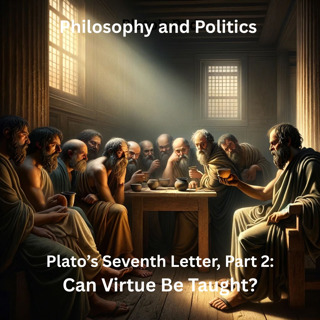
Plato's Seventh Letter, Part 2: Can Virtue Be Taught?
The second half of our discussion on Plato’s Seventh Letter begins with a reading of Plato’s famous statement that he never published any statement of his opinions. That’s both the beauty and, for som...
7 Apr 20251h 33min
Plato's Seventh Letter: On Tyrants Who are Blind to Philosophy
In our first discussion on Plato's letters, we look at his best-known Seventh Letter. In the letter, Plato relates his experience with Dionysius, the tyrannical ruler of Syracuse, and the philosophica...
3 Mars 20251h 17min