Brain Science Author, Horacio Sanchez Addresses Race, Culture and "How to Apply Brain Science to Improve Instruction and School Climate"

Brain Science Author, Horacio Sanchez Addresses Race, Culture and "How to Apply Brain Science to Improve Instruction and School Climate"

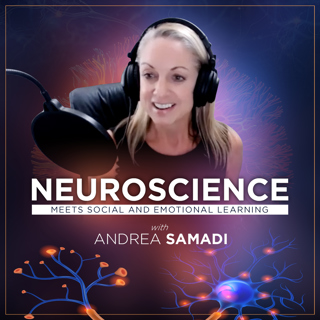
Welcome back to the Neuroscience Meets Social and Emotional Learning podcast, episode #74 with Horacio Sanchez, the President and CEO of Resiliency Inc.,[i] an agency leader in helping schools improve climate, instruction, and discipline with tools and resources that include his most recent book The Education Revolution.[ii]

Watch the interview on YouTube here.

My name is Andrea Samadi, a former educator who created this podcast to bring the most current neuroscience research, along with high performing experts with specific strategies or ideas that you can implement immediately, to take your results to the next level.

Welcome Horatio, it’s an honor to have you on today, especially knowing that one of our early interviews, EPISODE #3 with Ron Hall, from Valley Day School, Pennsylvania on “Launching Your Neuroeducational Program”[iii] features you in the show notes and YouTube video (2:51)[iv] I highly recommend listeners go back to the video interview, and hear Ron Hall’s story of meeting Horatio by chance at an educational conference, where he says that “in 10 minutes (of his presentation) he saw his future in education change right in front of his eyes.”

I want to give a bit more information on your background, since your background is vast in the field of neuroeducation, which is what we focus on here on this podcast. Horacio Sanchez is recognized as one of the nation’s prominent experts on promoting student resiliency and applying brain science to improve school outcomes. Horacio has been a teacher, administrator, clinician, mental health director, and consultant to the Department of Education in North Carolina, Pennsylvania, and other states. His diverse education and background have helped him to merge research, science, and practice which is why he has been so successful in the field of neuro education. His best-selling book, The Education Revolution published by Corwin Press, addresses the decline in empathy, increase in obesity, and the impact of implicit bias on minority students.

Welcome Horacio, I have so many questions to ask you, and hope that we can get them all in!

Q1: I like how you named your company Resiliency Inc as the word resiliency is important these days in education. Can you tell the story that I heard you tell on a podcast with John Williams, where you talk about how resiliency is built? (early days were hard, every day was a struggle, then they progress with hard work, effort, and now you have only good days and better days).

Q2: As a former publishing rep, I have visited thousands of schools in the US (mostly in the Southwest region) and know that you can “feel” a school’s climate within minutes of walking into a school, sometimes even from the parking lot. We’ve all felt this feeling—and you know that our students feel it also. How do you improve school climate and what outcomes does a school typically see with your school climate improvement plan?

Q3: One of the motivators for me doing the work that I’m doing with SEL/neuroscience began in the late 1990s with the Columbine tragedy being a huge motivator to take action. With all of your knowledge with students with emotional disorders, why do you think we have these incidents in the US? (My friends in Australia say they have not had one school shooting ever). What types of programs, or things should parents and educators be aware of to prevent these incidents from happening in the future? (connecting with the shy/anxious type)

Q4: These days, it’s very clear that students are not learning as much as they could be or should be learning. Parents are just not equipped to be teachers, and I’m talking from the heart, as a parent with a teaching degree, with more resources for my 2 kids at home to learn while schools have not been in session. With a sense of urgency, I’m thinking about students in poverty who will be struggling more these days with less instruction, especially if parents are working. How does culture and poverty impact an individual's perceptions, behaviors, and how they learn? What solutions do you see here?

In the next 2 weeks, I have been blessed to interview authors from Corwin Press, and while researching over the weekend, I can see that all authors for the school market are focusing on instilling character in addition to a student’s social and emotional skills. Why do you think there has been a decline in empathy and what do your programs do to build this skill back up again?

Q5: You have such a vast choice of training topics[v] on your website for educators. One of the topics that stood out to me was Overcoming Issues of Diversity. Can you explain the impact of implicit biases, and how they are formed? What can we do to reduce or eliminate bias in the human brain in order to experience immediate progress?

Q6: What obstacles do you see that hold schools back from making progress with your programs, or any other programs they might be using? What are some key areas that schools should focus on for the most noticeable improvement?

Q7: Is there anything important that we have missed? Final thoughts.

Thank you so much Horatio, for meeting with me today to share more about your programs for schools. Are you conducting these programs I saw at https://www.resiliencyinc.com/ online? For anyone who wants to learn more about Horatio Sanchez’s programs, go to https://www.resiliencyinc.com/

Follow Horatio on Twitter @resiliencyinc or Facebook and LinkedIn with Horatio Sanchez.

RESOURCES:

Cultural influences on neural systems (Feb.2020) https://www.sciencedirect.com/science/article/abs/pii/S0028393218303610

Kimberly Noble, Associate Professor of Neuroscience, Columbia University. https://www.irp.wisc.edu/staff/noble-kimberly/

REFERENCES:

[i] https://www.resiliencyinc.com/

[ii] The Education Revolution: How to Apply Brain Science to Improve Instruction and School Climate by Horatio Sanchez (August 5, 2016) https://www.amazon.com/Education-Revolution-Science-Improve-Instruction/dp/1506332064/ref=sr_1_2?crid=1GQ398GD9TR7I&dchild=1&keywords=education+revolution&qid=1595640400&sprefix=eduaction+revol%2Caps%2C198&sr=8-2

[iii] https://www.achieveit360.com/ron-hall-of-valley-day-school-pa-on-launching-your-neuroeducational-program/

[iv] https://www.youtube.com/watch?v=t1O0EWWYewQ&feature=youtu.be (2:51) where Ron Hall speaks about his introduction to educational neuroscience.

[v] https://www.resiliencyinc.com/training

Det här avsnittet är hämtat från ett öppet RSS-flöde och publiceras inte av Podme. Det kan innehålla reklam.

Avsnitt(415)

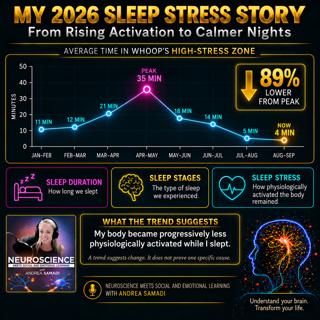
When Sleep Isn't Rest: What 'Sleep Stress' Reveals About Recovery (Bonus Episode)

When Sleep Isn't Rest: What 'Sleep Stress' Reveals About Recovery (Bonus Episode)

In this episode Andrea Samadi explains the concept of sleep stress — a wearable-device measured how physiologically activated your body remains during sleep — and places it within a neuroscience-based...

13 Sep 41min
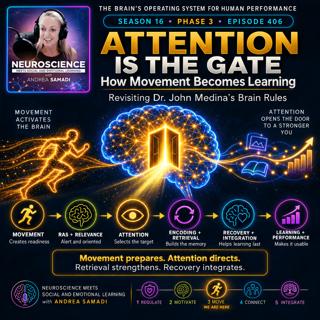
Attention Is the Gate—How Movement Becomes Lasting Learning with Dr. John Medina

Attention Is the Gate—How Movement Becomes Lasting Learning with Dr. John Medina

Episode 406 explains how movement prepares the brain but does not guarantee learning. It traces the full sequence—movement, RAS-driven readiness, salience and relevance, focused attention, encoding, r...

6 Sep 46min
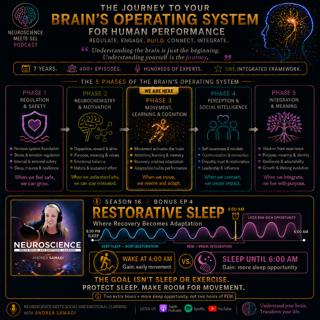
The 4:00 AM Tradeoff: Movement, REM and Recovery (Bonus Episode)

The 4:00 AM Tradeoff: Movement, REM and Recovery (Bonus Episode)

In this episode Andrea Samadi explores how movement and sleep work together in a "brain operating system" for human performance, focusing on restorative sleep (deep + REM), personal WHOOP data, and th...

30 Aug 29min
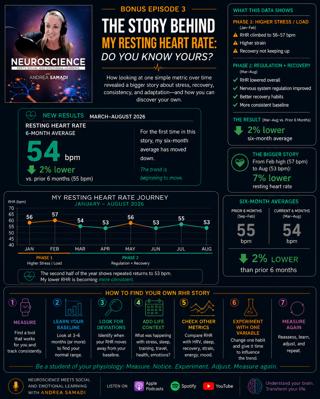
The Hidden Story Behind Your Resting Heart Rate: What Your RHR Can Reveal About Stress, Recovery & Adaptation (Bonus Episode)

The Hidden Story Behind Your Resting Heart Rate: What Your RHR Can Reveal About Stress, Recovery & Adaptation (Bonus Episode)

Andrea Samadi shares her personal resting heart rate data to show why measuring over time matters more than fixating on a single score. She explains how trends reveal stress, recovery, and adaptation,...

23 Aug 30min
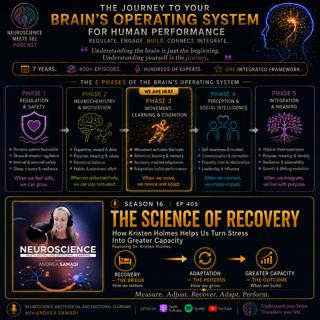
The Science of Recovery—How Dr. Kristen Holmes Helps Us Turn Stress Into Greater Capacity

The Science of Recovery—How Dr. Kristen Holmes Helps Us Turn Stress Into Greater Capacity

In this episode Andrea Samadi explores Phase 3 of the Brain's Operating System—movement, learning, and cognition—focusing on the recovery and adaptation side of the "movement loop." She revisits Dr. K...

16 Aug 45min
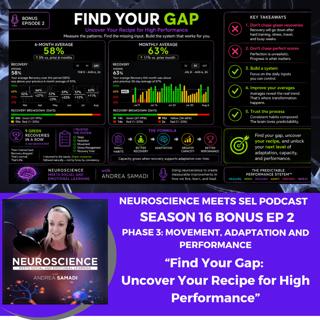
Find Your Gap: How Recovery Unlocks Predictable Performance (Bonus Episode)

Find Your Gap: How Recovery Unlocks Predictable Performance (Bonus Episode)

In this bonus episode Andrea Samadi introduces the Predictable Performance System, a practical roadmap from her Brain’s Operating System. She shows how measuring patterns—not chasing daily scores—plus...

9 Aug 30min
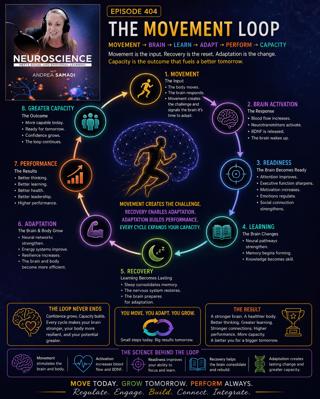
Dr. John Ratey and The Movement Loop: How Movement Becomes Human Performance

Dr. John Ratey and The Movement Loop: How Movement Becomes Human Performance

In this episode Andrea Samadi explores Phase Three of the Brain’s Operating System — how movement acts as the essential input that activates the brain, sharpens attention, boosts learning, and improve...

2 Aug 21min
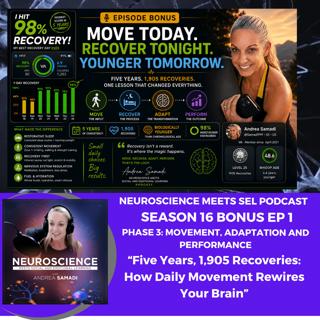
Five Years, 1,905 Recoveries: How Daily Movement Rewires Your Brain (Bonus Episode)

Five Years, 1,905 Recoveries: How Daily Movement Rewires Your Brain (Bonus Episode)

Andrea Samadi shares a five-year self-experiment using a WHOOP wearable to track sleep, recovery, movement, and biological age. She reveals how daily low-intensity movement and consistent recovery—not...

25 Juli 16min
Populärt inom Utbildning

historiepodden-se
rss-bara-en-till-om-beroende-medberoende
det-skaver
nu-blir-det-historia
harrisons-dramatiska-historia
not-fanny-anymore
rss-viktmedicinpodden
allt-du-velat-veta
johannes-hansen-podcast
roda-vita-rosen
rss-max-tant-med-max-villman
sa-in-i-sjalen
i-vantan-pa-katastrofen
rikatillsammans-om-privatekonomi-rikedom-i-livet
rss-ar-det-rimligt
rss-autismandan
rss-foraldramotet-bring-lagercrantz
rss-traningsklubben
rss-basta-livet
polisutbildningspodden