Author and Neuroscience Educator Sarah Peyton on "Brain Network Theory, Default Mode Network, Anxiety and Emotion Regulation."

Author and Neuroscience Educator Sarah Peyton on "Brain Network Theory, Default Mode Network, Anxiety and Emotion Regulation."

Welcome back to the Neuroscience Meets Social and Emotional Learning podcast, episode #92 with neuroscience educator, author and trainer, Sarah Peyton[i].

You can watch the interview on YouTube here.

My name is Andrea Samadi,  and if you are new here, I’m a former educator who created this podcast to bring the most current neuroscience research, along with high performing experts who have risen to the top of their field, with specific strategies or ideas that you can implement immediately, whether you are an educator, or in the corporate space, to take your results to the next level. If we want to improve our social, emotional and cognitive abilities, it all starts with an understanding of our brain.

I’m so grateful to have been introduced to Sarah Peyton, a neuroscience educator, and author of the book, Your Resonant Self: Guided Meditations and Exercises to Engage Your Brain’s Capacity for Healing[ii]. I took one look at Sarah’s work and website, and immediately had 100 questions for her. She also does have a workbook coming out to accompany this book, this summer. I will put the links in the show notes to learn more.[iii]

Welcome Sarah, thank you so much for your time today, to share your knowledge and resources with us.

Q1: Sarah, Brain Network Theory is now being talked about all over the place, listeners of this podcast, who follow the most current neuroscience research, will have heard about it. There are many books being written on this NEW Brain Network Theory (I’ve mentioned Dr. Srini Pillay and his book about the power of the unfocused mind in past episodes). I’ve been working closely with Mark Waldman (from EPISODE 30)[iv] this past year and know that applying Brain Network Theory to our life can be powerful.

Just as a reminder of what Brain Network Theory is all about, if you were to go to www.pubmed.gov and search for the most recent studies on the brain, instead of looking at different parts of the brain, like we used to do, we now know and study different networks in the brain to gain understanding, and we can measure and see the activity in each of these brain networks. This is a fascinating discovery that comes to life with these images that we’ve all seen with different regions of our brain lighting up.

Sarah, can you go over some of the brain function networks you cover in the beginning of your book and how an understanding of these networks can help us with our understanding of the world, and our perhaps ways we can improve our results? (seeing the world, decision-making, discerning importance, dorsal attention, listening, sensing and moving)?

Q2: How does trauma show up in the brain?

Q3: I did cover the Default Mode Network in EPISODE #48[iv] and mention the fact that this Default Mode Network involves those thought processes that can include worry, doubts and fears like “don’t try that, it didn’t work out last time” and so on. Swiss Psychologist Piaget called this “inner speech” that can be positive or negative, depending on what you are thinking. Chapter 1 of your book begins with “How We Talk to Ourselves: The Default Mode Network” that talks about our beliefs, our self-talk and strategies to overcome some of these limiting beliefs. How would you suggest we first of all identify, and then eliminate limiting beliefs from our brain to improve our results?

Q4: The Default Mode Network has also been linked to the Imagination. Marty Seligman, the founder of positive psychology calls the DMN the Imagination Network and my mentor, Mark Waldman created a diagram which he refers to as a map to simplify the 5 major brain networks, and he intentionally put the DMN or Imagination as the largest area, possibly because it develops so early in life and plays such an important role in child and brain development. How would you explain the Default Mode Network and why is it so important for us to understand this network in our brain with our early years of development in mind?

Q5: On EPISODE #53[v], we dive deep into self-regulation, and why it’s so important. This is such an important topic and one I’m always looking for new ideas with, especially these days, as the event in the world keep most of us on our toes. How do you suggest we stay emotionally regulated?

Q6: With anxiety being at an all-time high for many of our students these days, as well as everyone else, with the looming effects of the pandemic this year, what are your best tips for understanding anxiety and the brain, and what are you telling those you are working with, on how to reduce anxiety?

Q7: Sarah, I could keep asking you another 10 questions but do know that our time is limited. In closing, I wonder what the most important concept is, that you think everyone should know, whether we are educators in the workplace, or parents, with children we are raising, or if we are just trying to find our place in the world and make an impact. How can we best use our brain, and guide others to do the same?

Thank you so much for your time today, Sarah. For those who want to learn more about you, they can go to www.empathybrain.com and sign up for your newsletter and free meditations to help improve brain health and resiliency. https://empathybrain.com/newsletter/

They can follow you on Twitter @empathybrain

https://www.facebook.com/empathybrain

@yourresonantself on IG

Thanks Sarah!

RESOURCES:

Dr. Srini Pillay Tinker, Dabble, Doodle, Try: The Power of the Unfocused Mind (May 2017) https://www.amazon.com/Tinker-Dabble-Doodle-Try-Unfocused/dp/1101883650

Know Your Brain: The Default Mode Network June 16, 2015 by https://www.neuroscientificallychallenged.com/blog/know-your-brain-default-mode-network

A Brief Introduction to the Default Mode Network YouTube Published May, 2011 https://www.youtube.com/watch?v=6A-RqZzd2JU

Ruth Lanius Neuroscientist and Professor of Psychiatry, University of Western, Ontario, Canada https://www.thetraumatherapistproject.com/podcast/ruth-lanius-phd/

Joseph LeDoux, author of The Emotional Brain, on Trauma, Fear and Memory Consolidation YouTube Published Dec. 2012 “Can Memories be Erased” https://www.youtube.com/watch?v=km_unuMr-l8

Avoiding the Sickening Effects of Stress (July 2016) https://www.theatlantic.com/health/archive/2016/07/how-to-prevent-stress-from-sickening-the-body/490841/

Matthew Lieberman, Social: Why our brains are wired to connect (July 2015) https://www.amazon.com/Social-Why-brains-wired-connect/dp/0198743815

Beatrice Beebe https://www.beatricebeebe.com/

Jaak Panksepp and his discovery on human emotions https://www.discovermagazine.com/mind/discover-interview-jaak-panksepp-pinned-down-humanitys-7-primal-emotions

REFERENCES:

[i] https://empathybrain.com/ Sarah Peyton’s Website

[ii] Your Resonant Self by Sarah Peyton https://www.amazon.com/gp/product/B074WBVG42/ref=dbs_a_def_rwt_bibl_vppi_i0

[iii] Your Resonant Self Workbook by Sarah Peyton https://www.amazon.com/Your-Resonant-Self-Workbook-Self-sabotage/dp/0393714640/ref=sr_1_2?dchild=1&keywords=your+resonant+self&qid=1602474119&sr=8-2

[iv] Neuroscience Meets SEL Podcast EPISODE #48 “Brain Network Theory” https://www.achieveit360.com/brain-network-theory-using-neuroscience-to-stay-productive-during-times-of-change-and-chaos/

[v] Neuroscience Meets SEL Podcast EPISODE #53 on “Self-Regulation and Your Brain” https://www.achieveit360.com/self-regulation-the-foundational-learning-skill-for-future-success/

Det här avsnittet är hämtat från ett öppet RSS-flöde och publiceras inte av Podme. Det kan innehålla reklam.

Avsnitt(415)

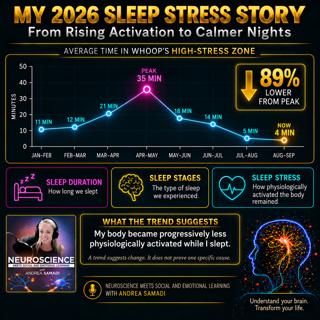
When Sleep Isn't Rest: What 'Sleep Stress' Reveals About Recovery (Bonus Episode)

When Sleep Isn't Rest: What 'Sleep Stress' Reveals About Recovery (Bonus Episode)

In this episode Andrea Samadi explains the concept of sleep stress — a wearable-device measured how physiologically activated your body remains during sleep — and places it within a neuroscience-based...

13 Sep 41min
Attention Is the Gate—How Movement Becomes Lasting Learning with Dr. John Medina

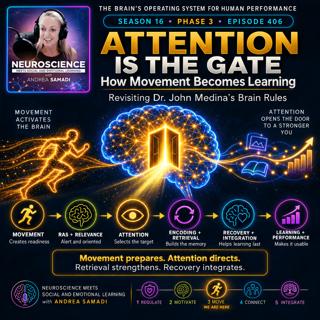
Attention Is the Gate—How Movement Becomes Lasting Learning with Dr. John Medina

Episode 406 explains how movement prepares the brain but does not guarantee learning. It traces the full sequence—movement, RAS-driven readiness, salience and relevance, focused attention, encoding, r...

6 Sep 46min
The 4:00 AM Tradeoff: Movement, REM and Recovery (Bonus Episode)

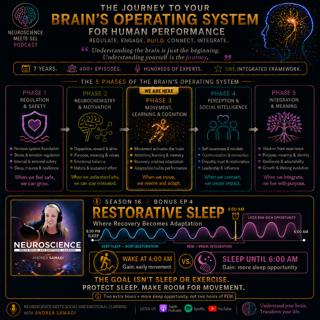
The 4:00 AM Tradeoff: Movement, REM and Recovery (Bonus Episode)

In this episode Andrea Samadi explores how movement and sleep work together in a "brain operating system" for human performance, focusing on restorative sleep (deep + REM), personal WHOOP data, and th...

30 Aug 29min
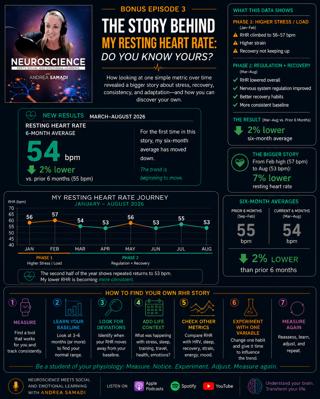
The Hidden Story Behind Your Resting Heart Rate: What Your RHR Can Reveal About Stress, Recovery & Adaptation (Bonus Episode)

The Hidden Story Behind Your Resting Heart Rate: What Your RHR Can Reveal About Stress, Recovery & Adaptation (Bonus Episode)

Andrea Samadi shares her personal resting heart rate data to show why measuring over time matters more than fixating on a single score. She explains how trends reveal stress, recovery, and adaptation,...

23 Aug 30min
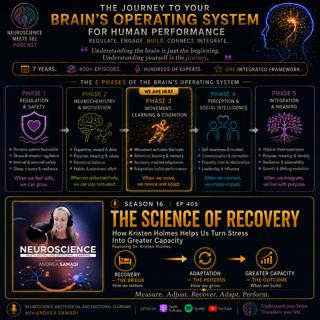
The Science of Recovery—How Dr. Kristen Holmes Helps Us Turn Stress Into Greater Capacity

The Science of Recovery—How Dr. Kristen Holmes Helps Us Turn Stress Into Greater Capacity

In this episode Andrea Samadi explores Phase 3 of the Brain's Operating System—movement, learning, and cognition—focusing on the recovery and adaptation side of the "movement loop." She revisits Dr. K...

16 Aug 45min
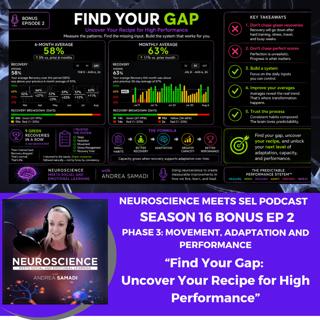
Find Your Gap: How Recovery Unlocks Predictable Performance (Bonus Episode)

Find Your Gap: How Recovery Unlocks Predictable Performance (Bonus Episode)

In this bonus episode Andrea Samadi introduces the Predictable Performance System, a practical roadmap from her Brain’s Operating System. She shows how measuring patterns—not chasing daily scores—plus...

9 Aug 30min
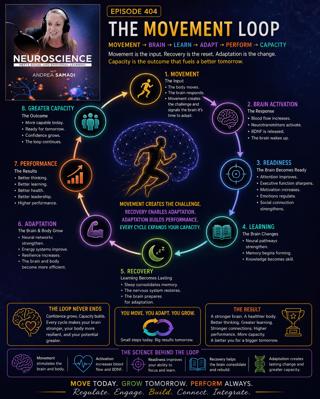
Dr. John Ratey and The Movement Loop: How Movement Becomes Human Performance

Dr. John Ratey and The Movement Loop: How Movement Becomes Human Performance

In this episode Andrea Samadi explores Phase Three of the Brain’s Operating System — how movement acts as the essential input that activates the brain, sharpens attention, boosts learning, and improve...

2 Aug 21min
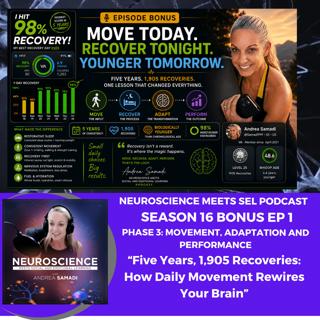
Five Years, 1,905 Recoveries: How Daily Movement Rewires Your Brain (Bonus Episode)

Five Years, 1,905 Recoveries: How Daily Movement Rewires Your Brain (Bonus Episode)

Andrea Samadi shares a five-year self-experiment using a WHOOP wearable to track sleep, recovery, movement, and biological age. She reveals how daily low-intensity movement and consistent recovery—not...

25 Juli 16min

Populärt inom Utbildning

historiepodden-se
det-skaver
rss-bara-en-till-om-beroende-medberoende
nu-blir-det-historia
harrisons-dramatiska-historia
not-fanny-anymore
rss-viktmedicinpodden
roda-vita-rosen
allt-du-velat-veta
johannes-hansen-podcast
sa-in-i-sjalen
i-vantan-pa-katastrofen
rikatillsammans-om-privatekonomi-rikedom-i-livet
rss-foraldramotet-bring-lagercrantz
polisutbildningspodden
rss-max-tant-med-max-villman
rss-basta-livet
rss-traningsklubben
rss-ar-det-rimligt
rss-autismandan