Dr. Dawson Church on "The Science Behind Using Meditation: Rewiring Your Brain for Happiness."

Dr. Dawson Church on "The Science Behind Using Meditation: Rewiring Your Brain for Happiness."

Welcome back to the Neuroscience Meets Social and Emotional Learning podcast, episode #98 with researcher Dr. Dawson Church[i], the author of the new book called Bliss Brain: The Neuroscience of Remodeling Your Brain for Resilience, Creativity and Joy[ii]. Dr. Church is an award-winning science writer who blends cutting-edge neuroscience with the stories of people who’ve had firsthand experience of brain change. Neural plasticity—the discovery that the brain is capable of rewiring itself—is now widely understood. But what few people have grasped yet is how quickly this is happening, how extensive brain changes can be, and how much control each of us exerts over the process of our thinking.

You can watch the YouTube interview here.

My name is Andrea Samadi, and if you are new here, I’m a former educator who created this podcast to bring the most current neuroscience research, along with high performing experts who have risen to the top of their field, with specific strategies or ideas that you can implement immediately, whether you are an educator, or in the corporate space, to take your results to the next level. If we want to improve our social, emotional and cognitive abilities, it all starts with an understanding of our brain.

Welcome Dr. Church, thank you for taking the time to speak with me today, and sharing the fascinating research you have been doing for the 50-plus years you’ve spent investigating human potential since first learning to meditate as a teenager, is that correct?

Dr. Church, before getting to the questions, I’ve got to say that I loved seeing Dave Asprey, the author of the book, Superhuman, and the creator of Bulletproof Coffee as your Foreword. I’m a longtime Dave Asprey follower and fan and loved to see his perspective where he mentions that the top performers he’s come across in his career, those people he calls “Game Changers” all meditate to improve the quality of their life.

Q1: This interview is timely and important, since the world is experiencing such difficult times, (on a day to day basis we are all experiencing significant change no matter what part of the world we are living in) your book is needed, and I do hope that people around the world listening to this episode will read your book (Bliss Brain) and implement the ideas. Can you explain what you have discovered to be the secret for tuning our brain towards positivity, directing our thoughts, habits and behaviors to support a long and happy life?

Q2: Most people who are listening to this podcast are aware of the importance of meditation, but I do hear some places where people often get stuck with their practice. Can you explain how it’s possible to release emotions that keep us in a reactive state—responding to the past—rather than the present so we can learn to be in the moment, rather than somewhere else?

Q3: I remember when I first started to meditate (around 2014), it was because I received a course as a gift that included a meditation program, and I thought I had better use it, knowing I would be asked what I thought about it. I started with sessions that were about 30 minutes long and found it to be a huge learning curve, mainly to sit still and clear my mind. Why do people find it so hard with learning to meditate? What can you tell us about our brain so that we can bypass this roadblock to learning to implement this valuable and important skill?

Q4: I think everyone could use more resilience these days, with the world we are living in. It’s not easy to push forward during such adverse times. Can you explain what your research has shown about how we can learn to relax, even during the most stressful times, explain the brain waves associated with relaxation and resilience, and what exactly does this do to the body/its effect on aging or even our energy?

Q5: What exactly happens to the brain when we meditate? What health and cognitive benefits do we receive?

Q6: What is “the bliss molecule” and how can we access it?

Q7: Can you sum up the benefits can we expect to see from developing a meditation practice and how soon will we see the results?

Thank you very much Dr. Church for taking the time to speak with me today about this important work, and years of research that’s needed right now in the world today. For people to learn more about your work, is the best place http://blissbrain.com/

https://www.facebook.com/dawsonchurch

https://www.facebook.com/mindtomatterbook

https://www.youtube.com/user/TheEFTUniverse

Bliss Brain reviews studies that provide remarkable evidence of rapid and radical brain change. In just eight weeks of meditation practice, 12 minutes a day, brain remodeling begins. Over time, these structural changes in brain anatomy make us calmer, happier, and more resilient.

When we cultivate these pleasurable states over time, they become traits. We don't just feel more blissful as a temporary state; the changes are literally hard-wired into our brains, becoming stable and enduring personality traits.

The startling conclusions of Church’s research show that neural remodeling goes much further than scientists have previously understood, with stress circuits shriveling over time. Simultaneously, the “Enlightenment Circuit”—associated with happiness, compassion, productivity, creativity, and resilience—expands.

During deep meditation, Church shows how “the 7 neurochemicals of ecstasy” are released in our brains. These include anandamide, a neurotransmitter that's been named “the bliss molecule” because it mimics the effects of THC, the active ingredient in cannabis. Meditation also boosts serotonin and dopamine; the first has a chemical structure similar to psilocybin (“magic mushrooms”), the second to cocaine. He shows how cultivating these elevated emotional states literally produces a self-induced high.

The foreword is by Dave Asprey[iii], of “Bulletproof” fame. The book includes numerous “Deeping Practices” that apply this brain science in a practical program of self-transformation. Presenting the latest research in non-technical language understandable to a lay audience, Bliss Brain makes an intriguing case for the potential each of us has to rewire our brains for happiness.

RESOURCES:

FREE ACCESS TO BLISS BRAIN RESOURCES, MEDITATIONS https://blissbrainbook.com/

How to Develop Zen Presence by Karl Albrecht, Ph.D. https://www.psychologytoday.com/us/blog/brainsnacks/201708/how-develop-zen-presence

Rhonda Byrne The Movie The Secret https://www.thesecret.tv/products/the-secret-book/

Dr. Dawson Church The Genie in Your Genes Published May 1, 2009 https://www.amazon.com/Genie-Genes-Dawson-Church-Ph-D-ebook/dp/B0028MVH28

When Science Meets Mindfulness by Alvin Powell April 9, 2018 https://news.harvard.edu/gazette/story/2018/04/harvard-researchers-study-how-mindfulness-may-change-the-brain-in-depressed-patients/

REFERENCES:

[i] http://blissbrain.com/

[ii] Dr. Dawson Church, Bliss Brain https://www.amazon.com/gp/product/1401957757?ie=UTF8&tag=energypsych00-20

[iii] Dave Asprey https://40yearsofzen.com/

Det här avsnittet är hämtat från ett öppet RSS-flöde och publiceras inte av Podme. Det kan innehålla reklam.

Avsnitt(406)

How Movement Builds the Brain, the Body & Human Performance (Phase 3 Introduction)

How Movement Builds the Brain, the Body & Human Performance (Phase 3 Introduction)

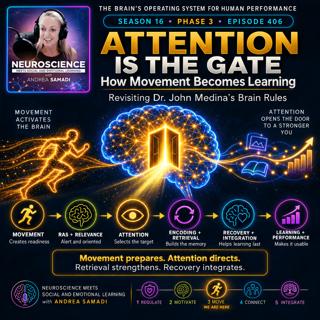
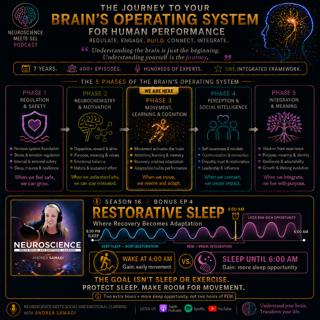
Season 16, Episode 402 explores the Brain's Operating System for Human Performance, focusing on Phase 3: movement, adaptation, and performance. Andrea Samadi explains how movement triggers neurochemic...

12 Juli 25min

Trust as the Foundation with Greg Hill: How Great Leaders Create the Conditions for Learning, Growth and Performance

Trust as the Foundation with Greg Hill: How Great Leaders Create the Conditions for Learning, Growth and Performance

In episode 401 Andrea Samadi welcomes Greg Hill to explore why trust is the essential foundation for learning, growth, and high performance. They discuss how trust creates psychological safety, encour...

27 Juni 37min

Episode 400: Sales Leadership Under Pressure with Majid Samadi: 7 Lessons Learned from 7 Years of Neuroscience

Episode 400: Sales Leadership Under Pressure with Majid Samadi: 7 Lessons Learned from 7 Years of Neuroscience

In this milestone episode (400), Andrea Samadi celebrates seven years of the Neuroscience Meets SEL Podcast with her husband Majid Samadi. They reflect on the journey of translating neuroscience into ...

20 Juni 47min

Phase 2 Review: The Motivation Loop: How to Keep Effort Worthwhile

Phase 2 Review: The Motivation Loop: How to Keep Effort Worthwhile

Episode 399 reviews Phase 2 of Season 15 and introduces the Motivation Loop — the sequence of meaning, belief, attention, action, reward, and recovery that drives sustained effort. The episode explain...

14 Juni 28min

Fun, Fear, Focus: Closing the Motivation Loop with Friederike Fabritius

Fun, Fear, Focus: Closing the Motivation Loop with Friederike Fabritius

Episode 398 revisits neuroscientist Friederike Fabritius (from November 2022) to explain how three ingredients — fun (dopamine), fear (productive challenge), and focus — create the neurochemical condi...

9 Juni 23min

Move to Learn: How Movement Activates the Brain and Fuels Motivation (with Dr. Chuck Hillman and Paul Zientarski)

Move to Learn: How Movement Activates the Brain and Fuels Motivation (with Dr. Chuck Hillman and Paul Zientarski)

Season 15, Episode 397 revisits research and real-world practice showing movement is more than fitness: it activates the brain, boosts attention, enhances learning, and sustains motivation. Dr. Chuck ...

31 Maj 35min

Dopamine, Motivation and Why the Brain Repeats Behavior with Dr. Anna Lembke

Dopamine, Motivation and Why the Brain Repeats Behavior with Dr. Anna Lembke

Host Andrea Samadi welcomes Dr. Anna Lembke to explain how pleasure and pain share the same neural circuitry and how dopamine governs motivation. The episode explores why overconsumption of easy rewar...

24 Maj 23min

Theory of Mind: The Missing Link Between Attention, Reward, and Motivation with John Medina

Theory of Mind: The Missing Link Between Attention, Reward, and Motivation with John Medina

Episode 395 explores how theory of mind — our ability to understand others' intentions — drives attention, emotional relevance, and reward, shaping motivation and behavior. Dr. John Medina explains wh...

17 Maj 37min

Populärt inom Utbildning

historiepodden-se
det-skaver
rss-bara-en-till-om-missbruk-medberoende-2
harrisons-dramatiska-historia
not-fanny-anymore
nu-blir-det-historia
rss-viktmedicinpodden
allt-du-velat-veta
sektledare
johannes-hansen-podcast
roda-vita-rosen
rikatillsammans-om-privatekonomi-rikedom-i-livet
sa-in-i-sjalen
i-vantan-pa-katastrofen
sex-pa-riktigt-med-marika-smith
rss-basta-livet
rss-traningsklubben
rss-dr-bjorklund
vi-gar-till-historien
rss-ar-det-rimligt