Sleep Scientist Antonio Zadra on "When Brains Dream: Exploring the Science and Mystery of Sleep."

Sleep Scientist Antonio Zadra on "When Brains Dream: Exploring the Science and Mystery of Sleep."

Welcome back to the Neuroscience Meets Social and Emotional Learning Podcast, episode #104.

Watch this interview on YouTube here.

Our guest today came to me when I was referred to his book on one of my neuro-coaching training calls with Mark Robert Waldman[i], from episode #30 when I asked a question that was sent to me from a close friend from the UK, on dreams. Mark Waldman told me that he was anxiously awaiting the NEW book, When Brains Dream: Exploring the Science and Mystery of Sleep[ii] and I immediately looked up the book, and contacted the author, Antonio Zadra, to appear on our podcast. He agreed, and the rest is history!

Before I get to the interview, I want to give you a bit more background information on this book, and the authors, and what you can expect before picking it up. I’ve got to say that what I expected from this book, continually changed as I began to read it, and it took me deeper and deeper into the mysterious world of our dreams.

Antonio Zadra and Robert Stickgold bring together state-of-the-art neuroscientific ideas and findings to propose a new and innovative model of dream function called NEXTUP—Network Exploration to Understand Possibilities. By detailing this model’s workings, they help readers understand key features of several types of dreams, from prophetic dreams to nightmares and lucid dreams. When Brains Dream reveals recent discoveries about the sleeping brain and the many ways in which dreams are psychologically, and neurologically, meaningful experiences; The book explores a host of dream-related disorders; and explains how dreams can facilitate creativity and be a source of personal insight.

Antonio Zadra[iii] is a professor at the Université de Montréal and a researcher at the Center for Advanced Research in Sleep Medicine. He has appeared on PBS's Nova and BBC's Horizon.

Welcome Tony, thank you so much for agreeing to share more about your new book, When Brains Dream today.

Q1: Tony, when we first spoke, I mentioned to you that I had been writing down my dreams since the late 1990s (off and on) it started when the speaker, Bob Proctor from episode #66[iv], who I worked for, suggested that I could learn a lot of insight from journaling about dreams, but nothing was more powerful than my first conversation with you. You taught me a valuable lesson, that “we cannot interpret other people’s dreams, only our own.” Can you share why this is important for all of us to understand, as we all probably have the same urge to ask “what does this dream mean?” and what should we be thinking of asking instead when searching for meaning with our dreams? (Ch 12 Working with Dreams).

Q2: How can readers use your model NEXTUP (Network Exploration to Understand Possibilities) to understand prophetic dreams, nightmares or lucid dreams?

Q3: Before we look at working with dreams, can you explain that while Freud’s influence on dreams was great, (you cover his influence in Chapter 3) what powerful scientific and clinical work was being done on dreams way before Freud?

Q4: What made you become interested in studying about dreams, and becoming a dream scientist?

Q5: I have to ask, the biggest question about dreaming that you cover in chapter 7. Why do we dream? I always thought our dreams were our wishes or fears, something from the past, unresolved issues, and something triggered by a current event. What would you say? Why do we dream?

Q6: What are the contents of most dreams and how can they facilitate creativity and have our dreams be a source of personal insight?

6 PART B Also, you mention in chapter 12 that “20 percent of dream material can be confidently traced to waking-life sources.” Where is the rest of 80% coming from? Our non-conscious? The collective consciousness that I know you mentioned.

Q7: When we were talking about 2 of my dreams before this call, you noticed that water was a theme in both dreams, and one included flowing water that you mentioned can be metaphor for our emotions. You were able to ask me some questions that pinpointed very quickly and easily the meaning of those dreams. Can you expand on any other metaphors like water that might be common themes for people? Also, what can you tell me about dream characters and why are they of such interest to you?

Q8: You had mentioned to me that taking art appreciation classes can help to get a better appreciation for our dreams, and not being one to go to the museum or art gallery, I wondered what I could learn from this. Then you mention Santiago Ramón y Cajal, (Cahal) a Spanish histologist and anatomist who won the 1906 Nobel Prize in Physiology or Medicine for his discovery of nerve cells and I watched a video about his book The Beautiful Brain: The Drawings of Santiago Ramon y Cajal[v] on YouTube and it was fascinating. For the first time I began to make connections between art and dreams and see this strategy in a new light. Can you expand on this idea and explain why art appreciation is an important strategy for dream exploration?

Q9: In the epilogue you talk about the future of dreaming and that maybe one day sleep trackers could store/log our dreams and how scary this could be. What do you think the future holds for us and our dreams? Do you think there will ever be solid answers that neuroscience can answer to help us to better understand some of the questions that come up with our dreams?

Thank you very much for your time today Tony and for sharing your insights on the power of understanding how our brains dream. If anyone wants to purchase your book, is the best place Amazon? If people want to contact you directly, or learn more about your work, what is the best way?

@DrZDreams on Twitter

https://antoniozadra.com/en

https://antoniozadra.com/en/media

Thank you!

RESOURCES:

Ready Player One https://www.imdb.com/title/tt1677720/

The Dream Keepers https://www.amazon.com/dp/B07L21GQBD/ref=dp-kindle-redirect?_encoding=UTF8&btkr=1

REFERENCES:

[i] Neuroscience Meets Social and Emotional Learning Episode #30 Neuroscience Researcher Mark Robert Waldman on “12 Brain-Based Experiential Living Principles” https://www.achieveit360.com/neuroscience-researcher-mark-robert-waldman-on-12-brain-based-experiential-learning-and-living-principles/

[ii] When Brains Dream: Exploring the Science and Mystery of Sleep by Antonio Zadra and Robert Stickgold (Jan. 12, 2021) https://www.amazon.com/dp/B08D1SF658/ref=dp-kindle-redirect?_encoding=UTF8&btkr=1

[iii] https://www.researchgate.net/profile/Antonio_Zadra

[iv] Neuroscience Meets Social and Emotional Learning Podcast episode #66 The Legendary Bob Proctor on “Social and Emotional Learning: Where it All Started” https://www.achieveit360.com/the-legendary-bob-proctor-on-social-and-emotional-learning-where-it-all-started/

[v] The Beautiful Brain: The Drawings of Santiago Ramon y Cajal Published August 10, 2017 on YouTube https://www.youtube.com/watch?v=72IPPIt5iMw&feature=youtu.be

Det här avsnittet är hämtat från ett öppet RSS-flöde och publiceras inte av Podme. Det kan innehålla reklam.

Avsnitt(407)

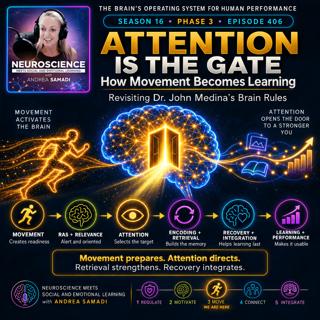
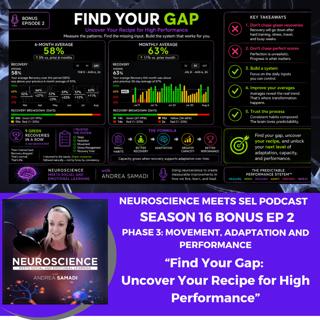
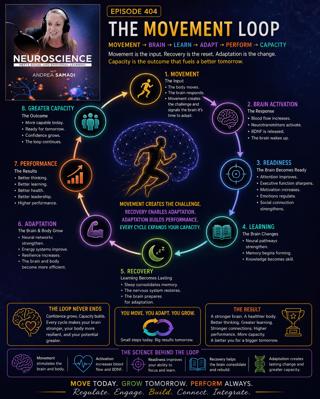
The Movement Loop: How Movement Activates the Brain for Learning, Adaptation & Performance

The Movement Loop: How Movement Activates the Brain for Learning, Adaptation & Performance

Welcome back to Season 16 of the Neuroscience Meets Social and Emotional Learning Podcast. I'm Andrea Samadi, and this is where we bridge neuroscience, social and emotional learning, and human perform...

19 Juli 34min

How Movement Builds the Brain, the Body & Human Performance (Phase 3 Introduction)

How Movement Builds the Brain, the Body & Human Performance (Phase 3 Introduction)

Season 16, Episode 402 explores the Brain's Operating System for Human Performance, focusing on Phase 3: movement, adaptation, and performance. Andrea Samadi explains how movement triggers neurochemic...

12 Juli 25min

Trust as the Foundation with Greg Hill: How Great Leaders Create the Conditions for Learning, Growth and Performance

Trust as the Foundation with Greg Hill: How Great Leaders Create the Conditions for Learning, Growth and Performance

In episode 401 Andrea Samadi welcomes Greg Hill to explore why trust is the essential foundation for learning, growth, and high performance. They discuss how trust creates psychological safety, encour...

27 Juni 37min

Episode 400: Sales Leadership Under Pressure with Majid Samadi: 7 Lessons Learned from 7 Years of Neuroscience

Episode 400: Sales Leadership Under Pressure with Majid Samadi: 7 Lessons Learned from 7 Years of Neuroscience

In this milestone episode (400), Andrea Samadi celebrates seven years of the Neuroscience Meets SEL Podcast with her husband Majid Samadi. They reflect on the journey of translating neuroscience into ...

20 Juni 47min

Phase 2 Review: The Motivation Loop: How to Keep Effort Worthwhile

Phase 2 Review: The Motivation Loop: How to Keep Effort Worthwhile

Episode 399 reviews Phase 2 of Season 15 and introduces the Motivation Loop — the sequence of meaning, belief, attention, action, reward, and recovery that drives sustained effort. The episode explain...

14 Juni 28min

Fun, Fear, Focus: Closing the Motivation Loop with Friederike Fabritius

Fun, Fear, Focus: Closing the Motivation Loop with Friederike Fabritius

Episode 398 revisits neuroscientist Friederike Fabritius (from November 2022) to explain how three ingredients — fun (dopamine), fear (productive challenge), and focus — create the neurochemical condi...

9 Juni 23min

Move to Learn: How Movement Activates the Brain and Fuels Motivation (with Dr. Chuck Hillman and Paul Zientarski)

Move to Learn: How Movement Activates the Brain and Fuels Motivation (with Dr. Chuck Hillman and Paul Zientarski)

Season 15, Episode 397 revisits research and real-world practice showing movement is more than fitness: it activates the brain, boosts attention, enhances learning, and sustains motivation. Dr. Chuck ...

31 Maj 35min

Dopamine, Motivation and Why the Brain Repeats Behavior with Dr. Anna Lembke

Dopamine, Motivation and Why the Brain Repeats Behavior with Dr. Anna Lembke

Host Andrea Samadi welcomes Dr. Anna Lembke to explain how pleasure and pain share the same neural circuitry and how dopamine governs motivation. The episode explores why overconsumption of easy rewar...

24 Maj 23min

Populärt inom Utbildning

historiepodden-se
det-skaver
rss-bara-en-till-om-missbruk-medberoende-2
harrisons-dramatiska-historia
not-fanny-anymore
nu-blir-det-historia
rss-viktmedicinpodden
allt-du-velat-veta
johannes-hansen-podcast
sektledare
rikatillsammans-om-privatekonomi-rikedom-i-livet
sa-in-i-sjalen
roda-vita-rosen
i-vantan-pa-katastrofen
rss-basta-livet
rss-traningsklubben
sex-pa-riktigt-med-marika-smith
vi-gar-till-historien
rss-ar-det-rimligt
rss-dr-bjorklund