Behavior Analyst and Author Jessica Minahan on her book "The Behavior Code: A Practical Guide to Understanding and Teaching the Most Challenging Students"

Behavior Analyst and Author Jessica Minahan on her book "The Behavior Code: A Practical Guide to Understanding and Teaching the Most Challenging Students"

Welcome back to the Neuroscience Meets Social and Emotional Learning Podcast episode #107 with Jessica Minahan[i], the author of The Behavior Code: A Practical Guide to Understanding and Teaching the Most Challenging Students[ii] In this much needed book, based on a collaboration dating back nearly a decade, the authors Jessica Minahan, a behavioral analyst and Nancy Rappaport, a child psychiatrist—reveal their systematic approach for deciphering causes and patterns of difficult behaviors and how to match them with proven strategies for getting students back on track to learn.

Watch the interview on YouTube here.

My name is Andrea Samadi, and if you are new here, I’m a former educator who created this podcast to bring the most current neuroscience research, along with high performing experts who have risen to the top of their field, with specific strategies or ideas that you can implement immediately, whether you are an educator, or in the corporate space, to take your results to the next level. If you have ever heard my story of where my career began, you would know why I would be so interested to speak with Jessica about the strategies in The Behavior Code. My first job out of The University of Toronto’s Faculty of Education, was a behavioral class. I felt overwhelmed and frustrated by the lack of resources to manage and teach my students and this was one of the catalysts that drew me towards social and emotional learning in the late 1990s. If only I had read this book back then, I wouldn’t have struggled so much.

Let me tell you more about Jessica:

She is a licensed and board-certified behavior analyst (BCBA), author, special educator, and consultant to schools internationally. Since 2000 she has worked with students who struggle with mental health issues and challenging behavior in public school systems. She specializes in training staff and creating behavior intervention plans for students who demonstrate explosive and unsafe behavior. She also works with students who have emotional and behavioral disabilities, anxiety disorders, or high-functioning Autism. Her particular interest is to serve these students by combining behavioral interventions with a comprehensive knowledge of best practices for those with complex mental health profiles and learning needs.

She is a blogger on The Huffington Post[iii], the author of The Behavior Code: A Practical Guide to Understanding and Teaching the Most Challenging Students,[iv] with Nancy Rappaport (Harvard Education Press, 2012), and author of The Behavior Code Companion: Strategies, Tools, and Interventions for Supporting Students with Anxiety-Related or Oppositional Behaviors [v](Harvard Education Press, 2014).]

She holds a Bachelor in Science in Intensive Special Education from Boston University and a dual master’s degree in Special Education and Elementary Education from Wheelock College. She has a certificate of graduate study (CGS) in teaching children with Autism from the University of Albany and received her BCBA training from Northeastern University in Boston. She is sought-after internationally to speak on subjects ranging from effective interventions for students with anxiety to supporting hard-to-reach students in full-inclusion public school settings.

How did I come across Jessica’s work?

A couple of Saturday mornings ago, I was at my desk getting caught up from the week, and an email came in from Greg Wolcott, who I mention often on the podcast. He’s an assistant superintendent from Chicago who has not only been a guest a couple of times on the podcast, but is a huge supporter. He often brainstorms ideas, topics, and guest speakers with me, and this time, when he sent me Jessica’s name, and told me that he was on a webinar with her, and that I should take a look at her work, I knew I needed to speak with her the minute I saw the title of her book.

If you are a current teacher, former teacher, or thinking about being a teacher, I am sure that you would want to know “what is the behavior code?” As a parent I am still trying to figure this out, and my girls are not teenagers yet! So I emailed Jessica that second, asked her if she would come on the podcast, and within hours we had the interview set up.

Let’s hear what Jessica has to say about the Behavior Code.

--------------------This is where the interview begins-----------

Welcome Jessica, thank you so much for taking the time out of a busy schedule (where I know you’ve been working hard presenting on the weekends) to speak with me about your book The Behavior Code.

Before we get to the questions, I wanted to read one of the reviews that you have in the beginning of the book. We haven’t met until now, so you wouldn’t possibly know my story of my first job out of teacher’s college being a behavioral class, where I wished I had some strategies, any strategies, to manage my class that was out of control, but this review could have been written by me and I think it will give you some insight into the passion that I have for your work before I begin the questions.

The review says….

“The Behavior Code needs to be read by all teachers, counselors, administrators, and parents!/From cover to cover I felt (the authors) were speaking to me, an elementary teacher (I was a middle-school teacher) and a mom (I wasn’t a mom back then, but I am now). I felt they knew me, and knew those students who kept me awake at night. ( I still wonder what happened to those students who used to keep me up at night, over 20 years later). Teachers, this book is written by authors who KNOW what our jobs are like.” — Lorna d’Entremont, Special Needs Book Review

Jessica, I’ve heard you say that when you show up at a school to help teachers, it’s usually after an incident has happened, and teachers or school admin are looking for an immediate solution. I know you can’t solve everyone school’s behavior problems, but what is your vision with the Behavior Code?

Q1: When I left teaching, in the late 1990s, my close friends would say that I was the least likely out of anyone to quit anything. I broke my contract, felt burnt out, after one year of teaching behavioral students. There were no strategies at all in my teacher training programs to help me to deal with challenging behavior, and it’s been just recently that I have come across books like Dr. Lori Desautels” Connections Over Compliance: Rewiring Our Perceptions of Discipline[vi] where I started to see that there were strategies out there to help turn around even the most challenging students. Why do you think there is this gap in our teacher training programs, that “creates teachers who are undertrained and overwhelmed?” (Jessica Minahan, on Unrestrained Podcast Episode #18)[vii].

My thoughts: Unless you have stood in a classroom, in front of students, it’s not easy to really understand the job of an educator. Even sitting in the back of the classroom, as a parent volunteer, you can get a glimpse of what the day-to-day life is like in today’s schools.

Q2: When I was teaching, I remember thinking in my head “what’s wrong with these kids?” showing that I was missing some really important training. What should all teachers know about behavior, and can you explain how we can turn around even the most challenging student behavior?

Q3: What is the process of figuring out the underlying cause behind a behavior? What are some patterns and causes of challenging behavior?

Q4: How do social and emotional skills tie into behavior control? In Ch 1 of your book you mention an incident with a student name Alyssa who blows up at another student, and you had a chart showing the SEL skills that were missing, that need to be taught. How can teachers assess the strategies you outline a situation like this in real-time, to prevent more disruption, or is the key just to keep our calm until we can get more information? What is the best way to deal with explosive situations while they are happening?

Q5: I know that you go into depth on your FAIR Intervention Plan that you describe in chapter 2 on the podcast I heard you on recently. I will put a link to this podcast in the show notes[viii] so you don’t have to explain it again, but can you briefly explain why replacement behavior is the first step toward desired behavior, and what would the FAIR PLAN look like in practice, maybe with a student with Anxiety-Related behavior, since anxiety is at an all-time high these days?

Q6: If you had met me 20 years ago when I was a new teacher, with a room full of behavioral students, and I shared with you that I was thinking of leaving teaching, not only leaving teaching, but thinking of moving to another country, it was such a stressful experience. What would you have said to me? What would you say to teachers these days who are feeling the stress and pressure of Covid19, whether they are teaching in the classroom or online?

Q7: I just presented at a virtual conference on the topic of stress, learning and the brain[ix], as this topic is something I would like to bring more awareness to for our teachers in the classroom, or parents who might be homeschooling their children, or helping them on a different level than they’ve ever had to before. What calming strategies do you think would help a stressed teacher, or even a parent stressed out in the workplace, and then they have to come home and find new strategies to help their children who are also stressed with the way the world is today?

Jessica, I want to thank you so much for taking the time to speak with me today, to share your research and years of work around a topic that I am deeply invested in. If people want to learn more about your books, articles, radio and podcasts, they can go to

https://jessicaminahan.com/publications/

They can follow you on social media:

https://twitter.com/jessica_minahan

https://www.linkedin.com/in/jessica-minahan-64a8782/

https://www.facebook.com/TheBehaviorCode

https://www.websudoku.com/

RESOURCES:

The Behavior Code Book and Companion Guide. You will learn:

*Tools that can be understood and used immediately *How anxiety-related behaviors impact students and easy to implement strategies that are really effective! *Case studies that are springboards to creating effective intervention support plans. *Progress monitoring tools that measure if the interventions are effective! *Clearly outlined components of a transition and how to support all students be successful with the numerous transitions they incur in the school day. *The IEP goals and objectives included in the book are fantastic templates *Protocols for unsafe behaviors *Comprehensive list of helpful apps

Treating Explosive Kids by Ross Green and J. Stuart Ablon, https://www.stuartablon.com/treating-explosive-kids

REFERENCES:

[i] https://jessicaminahan.com/about-jessica-minahan/

[ii][ii] The Behavior Code: A Practical Guide to Understanding and Teaching the Most Challenging Students (April 1, 2012) https://www.amazon.com/Behavior-Code-Practical-Understanding-Challenging/dp/1612501362

[iii] 5 Tips for Preventing Dependency in Anxious Students (Feb.2017) by Jessica Minahan https://www.huffpost.com/entry/5-tips-for-preventing-dependency-in-anxious-students_b_58b4a421e4b0e5fdf61975f0

[iv] The Behavior Code: A Practical Guide to Understanding and Teaching the Most Challenging Students (April 1, 2012) https://jessicaminahan.com/the-behavior-code/

[v] The Behavior Code Companion: Strategies, Tools and Interventions for Supporting Students with Anxiety-Related or Oppositional Behaviors https://jessicaminahan.com/the-behavior-code-companion/

[vi] Lori L Desautels, Ph.D Connections Over Compliance: Rewiring Our Perceptions of Discipline (Sept. 18, 2020) http://revelationsineducation.com/the-book/connections-over-compliance-rewiring-our-perceptions-of-discipline/

[vii] Cracking the Behavior Code (Unrestrained Podcast Episode #18) with Terry Vittone https://www.crisisprevention.com/Blog/Unrestrained-Episode-18-Guest-Jessica-Minahan

[viii] Cracking the Behavior Code (Unrestrained Podcast Episode #18) with Terry Vittone https://www.crisisprevention.com/Blog/Unrestrained-Episode-18-Guest-Jessica-Minahan

[ix] Neuroscience Meets SEL: 12 Brain-Aligned Strategies to Reduce Stress and Increase Learning by Andrea Samadi https://twitter.com/andreasamadi/status/1359096620848058371/photo/2

Det här avsnittet är hämtat från ett öppet RSS-flöde och publiceras inte av Podme. Det kan innehålla reklam.

Avsnitt(407)

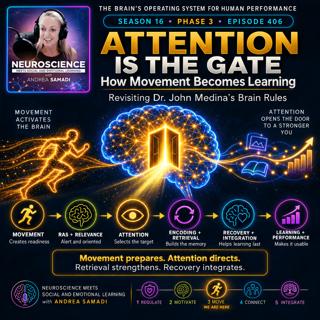
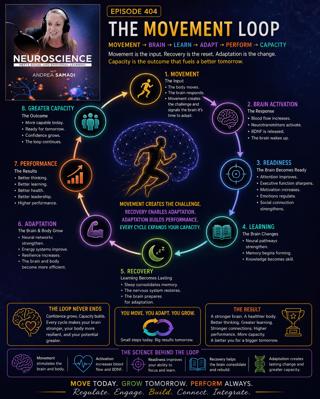
The Movement Loop: How Movement Activates the Brain for Learning, Adaptation & Performance

The Movement Loop: How Movement Activates the Brain for Learning, Adaptation & Performance

Welcome back to Season 16 of the Neuroscience Meets Social and Emotional Learning Podcast. I'm Andrea Samadi, and this is where we bridge neuroscience, social and emotional learning, and human perform...

19 Juli 34min

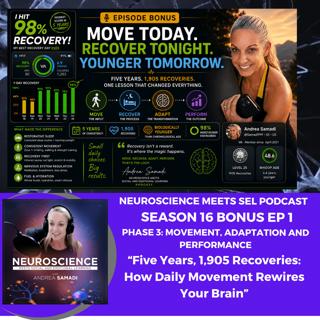
How Movement Builds the Brain, the Body & Human Performance (Phase 3 Introduction)

How Movement Builds the Brain, the Body & Human Performance (Phase 3 Introduction)

Season 16, Episode 402 explores the Brain's Operating System for Human Performance, focusing on Phase 3: movement, adaptation, and performance. Andrea Samadi explains how movement triggers neurochemic...

12 Juli 25min

Trust as the Foundation with Greg Hill: How Great Leaders Create the Conditions for Learning, Growth and Performance

Trust as the Foundation with Greg Hill: How Great Leaders Create the Conditions for Learning, Growth and Performance

In episode 401 Andrea Samadi welcomes Greg Hill to explore why trust is the essential foundation for learning, growth, and high performance. They discuss how trust creates psychological safety, encour...

27 Juni 37min

Episode 400: Sales Leadership Under Pressure with Majid Samadi: 7 Lessons Learned from 7 Years of Neuroscience

Episode 400: Sales Leadership Under Pressure with Majid Samadi: 7 Lessons Learned from 7 Years of Neuroscience

In this milestone episode (400), Andrea Samadi celebrates seven years of the Neuroscience Meets SEL Podcast with her husband Majid Samadi. They reflect on the journey of translating neuroscience into ...

20 Juni 47min

Phase 2 Review: The Motivation Loop: How to Keep Effort Worthwhile

Phase 2 Review: The Motivation Loop: How to Keep Effort Worthwhile

Episode 399 reviews Phase 2 of Season 15 and introduces the Motivation Loop — the sequence of meaning, belief, attention, action, reward, and recovery that drives sustained effort. The episode explain...

14 Juni 28min

Fun, Fear, Focus: Closing the Motivation Loop with Friederike Fabritius

Fun, Fear, Focus: Closing the Motivation Loop with Friederike Fabritius

Episode 398 revisits neuroscientist Friederike Fabritius (from November 2022) to explain how three ingredients — fun (dopamine), fear (productive challenge), and focus — create the neurochemical condi...

9 Juni 23min

Move to Learn: How Movement Activates the Brain and Fuels Motivation (with Dr. Chuck Hillman and Paul Zientarski)

Move to Learn: How Movement Activates the Brain and Fuels Motivation (with Dr. Chuck Hillman and Paul Zientarski)

Season 15, Episode 397 revisits research and real-world practice showing movement is more than fitness: it activates the brain, boosts attention, enhances learning, and sustains motivation. Dr. Chuck ...

31 Maj 35min

Dopamine, Motivation and Why the Brain Repeats Behavior with Dr. Anna Lembke

Dopamine, Motivation and Why the Brain Repeats Behavior with Dr. Anna Lembke

Host Andrea Samadi welcomes Dr. Anna Lembke to explain how pleasure and pain share the same neural circuitry and how dopamine governs motivation. The episode explores why overconsumption of easy rewar...

24 Maj 23min

Populärt inom Utbildning

historiepodden-se
det-skaver
rss-bara-en-till-om-missbruk-medberoende-2
harrisons-dramatiska-historia
not-fanny-anymore
nu-blir-det-historia
rss-viktmedicinpodden
allt-du-velat-veta
johannes-hansen-podcast
sektledare
rikatillsammans-om-privatekonomi-rikedom-i-livet
sa-in-i-sjalen
roda-vita-rosen
i-vantan-pa-katastrofen
rss-basta-livet
rss-traningsklubben
sex-pa-riktigt-med-marika-smith
vi-gar-till-historien
rss-ar-det-rimligt
rss-dr-bjorklund