Scott Flansburg, The Human Calculator on ”Math Hacks Anyone Can Learn To Transform Your Math Mindset”

Scott Flansburg, The Human Calculator on ”Math Hacks Anyone Can Learn To Transform Your Math Mindset”

Welcome back to the Neuroscience Meets Social and Emotional Learning Podcast for episode #150 with Scott Flansburg[i] who Regis Philbin called “The Human Calculator[ii]” because he can mentally count faster than a calculator.

Watch this interview on YouTube here. https://youtu.be/aa8mbxvYqrc

Learn more about Scott Flansburg's online programs here.

https://scottflansburg.com/a/andrea

See past episodes here. https://www.achieveit360.com/episodes/

On this episode you will learn: ✔︎ How someone with incredible math abilities has started the National Counting Bee to share his talents with students around the country.

✔︎ 2 NEW WAYS to look at numeracy and math that will change your mindset forever.

✔︎ How Scott Flansburg got into the Guinness World Book of Records for his unique mathematical abilities and what his brain scans revealed about his brain.

✔︎ Scott's vision for the future and how he plans to change the way ALL 3rd graders approach math in the future.

I'm Andrea Samadi, author, and educator from Toronto, Canada, now in Arizona, and like many of our listeners, have been fascinated with learning and understanding the science behind high performance strategies in our schools, sports, and the workplace with ideas that we can all use, understand and implement immediately. I do want to thank the listeners who have sent me messages through social media about how you are using these podcast episodes in your personal and professional lives. We are approaching our goal of hitting 200 episodes and 100,000 downloads and couldn’t do this without listeners, or high-quality guests.

Back to this episode.

After being introduced to Howard Berg[iii], who holds the Guinness World record for speed reading, I was introduced to Dave Farrow[iv], a two-time Guinness World Record holder for correctly memorizing and recalling the exact order of 59 decks of shuffled playing cards. I began to see that extraordinary results are possible, when regular people, like you and me, do certain things in a certain way. I look forward to sharing Scott Flansburg’s story, to see what strategies we can learn and implement to help us all improve our numeracy skills. Yes, he does hold the Guinness World Record for the fastest mental calculation after adding the same number to itself more times in 15 seconds, even faster than anyone could do with a calculator.

I’ve heard of the importance of developing strong numeracy skills twice already, from past guests. On episode #138,[v] Professor and Canada Research Chair in Developmental Cognitive Neuroscience and Learning, Dr. Daniel Ansari, affirmed that research shows that students with weak numeracy skills are more likely to default on their mortgage payments in the future, and on episode #146[vi] Dr. Howard Rankin, an expert in Psychology and Cognitive Neuroscience who spoke on the topic of “How Not to Think” agreed that low numeracy skills are a noticeable problem in the US, and that many people have no idea on the concept of “compounding interest.”

Let’s see what we can learn from Scott Flansburg. But first, here’s a bit more about him.

Since about 1990 Scott Flansburg has regularly given lectures and presentations at schools. He has been a presenter at organizations such as NASA, IBM, The Smithsonian Institution, the National Council of Teachers of Mathematics, and the Mental Calculation World Cup. The latter described Flansburg as “more an auditory than a visual [mental] calculator”.

One of Flansburg’s “personal missions” is to use education to elevate math confidence and self-esteem in adults and children. He says “Why has it become so socially acceptable to be bad at math?,” and reminds us that “If you were illiterate, you wouldn’t say that on TV, but you can say that you are bad at math. We have to change the attitude.” He believes students should become proficient with calculation methods rather than relying on table memorization.

Scott is the creator of The Counting Bee™[vii], an annual STEM competition open for K-12 students at all public, private, charter, and home schools. Its inaugural competition was held on November 8, 2018, in Arizona, where I live. I wish I had known of Scott back then, for I would have been sitting in the front row, hoping to learn something.

What’s really interesting is that Scott discovered his mental calculation ability at the age of 9 when his math teacher asked him to add four numbers. He can mentally add, subtract, divide and multiply numbers with the accuracy of the calculator naturally. In 1990, he started using his abilities in the education and entertainment industry. To date, he has published books like Math Magic and Math Magic For Your Kids.

Scott has been featured in popular shows around the world like The Ellen Show, The Oprah Winfrey Show, USA Today, BBC breakfast, ESPN, History Channel, and many more.

Let’s meet Scott Flansburg.

Welcome Scott, thank you very much for coming on the podcast today to share ways that we can improve our numeracy skills. This is such an honor for me to have this chance to speak with you. When I looked at your website, it’s clear that you have caught the attention of some of the greats who have made their mark in history, like Larry King, or Regis Philbin who nicknamed you “The Human Calculator,” Tony Robbins, Oprah or comic book writer Stan Lee.

Welcome!

I’ve got to tell you Scott, when I see talent, it’s impossible to look away! I was blown away with your story (watching you add a 2-digit number to itself 36 times in 15 seconds) but what really got me was seeing you on AZ Family TV with the 1st AZ Counting Bee[viii]and the National Counting Bee[ix] helping students with these skills.

Intro Q: Why did you start the Counting Bee, and what is your vision for young people around the world with numeracy skills?

Q1: Scott, what I love about stories like yours, is that there is such a huge need for numeracy skills (not just here in the US, but Globally) and I’m fully aware of how important mindset is for my own results/future, let alone my two girls who watch and model everything that I do, especially now that the Pandemic has taken away so much of those math skills that are cumulative. When I watched the winner of your Counting Bee, and the anchor asked his Mom “Where did he learn this from, was it you?” And she said strongly, “Definitely not!” Perhaps his Father? I recognized that I have said the exact same thing about my husband who is really good with numbers. Why do you think people so afraid of numbers? Do you think there is a new sense of urgency around numeracy skills that is different now with the times we have faced?

Q2: When did you notice that you had these numeracy skills that were helpful for your family while grocery shopping (I read that you could add up the tally of a grocery list before the cashier had rung up your orders) or at what age did you notice that your brain worked differently from the other students?

Q3: How did you get into the Guinness World Book of Records? How did you even know about trying for this?

Q4: What have you learned about your brain and how it might be different from other brains? I saw something about the fact that scientists associate your mathematical skills with the fact that an area in your brain is displaced upward and significantly expanded? Did you have your brain scanned? How would anyone know this?

Q5: I have put a link to your website, with your programs listed, but what are the programs you offer? I see courses for kids, students, and professionals. Can you tell me about each one?

Thank you so much for your time today and for what you are doing to help the world embrace numbers in a different way. If anyone wants to reach you, they can click on the link in the show notes and also find you

https://twitter.com/HumanCalculator

https://scottflansburg.com/a/andrea

https://www.linkedin.com/in/thehumancalculator/

https://www.facebook.com/IAmTheHumanCalculator

Area 44 of the Brain https://en.wikipedia.org/wiki/Brodmann_area_44

https://mobile.twitter.com/TheCountingBee The National Counting Bee on Twitter

Sign up for the next Counting Bee https://www.thecountingbee.org/

FOLLOW ANDREA SAMADI:

YouTube Channel: https://www.youtube.com/c/AndreaSamadi

Website https://www.achieveit360.com/

LinkedIn: https://www.linkedin.com/in/samadi/

Facebook: https://www.facebook.com/Achieveit360com

Neuroscience Meets SEL Facebook Group https://www.facebook.com/groups/2975814899101697

Twitter: https://twitter.com/andreasamadi

Instagram: https://www.instagram.com/andreasamadi/

RESOURCES:

Nelson Dellis’ Mind Show with Scott Flansburg Published March 8, 2016 https://memory-sports.com/blog/videos/nelson-dellis-mind-show-with-scott-flansburg-the-human-calculator/

Re-learning Math with Scott Flansburg Part 1 Published on YouTube October 24, 2012 https://www.youtube.com/watch?v=hesKQ_y1P7k

Human Calculator Shares Math Secrets Feb. 23, 2012 https://www.greenwichtime.com/news/article/Human-Calculator-shares-math-secrets-3357228.php

Math Magic by Scott Flansburg Published in Amazon June 15, 2015 https://www.amazon.com/dp/B016UEKRA2/ref=dp-kindle-redirect?_encoding=UTF8&btkr=1

Math Magic for Your Kids Published Jan. 20, 1998 https://www.amazon.com/Math-Magic-Your-Kids-Calculator/dp/0060977310

Scott Flansburg Shares How He Came Up with the 0-99 Grid May 21, 2015 https://news.wttw.com/2015/05/21/human-calculator

http://wellmichelleblog.blogspot.com/2013/10/the-power-of-00.html

Stan Lee’s Superhumans Human Calculator| History Channel Published on YouTube October 1, 2020 https://www.youtube.com/watch?v=dtotrboSUqQ

Extraordinary Humans with Scott Flansburg https://watch.insight.tv/extraordinary-humans/videos/scott-flansburg

REFERENCES:

[i] https://scottflansburg.com/a/andrea

[ii] Scott Flansburg, The Human Calculator, Short History, Published on YouTube Dec. 4, 2020 https://www.youtube.com/watch?v=qXkt-hQbm_k

[iii] Neuroscience Meets Social and Emotional Learning Podcast EPISODE #145 with the World’s Fastest Reader, Howard Berg on “Strategies to Improve Reading, Comprehension and Recall” https://andreasamadi.podbean.com/e/the-worlds-fastest-reader-howard-stephen-berg-on-strategies-to-improve-reading-comprehension-and-recall-for-educators-and-the-workplace/

[iv]https://farrowmemory.com/a/andrea

[v] Neuroscience Meets Social and Emotional Learning Podcast EPISODE #138 with Dr. Daniel Ansari on “The Future of Educational Neuroscience” https://andreasamadi.podbean.com/e/professor-and-canada-research-chair-in-developmental-cognitive-neuroscience-and-learning-on-the-future-of-educational-neuroscience/

[vi] Neuroscience Meets Social and Emotional Learning Podcast EPISODE #146 with Expert in Psychology, Cognitive Neuroscience and Neurotechnology, Howard Rankin, Ph.D. on “How Not to Think” https://andreasamadi.podbean.com/e/expert-in-psychology-cognitive-neuroscience-and-neurotechnology-howard-rankin-phd-on-how-not-to-think/

[vii] The Counting Bee https://www.facebook.com/TheCountingBee/

[viii] AZ Channel 3 News 1st AZ Counting Bee Winner Published on YouTube Nov. 23, 2018 https://www.youtube.com/watch?v=zjZ7cTBMEr4

[ix] The National Counting Bee April 3, 2019 https://www.kusi.com/the-human-calculator-encourages-students-to-sign-up-for-national-counting-bee/

Det här avsnittet är hämtat från ett öppet RSS-flöde och publiceras inte av Podme. Det kan innehålla reklam.

Avsnitt(415)

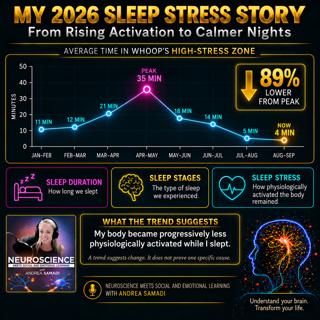
When Sleep Isn't Rest: What 'Sleep Stress' Reveals About Recovery (Bonus Episode)

When Sleep Isn't Rest: What 'Sleep Stress' Reveals About Recovery (Bonus Episode)

In this episode Andrea Samadi explains the concept of sleep stress — a wearable-device measured how physiologically activated your body remains during sleep — and places it within a neuroscience-based...

13 Sep 41min
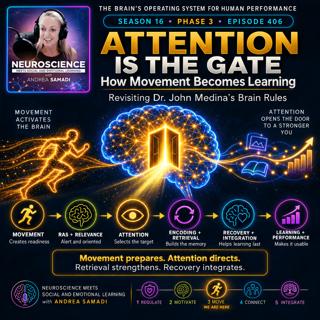
Attention Is the Gate—How Movement Becomes Lasting Learning with Dr. John Medina

Attention Is the Gate—How Movement Becomes Lasting Learning with Dr. John Medina

Episode 406 explains how movement prepares the brain but does not guarantee learning. It traces the full sequence—movement, RAS-driven readiness, salience and relevance, focused attention, encoding, r...

6 Sep 46min
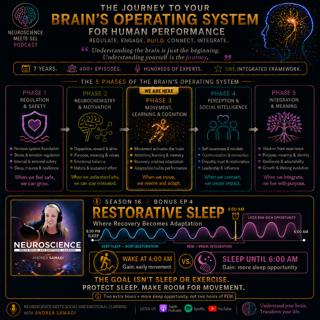
The 4:00 AM Tradeoff: Movement, REM and Recovery (Bonus Episode)

The 4:00 AM Tradeoff: Movement, REM and Recovery (Bonus Episode)

In this episode Andrea Samadi explores how movement and sleep work together in a "brain operating system" for human performance, focusing on restorative sleep (deep + REM), personal WHOOP data, and th...

30 Aug 29min
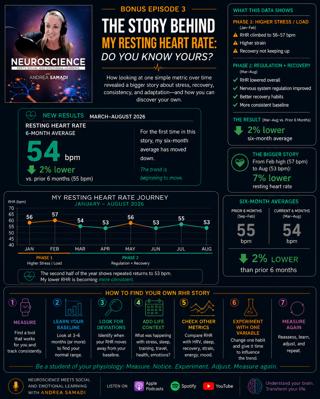
The Hidden Story Behind Your Resting Heart Rate: What Your RHR Can Reveal About Stress, Recovery & Adaptation (Bonus Episode)

The Hidden Story Behind Your Resting Heart Rate: What Your RHR Can Reveal About Stress, Recovery & Adaptation (Bonus Episode)

Andrea Samadi shares her personal resting heart rate data to show why measuring over time matters more than fixating on a single score. She explains how trends reveal stress, recovery, and adaptation,...

23 Aug 30min
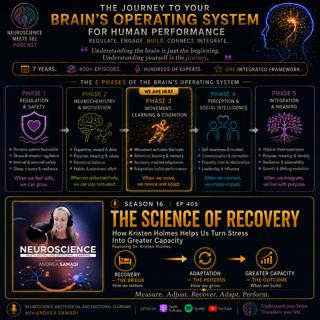
The Science of Recovery—How Dr. Kristen Holmes Helps Us Turn Stress Into Greater Capacity

The Science of Recovery—How Dr. Kristen Holmes Helps Us Turn Stress Into Greater Capacity

In this episode Andrea Samadi explores Phase 3 of the Brain's Operating System—movement, learning, and cognition—focusing on the recovery and adaptation side of the "movement loop." She revisits Dr. K...

16 Aug 45min
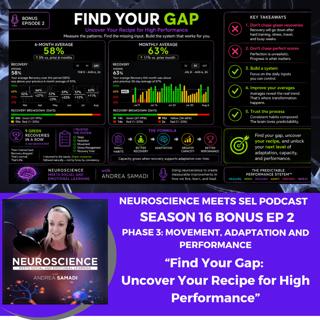
Find Your Gap: How Recovery Unlocks Predictable Performance (Bonus Episode)

Find Your Gap: How Recovery Unlocks Predictable Performance (Bonus Episode)

In this bonus episode Andrea Samadi introduces the Predictable Performance System, a practical roadmap from her Brain’s Operating System. She shows how measuring patterns—not chasing daily scores—plus...

9 Aug 30min
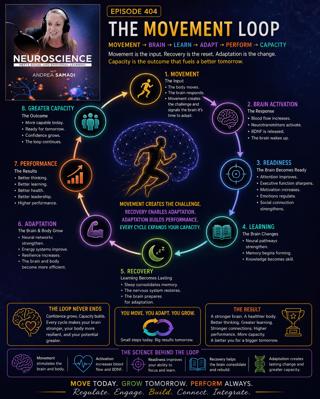
Dr. John Ratey and The Movement Loop: How Movement Becomes Human Performance

Dr. John Ratey and The Movement Loop: How Movement Becomes Human Performance

In this episode Andrea Samadi explores Phase Three of the Brain’s Operating System — how movement acts as the essential input that activates the brain, sharpens attention, boosts learning, and improve...

2 Aug 21min
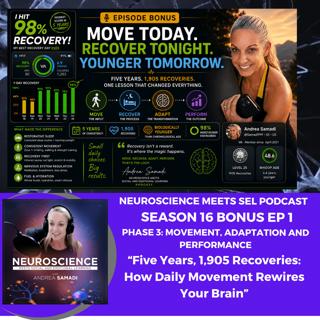
Five Years, 1,905 Recoveries: How Daily Movement Rewires Your Brain (Bonus Episode)

Five Years, 1,905 Recoveries: How Daily Movement Rewires Your Brain (Bonus Episode)

Andrea Samadi shares a five-year self-experiment using a WHOOP wearable to track sleep, recovery, movement, and biological age. She reveals how daily low-intensity movement and consistent recovery—not...

25 Juli 16min
Populärt inom Utbildning

historiepodden-se
rss-bara-en-till-om-beroende-medberoende
det-skaver
nu-blir-det-historia
harrisons-dramatiska-historia
not-fanny-anymore
roda-vita-rosen
rss-viktmedicinpodden
johannes-hansen-podcast
allt-du-velat-veta
rikatillsammans-om-privatekonomi-rikedom-i-livet
sa-in-i-sjalen
rss-foraldramotet-bring-lagercrantz
rss-basta-livet
rss-traningsklubben
rss-max-tant-med-max-villman
sektledare
polisutbildningspodden
rss-autismandan
vi-gar-till-historien