Brain Fact Friday ”Chronic Pain and the Brain: Is it All in Your Head?”

Brain Fact Friday ”Chronic Pain and the Brain: Is it All in Your Head?”

Welcome back to The Neuroscience Meets Social and Emotional Learning Podcast, where we cover the science-based evidence behind social and emotional learning (for schools) and emotional intelligence training (in the workplace) aligning our lives to the most current brain research.

This week's Brain Fact Friday will explore: ✔ How neuroscience is a new field of study--where it began in academics in 1960, and where it is today. ✔ How fMRI scans changed the way we can look at and study the brain. ✔ Where advancements in neuroscience are going (in education and other sectors). ✔ How fMRI scans can help us to learn more about chronic pain and disease.

IMAGE CREDIT: PAGE 51 of National Geographic's June 10, 2022 Issue on The Brain: Discover the Way Your Mind Works.

I’m Andrea Samadi, an author, and educator with a passion for learning specifically on the topics of health, wellbeing and productivity, and launched this podcast to share how important an understanding of our brain is for our everyday life and results--whether we are a teacher or student in the classroom, or in working the modern workplace.

This season, Season 8 of the podcast, and our third year of creating content, I wanted to take a deeper dive into the importance of brain health since this 3 pound organ of remarkable matter that we all have, our brain, literally controls everything for us. We all have a brain, but it still boggles my mind that we were never taught how to use it. We have now entered this “new era of neuroscience”[i] where we are gaining a deeper understanding of what makes us human, and the latest breakthroughs in science that can propel us all forward in ways we never could without the latest discoveries in science. When we think about how new these concepts are, this topic is truly fascinating, and I can understand why there is so much interest in this podcast, along with others of the same theme. Who wouldn’t want to know the latest secrets of the brain, and how they are relevant to our daily life?

This topic is a relatively new field of study, where the first academic departments that focused on studying neuroscience didn’t begin until the 1960s, and then “for the next 40 years, brain science was hyper-focused on establishing the basics like

    What is a neuron? How do brain cells communicate with each other? What are the brain’s functional areas that map onto behaviors?”

(National Geographic, page 5)

This solid foundation does help us to learn about different parts of the brain and uncover their functions, but I’m sure that you are like me, and have more questions that there are answers for when it comes to uncovering the mysteries within our brain.

When fMRI scans came about in the early 2000s, this changed the way we could look at the activity within the brain, and advancements in our understanding took a fast track, going far beyond just what we could see looking at the brain through a microscope.

I’ve mentioned it before on this podcast, that in the early days of studying neuroscience, we went from seeing research that was focused on different parts of the brain (like the amygdala or hypothalamus) to seeing entire networks in the brain as technology advanced. Studies became focused more on the neural pathways, or the interconnected brain, bringing to light that when we take an action, it’s not just one part of the brain we should consider, but the “immense networks of the brain working together, sometimes across blurred borders and multiple functions.” (National Geographic, Page 6, The Interconnected Brain).

It’s taken some time (well, it’s taken over 60 years since those early academics began studying neuroscience) but we are now finally seeing positions in the field of education turn up in certain states where leaders like Dr. Lori Desautels[ii], an Assistant Professor at Butler University, just shared that in her state (Indiana) schools that were just a few years ago beginning to add social and emotional learning department heads, are now looking for those who are trained in the field of educational neuroscience. This topic is broad, and important not only for those in education, but in every sector of the modern workplace.

Which brings us to this week’s Brain Fact Friday, where we are preparing for an upcoming interview (closer to the end of this month now), with Dr. Ashok Gupta[iii], who is a well-known Neuroplasticity "brain retraining" expert who has spent the last 25 years researching the effects of the brain and the mind on illness, when he began researching ways to help himself with chronic fatigue that he was diagnosed with. He was frustrated with his own health and became fascinated in learning more about how his brain was connected to his body (in the late 1990s) when he began looking for answers, no one was talking about the brain/body connection. He says that medicine was focused on what we could measure, but the brain was a black box (without fMRI scans) that no one could peer into.

Like Dr. Gupta, I’m sure we can all relate with an injury we’ve had in the past, where the pain just doesn’t seem to go away. We keep going to the chiropractor, massage therapist or physical therapy, with no avail. Or we’ve gone to the doctor with chronic pain, or when we just don’t feel right, and the doctor does a bunch of blood tests, and says “there’s nothing wrong with you,” so we get a frustrating diagnosis of fibromyalgia, or some other autoimmune disease where doctor visits seem never-ending, and results or healing never occur.

It’s not been until recent discoveries that the brain was even considered with chronic pain or disease, but Dr. Gupta kept looking for answers within the brain, until he found them. We’ll learn more about Dr. Gupta’s discoveries when we speak with him, that has made a serious case for the fact that chronic pain, or illness, is due to the fact that “maybe the brain is creating an artificial environment in the body because its overprotecting the system to ensure its survival.” (Dr. Ashok Gupta).

Which brings us to this week’s Brain Fact Friday. I wanted to take a closer look at how neuroscience is connected to chronic pain. Data from the National Center for Health Statistics showed that in 2019, 20.4% (or 1/5) adults had chronic pain and 7.4% of adults had chronic pain that frequently limited life or work activities (called high impact chronic pain)[iv] lasting more than a 3-month period.

    Do you relate? Have you had an injury and the pain just never seemed to go away? Does this pain bother you while you are working, or impact your sleep? Have you been to the chiropractor, or any other health care provider and it’s helped for a short period of time, but the pain returns?

I surely do relate to this and I’ve wondered for years. What is this pain in my neck? The doctors say there’s nothing structurally there, so off I go to physical therapy and learn to stand up straighter, and work without leaning forward, but the pain is always there and it has been since I slipped and fell on a pool deck in my late 20s. I’m not one of the 7.4% of adults whose life is limited with pain, but it’s been there all those years I was studying in University, or teaching a class, or leading a presentation. I always end the day with some neck exercises and Biofreeze for pain relief.

When a top sports chiropractor, who has worked closely with athletes and sports teams in my state evaluated me years ago, he seemed surprised that for someone who seemed to be doing things the right way, that I couldn’t solve this one thing—this pain in my neck. I definitely started to wonder “is this pain all in my head?” and now, I think there is some truth to this.

For this week’s Brain Fact Friday, DID YOU KNOW THAT “there is no single brain region that generates pain” (National Geographic, Page 58) and that “our pain is in our head…not for some people, but for everyone, 100% of the time?”[v] (Julia Gover, Pain and the Brain TEDx). Dr. Gupta will explain what he has discovered about how the brain creates a vicious loop of inflammation in our body (or you can watch his recent interviews here)[vi] but Julia Gover explains it really well in her TEDx talk on Pain and the Brain[vii].

Julia likens the pain we feel to a fire alarm that senses fire by being sensitive to heat and smoke, not specifically to the fire itself. This is exactly like our body. She explains there are “no pain signals, pain pathways, or pain nerves in your body—it’s the receptors on the end of your nerves that are receptive to pressure, touch, chemicals in the area, or temperature. Our brain takes clues from our mood, from our senses, and memory to see if we’ve been in this situation before. It also takes into account our own personal beliefs about your health and your body.” (Grovers)

We can see now that pain is a subjective experience and I began to learn more when I read that “two people may undergo exactly the same procedure, but they may come up with a very different pain response and also (pain relief) requirements.”[viii]

It goes back to Dr. Gupta’s hypothesis for pain, where he guessed that “maybe the brain is creating an artificial environment in the body because it’s overprotecting the system to ensure its survival.”

The brain takes everything it’s experiencing into consideration and asks—do I need to protect myself? If the brain thinks there’s a threat, it will produce the experience of pain to protect you. (Like the fire alarm sounding when it senses danger with smoke or heat).

To review this week’s Brain Fact Friday—

Did you know that “although brain injury and chronic pain reshape how the brain works” that “the brain itself cannot feel pain?” (National Geographic, The Brain Page 50).

Which means that pain doesn’t exist in our body, it’s created by our brain and projected onto our body. So, if you have a pain in your neck like me, that just doesn’t go away, we do know that our brain and its neural networks are involved. We will dive deeper into this topic next Friday, and hopefully, Dr. Gupta will answer our questions on the best solutions we can use to resolve our chronic pain the following week. Until then, have a wonderful weekend, and hopefully its pain free. See you next week.

FOLLOW ANDREA SAMADI:

YouTube Channel: https://www.youtube.com/c/AndreaSamadi

Website https://www.achieveit360.com/

LinkedIn: https://www.linkedin.com/in/samadi/

Facebook: https://www.facebook.com/Achieveit360com

Neuroscience Meets SEL Facebook Group https://www.facebook.com/groups/2975814899101697

Twitter: https://twitter.com/andreasamadi

Instagram: https://www.instagram.com/andreasamadi/

REFERENCES:

[i] National Geographic, The Brain Discovers the Ways Your Mind Works (page 5) Published June 10, 2022 https://www.amazon.com/National-Geographic-Brain-Editors/dp/1547859121/ref=asc_df_1547859121/?tag=hyprod-20&linkCode=df0&hvadid=598244665656&hvpos=&hvnetw=g&hvrand=16963226721841914892&hvpone=&hvptwo=&hvqmt=&hvdev=c&hvdvcmdl=&hvlocint=&hvlocphy=9030068&hvtargid=pla-1672909059785&psc=1

[ii] Dr. Lori Desautels https://www.facebook.com/revelationsineducation

[iii] https://www.guptaprogram.com/

[iv] https://www.cdc.gov/nchs/products/databriefs/db390.htm

[v] Julia Gover Pain and the Brain TEDx Northwich Published on YouTube August 21, 2019 https://www.youtube.com/watch?v=zR-1M95Kthw

[vi] Sam Visnic Podcast with Ashok Gupta on Retraining Your Brain for Chronic Conditions https://www.youtube.com/watch?v=8z81QhEHYiQ&t=2235s

[vii] Julia Gover Pain and the Brain TEDx Northwich Published on YouTube August 21, 2019 https://www.youtube.com/watch?v=zR-1M95Kthw

[viii] National Geographic, The Brain Discovers the Ways Your Mind Works (page 5) Published June 10, 2022 https://www.amazon.com/National-Geographic-Brain-Editors/dp/1547859121/ref=asc_df_1547859121/?tag=hyprod-20&linkCode=df0&hvadid=598244665656&hvpos=&hvnetw=g&hvrand=16963226721841914892&hvpone=&hvptwo=&hvqmt=&hvdev=c&hvdvcmdl=&hvlocint=&hvlocphy=9030068&hvtargid=pla-1672909059785&psc=1 Page 53

Det här avsnittet är hämtat från ett öppet RSS-flöde och publiceras inte av Podme. Det kan innehålla reklam.

Avsnitt(408)

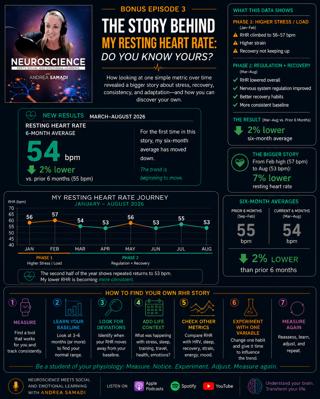
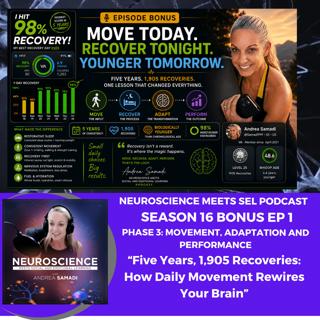
Five Years, 1,905 Recoveries: How Daily Movement Rewires Your Brain (Bonus Episode)

Five Years, 1,905 Recoveries: How Daily Movement Rewires Your Brain (Bonus Episode)

Andrea Samadi shares a five-year self-experiment using a WHOOP wearable to track sleep, recovery, movement, and biological age. She reveals how daily low-intensity movement and consistent recovery—not...

25 Juli 0s

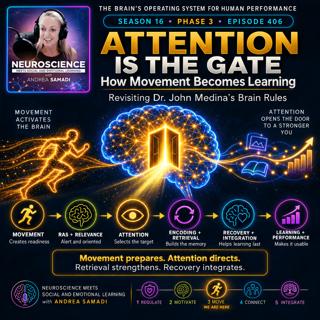
The Movement Loop: How Movement Activates the Brain for Learning, Adaptation & Performance

The Movement Loop: How Movement Activates the Brain for Learning, Adaptation & Performance

Welcome back to Season 16 of the Neuroscience Meets Social and Emotional Learning Podcast. I'm Andrea Samadi, and this is where we bridge neuroscience, social and emotional learning, and human perform...

19 Juli 34min

How Movement Builds the Brain, the Body & Human Performance (Phase 3 Introduction)

How Movement Builds the Brain, the Body & Human Performance (Phase 3 Introduction)

Season 16, Episode 402 explores the Brain's Operating System for Human Performance, focusing on Phase 3: movement, adaptation, and performance. Andrea Samadi explains how movement triggers neurochemic...

12 Juli 25min

Trust as the Foundation with Greg Hill: How Great Leaders Create the Conditions for Learning, Growth and Performance

Trust as the Foundation with Greg Hill: How Great Leaders Create the Conditions for Learning, Growth and Performance

In episode 401 Andrea Samadi welcomes Greg Hill to explore why trust is the essential foundation for learning, growth, and high performance. They discuss how trust creates psychological safety, encour...

27 Juni 37min

Episode 400: Sales Leadership Under Pressure with Majid Samadi: 7 Lessons Learned from 7 Years of Neuroscience

Episode 400: Sales Leadership Under Pressure with Majid Samadi: 7 Lessons Learned from 7 Years of Neuroscience

In this milestone episode (400), Andrea Samadi celebrates seven years of the Neuroscience Meets SEL Podcast with her husband Majid Samadi. They reflect on the journey of translating neuroscience into ...

20 Juni 47min

Phase 2 Review: The Motivation Loop: How to Keep Effort Worthwhile

Phase 2 Review: The Motivation Loop: How to Keep Effort Worthwhile

Episode 399 reviews Phase 2 of Season 15 and introduces the Motivation Loop — the sequence of meaning, belief, attention, action, reward, and recovery that drives sustained effort. The episode explain...

14 Juni 28min

Fun, Fear, Focus: Closing the Motivation Loop with Friederike Fabritius

Fun, Fear, Focus: Closing the Motivation Loop with Friederike Fabritius

Episode 398 revisits neuroscientist Friederike Fabritius (from November 2022) to explain how three ingredients — fun (dopamine), fear (productive challenge), and focus — create the neurochemical condi...

9 Juni 23min

Move to Learn: How Movement Activates the Brain and Fuels Motivation (with Dr. Chuck Hillman and Paul Zientarski)

Move to Learn: How Movement Activates the Brain and Fuels Motivation (with Dr. Chuck Hillman and Paul Zientarski)

Season 15, Episode 397 revisits research and real-world practice showing movement is more than fitness: it activates the brain, boosts attention, enhances learning, and sustains motivation. Dr. Chuck ...

31 Maj 35min

Populärt inom Utbildning

historiepodden-se
det-skaver
rss-bara-en-till-om-missbruk-medberoende-2
harrisons-dramatiska-historia
nu-blir-det-historia
not-fanny-anymore
rss-viktmedicinpodden
allt-du-velat-veta
johannes-hansen-podcast
i-vantan-pa-katastrofen
rikatillsammans-om-privatekonomi-rikedom-i-livet
sex-pa-riktigt-med-marika-smith
rss-max-tant-med-max-villman
rss-basta-livet
sa-in-i-sjalen
rss-traningsklubben
rss-sjalsligt-avkladd
henry-laser-wikipedia
rss-rummet-podcast
sektledare