Brain Fact Friday ”Using Neuroscience to Change Our Perception”

Brain Fact Friday ”Using Neuroscience to Change Our Perception”

“If we have very strong beliefs about something, evidence to the contrary could be sitting right in front of us, but we may not see it because what we perceive is entirely different.” (Dr. Joe Dispenza, speaker, researcher and author who is passionate about the fields of neuroscience, epigenetics, and quantum physics, pushing the limits of possibility).

On this episode we will cover:

✔ How to change our perceptions, or what we believe, using the most current brain research.

✔ That we each have a pattern of connectivity in our brain as unique as our fingerprint.

✔ How each person, with a unique brain, learns and behaves differently, based on how it's wired.

✔ 2 Strategies to improve health, well-being, productivity and resiliency, by measuring your personal fitness metrics.

✔The importance of accepting other people's differences.

Welcome back to The Neuroscience Meets Social and Emotional Learning Podcast. I’m Andrea Samadi, and launched this podcast just over 3 years ago, with a vision to bridge the gap between theory and practice, with strategies, tools and ideas we can all use immediately to take what we know (our current knowledge) and apply what we know to the most current brain research for new results, and heightened productivity in our schools, sports environments and modern workplaces. Like Dr. Dispenza, I believe in pushing the limits of what’s possible, and hope this podcast helps those who tune in, to do the same.

As I’m writing this episode, it’s September 1st and I can’t believe how fast time flies. If we think back to the start of this year[i], we looked at how to make 2022 our best year ever, with what will we change, or do differently this year, to attain NEW results and I wonder, have YOU “thought in a wildly different way than you previously have been to get to the next level of what YOU are doing?” (Grant Cardone). If the answer is YES, then congratulations, you’re well on your way to new conditions and circumstances in 2023, but if the answer is “not yet” then let’s see what else we can do, together, using neuroscience to challenge our perceptions and change our old habits and behaviors, for new results, with our health in mind.

Changing our Perceptions, of What We Believe:

For this week’s Brain Fact Friday, and EPISODE #244, I wanted to look at how exactly we create behavior change, using science to challenge our old beliefs. How can we change our perception or what we believe? To do this, we will go deeper into EP #239, where we looked at “Building a Stronger 2.0 Version of Ourselves”[ii] where we picked something that we wanted to change, with the bigger picture of what this change would mean, using our motivation based on our values, holding our focus on what we wanted to change, with a 90-day plan to make this change stick.

But, what if we see the evidence, (we know that whatever it is we want to change is bad for us), we really want the change, but there’s nothing compelling enough for us to make this change, like Dr. Dispenza’s quote said.

“If we have very strong beliefs about something, evidence to the contrary could be sitting right in front of us, but we may not see it because what we perceive is entirely different.” (Dispenza)

Our beliefs (old habits and behaviors) will override the desired behavior change. Which leads me to this week’s Brain Fact Friday.

DID YOU KNOW THAT:

“Your brain has a pattern of connectivity as unique as your fingerprint?”[iii]

This episode is not about swaying you to believe what I believe, but to have you challenge your own beliefs, knowing my brain is different from your brain, and see if you can look at something from a different point of view, while I’m doing the same.

Just like Dr. Ginger Campbell told us on our last EPISODE #243, as the host of the longest running podcast on Neuroscience, she acknowledges that what she’s learned over the years is that everyone will have their own beliefs and perceptions about things, and since our brains are all wired differently, we must learn to be more accepting of other people’s beliefs, and the more we can accept each other for our differences, the better place our world will be. Accept that we are all different.

Even tuning into Brendon Burchard’s[iv] most recent podcast episode, he mentioned that there are secrets to helping people “achieve their goals, and get healthier” and that with all the years he has been working in the area of high performance, with world class athletes, high level executives, he’s discovered four things that needs to achieve their goals (health and happiness) and one them is to acknowledge that although we all might have different beliefs, that we are in fact, very similar, and that judging someone else for being “different” than us, is what creates the divisiveness we see in the world today. Progress can be made for all of us when we can embrace our unity, despite our differences.

With this model in place, on our recent interview with physician and neurologist Dr. Douyon[v], I asked him “when science reveals that something is bad for us, and even a carcinogen, what needs to happen to STOP society from consuming it?” (without judging people for their choices) and the answer to behavior change is going to be different for everyone, since our brains are all wired differently. What worked for me, might not work for you, but I think that when you can see the impacts of the behavior change on your own health, that this in itself is enough to drive someone towards lasting change and transformation.

Once you see an area of your health that you would like to change, Dr. Douyon mentioned to begin slowly, and see if you can “wean” yourself off of whatever it is you are doing. We were talking about a patient of his who he took soda away from, to stop her from having seizures, and the change didn’t last for her, because he felt like some people just can’t stop using the “cold turkey” method.

We are all wired differently, and without being judgmental, we all need to find our own way towards making our behavior change stick.

Using Data to Inform Our Health

Once you either cut out the food, the drink, the substance or the behavior that you know isn’t good for your body or your health, try measuring your biomarkers to see the impact of this decision on your health and body. There are many devices you can use to measure your results. I use the Whoop[vi] wearable device, (since I did interview their team) but you can also use the Oura Ring[vii] or even your Apple Watch.

After listening to Dr. Huberman’s podcast, I cut out alcohol immediately, without a thought, and then watched in amazement at the results of this “science-based” decision. In the past, I have cut this toxin out for 30, 60 and 90 days, but never payed attention to the physiological response that this had on my body.

This is what I saw after 2 weeks of eliminating alcohol from my diet August:

    My HRV (heart rate variability) increased by 11%.

WHAT THIS MEANS: We reviewed HRV on EP #228[viii] What is HRV: The Most Important Biomarker for Tracking Health, Recovery and Resilience which means that this decision gave me 11% more capacity to perform. It gave me more resources to use towards my daily activities, helping me to be more resilient to daily stress.

    My RHR (resting heart rate) decreased from 54 bpm to 51 bpm.

WHAT THIS MEANS: Resting Heart Rate (RHR) is a measure of your average heart beats per minute (bpm) while your body is at a state of complete rest[ix] and “a low RHR is an indication of a strong heart muscle that can pump out greater amounts of blood with every beat, so it doesn’t have to do it as frequently.” (Whoop) and “physical fitness is directly correlated to the strength of your heart.” (Whoop).

This data helped me to see that in a very short period of time I’ve found ways to become more resilient to daily stress, and have increased my physical fitness, which are in line with my values of improving my health, so this habit is going to stick for me.

Review and Conclusion: Using Neuroscience to Change Our Perception and Build a Stronger 2.0 Version of Ourselves

But I’m not sure what it will take for you to change your behavior, when looking to create that NEW and improved 2.0 version of YOU, since our “brains are all as unique as our fingerprint” and what works for me, might not work for you, but I do know that when most of us are presented with sound information, or the most current research, and we are able to explain this research to others, that this is the beginning how our brains rewire for the better.

Sergei’s Story: Shocked into Behavior Change with the Fear of Death

To close out this episode, I wanted to share a story of how one person I know made their behavior stick, an entirely different way. I thought about this one guy I met on the hiking trials, who changed his behavior, because his life depended on it. Since I’m on the trails every day, you get to see the same faces over and over again and you get to know people this way, even if you don’t stop to have a conversation with them.

One day I noticed a new face showing up on the trails, and he was a bit out of shape, but clearly working daily to change it. There were times I’m sure I saw tears in his eyes as we passed each other but it was months before we spoke, and exchanged names. You can tell when someone is working something out during exercise and focused, so we just usually waved until one day, we stopped to speak.

His name was Sergei, and he was a mathematics professor at ASU and he told me that his doctor told him if he didn’t lose weight, he was going to die. Plain and simple, Sergei was scared into making a change in his health, and in a few months, he took off over 40 lbs. and completely turned his health around. I remembered later when he reminded me of his story that it made sense that he was crying in the first few weeks. Behavior change can be extremely difficult, that’s for sure, but Sergei stuck to his change, because his results were easy to measure. He quickly went off all the medicine he was on, and his new behavior stuck.

If we can measure the impacts of our change like Sergei, or like I was able to see with an increased HRV and lower RHR after just a few weeks, we can see and feel the physiological changes with the decisions we’ve made have on our health and wellbeing, then this is the first step towards lasting transformation, and permanent change, building a stronger 2.0 version of ourselves.

Recognizing Neurodiversity:

But not every strategy fits all. To get a bigger picture of the differences within our brain, a quick glance at the Neurodiversity image in the show notes can help us to see that “there is no right way of thinking, learning or behaving”[x] but I do hope that we all look for ways that we can each take our results to new heights, using the most current research, and decide for yourself what behaviors or habits you want to stick, or kick to the curb, and then get to work, and see if you can match your behavior, with your intention, to create your new 2.0he identity.

I’ll see you next week!

FOLLOW ANDREA SAMADI:

YouTube Channel: https://www.youtube.com/c/AndreaSamadi

Website https://www.achieveit360.com/

LinkedIn: https://www.linkedin.com/in/samadi/

Facebook: https://www.facebook.com/Achieveit360com

Neuroscience Meets SEL Facebook Group https://www.facebook.com/groups/2975814899101697

Twitter: https://twitter.com/andreasamadi

Instagram: https://www.instagram.com/andreasamadi/

REFERENCES:

[i]Neuroscience Meets Social and Emotional Learning Podcast EPISODE #190 “How to Make 2022 Your Best Year Ever” https://andreasamadi.podbean.com/e/think-and-grow-rich-book-review-part-2-how-to-make-2022-your-best-year-ever-by-thinking-differently-and-choosing-faith-over-fear/

[ii] Neuroscience Meets Social and Emotional Learning Podcast EPISODE #239 “using Neuroscience to Build a Stronger 2.0 Version of You”

https://andreasamadi.podbean.com/e/brain-fact-friday-using-neuroscience-to-build-a-stronger-20-version-of-you/

[iii] Deane Alban 72 Amazing Brain Facts https://sdbif.org/index/72-amazing-human-brain-facts-based-on-the-latest-science/

[iv] Brendon Burchard “4 Parts to a Meaningful Life” https://itunes.apple.com/us/podcast/charged-life-brendon-burchard/id821746377

[v]Neuroscience Meets Social and Emotional Learning Podcast EPISODE #241 with “Physician and Neurologist Dr. Philippe Douyon on How to Rewire Our Brain for Health and Happiness: https://andreasamadi.podbean.com/e/physician-and-neurologist-philippe-douyon-md-on-how-to-rewire-our-brain-for-health-and-happiness/

[vi] www.whoop.com

[vii] www.ouraring.com

[viii] Neuroscience Meets Social and Emotional Learning Podcast EPISODE #228 on “Review of Heart Rate Variability: The Most Important Biomarker for Tracking Health, Recovery and Resilience” https://andreasamadi.podbean.com/e/brain-fact-friday-review-of-heart-rate-variability-the-most-important-biomarker-for-tracking-health-recovery-and-resilience/

[ix] Resting Heart Rate: What’s Normal, Why it’s a Sign of Fitness, How to Improve it Published May 7, 2020 by Whoop https://www.whoop.com/thelocker/normal-resting-heart-rate-improve-fitness/

[x] What is Neurodiversity Published Nov. 21, 2021 by Nicole Baumer https://www.health.harvard.edu/blog/what-is-neurodiversity-202111232645

Det här avsnittet är hämtat från ett öppet RSS-flöde och publiceras inte av Podme. Det kan innehålla reklam.

Avsnitt(408)

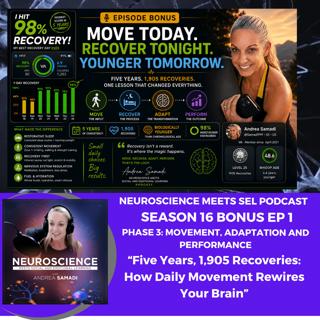
Five Years, 1,905 Recoveries: How Daily Movement Rewires Your Brain (Bonus Episode)

Five Years, 1,905 Recoveries: How Daily Movement Rewires Your Brain (Bonus Episode)

Andrea Samadi shares a five-year self-experiment using a WHOOP wearable to track sleep, recovery, movement, and biological age. She reveals how daily low-intensity movement and consistent recovery—not...

25 Juli 0s

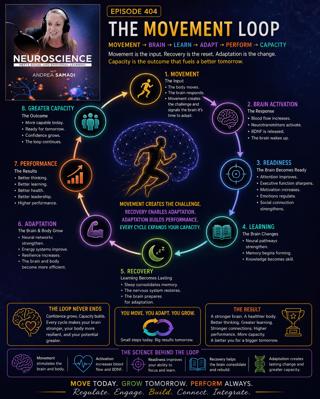
The Movement Loop: How Movement Activates the Brain for Learning, Adaptation & Performance

The Movement Loop: How Movement Activates the Brain for Learning, Adaptation & Performance

Welcome back to Season 16 of the Neuroscience Meets Social and Emotional Learning Podcast. I'm Andrea Samadi, and this is where we bridge neuroscience, social and emotional learning, and human perform...

19 Juli 34min

How Movement Builds the Brain, the Body & Human Performance (Phase 3 Introduction)

How Movement Builds the Brain, the Body & Human Performance (Phase 3 Introduction)

Season 16, Episode 402 explores the Brain's Operating System for Human Performance, focusing on Phase 3: movement, adaptation, and performance. Andrea Samadi explains how movement triggers neurochemic...

12 Juli 25min

Trust as the Foundation with Greg Hill: How Great Leaders Create the Conditions for Learning, Growth and Performance

Trust as the Foundation with Greg Hill: How Great Leaders Create the Conditions for Learning, Growth and Performance

In episode 401 Andrea Samadi welcomes Greg Hill to explore why trust is the essential foundation for learning, growth, and high performance. They discuss how trust creates psychological safety, encour...

27 Juni 37min

Episode 400: Sales Leadership Under Pressure with Majid Samadi: 7 Lessons Learned from 7 Years of Neuroscience

Episode 400: Sales Leadership Under Pressure with Majid Samadi: 7 Lessons Learned from 7 Years of Neuroscience

In this milestone episode (400), Andrea Samadi celebrates seven years of the Neuroscience Meets SEL Podcast with her husband Majid Samadi. They reflect on the journey of translating neuroscience into ...

20 Juni 47min

Phase 2 Review: The Motivation Loop: How to Keep Effort Worthwhile

Phase 2 Review: The Motivation Loop: How to Keep Effort Worthwhile

Episode 399 reviews Phase 2 of Season 15 and introduces the Motivation Loop — the sequence of meaning, belief, attention, action, reward, and recovery that drives sustained effort. The episode explain...

14 Juni 28min

Fun, Fear, Focus: Closing the Motivation Loop with Friederike Fabritius

Fun, Fear, Focus: Closing the Motivation Loop with Friederike Fabritius

Episode 398 revisits neuroscientist Friederike Fabritius (from November 2022) to explain how three ingredients — fun (dopamine), fear (productive challenge), and focus — create the neurochemical condi...

9 Juni 23min

Move to Learn: How Movement Activates the Brain and Fuels Motivation (with Dr. Chuck Hillman and Paul Zientarski)

Move to Learn: How Movement Activates the Brain and Fuels Motivation (with Dr. Chuck Hillman and Paul Zientarski)

Season 15, Episode 397 revisits research and real-world practice showing movement is more than fitness: it activates the brain, boosts attention, enhances learning, and sustains motivation. Dr. Chuck ...

31 Maj 35min

Populärt inom Utbildning

historiepodden-se
det-skaver
rss-bara-en-till-om-missbruk-medberoende-2
harrisons-dramatiska-historia
nu-blir-det-historia
not-fanny-anymore
rss-viktmedicinpodden
allt-du-velat-veta
johannes-hansen-podcast
i-vantan-pa-katastrofen
rikatillsammans-om-privatekonomi-rikedom-i-livet
sex-pa-riktigt-med-marika-smith
rss-max-tant-med-max-villman
rss-basta-livet
sa-in-i-sjalen
rss-traningsklubben
rss-sjalsligt-avkladd
henry-laser-wikipedia
rss-rummet-podcast
sektledare