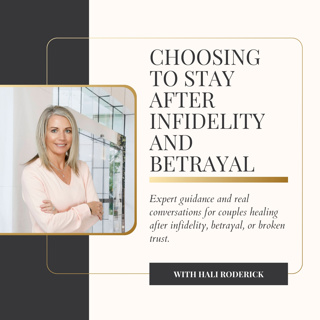
#111 Love Bombing: How to Recognize It, Protect Yourself, and Break the Cycle

#111 Love Bombing: How to Recognize It, Protect Yourself, and Break the Cycle

💔 Episode Summary:This episode will help you understand what love bombing really is, how it shows up in relationships after betrayal, and why it can be a form of manipulation or emotional abuse.

✅ What love bombing is and what it isn't

✅ How to distinguish between genuine connection and manipulative intensity

✅ The red flags that indicate love bombing is occurring

✅ How it plays out in the betrayal and recovery cycle

✅ Why it feels so good—and why it can be so dangerous

✅ How to set healthy boundaries to protect your heart and clarity

✅ What to do if you are the one using love bombing as a coping or control strategy

✅ How to move toward authentic connection, not performance-based intimacy

🛑 If you've ever felt swept off your feet only to crash into confusion, guilt, or emotional chaos—this episode is for you.

🎯 Key Insight: Love bombing may look like love, but it's often about control, fear, or image management. Real love builds over time. It respects boundaries. It honors truth.

🛠️ Tools You'll Walk Away With:

  • Language to name love bombing when it happens

  • Reflective prompts for identifying if you're using love bombing behaviors

  • Supportive practices for reconnecting with your core needs and self-worth

Thank you for tuning in!

We’re here to support couples healing from infidelity and betrayal, offering encouragement. As certified relational recovery coaches, we are passionate about guiding you toward hope, empathy, and lasting healing.

Stay connected with us and access all the resources we offer—coaching sessions, groups, and more—by visiting this link.

Your Hosts:

Hali RoderickCertified Relational Recovery CoachTICC, ACC, APSATS CPC, ERCEM-C, Brainspotting Practitioner

Read Hali’s Bio

Stephanie HambyCertified Relational Recovery CoachMCLC, ACC, APSATS CPC, ERCEM-CRead Stephanie’s Bio

We look forward to journeying with you!

5.28

  • Common examples:

    • Constant compliments, grand gestures, lavish gifts, excessive apologies or promises.

    • Overwhelming reassurances like: “I’ll do anything to make this right” or “You’re the only thing that matters.”

  • The betrayer may use it to:

    • Avoid consequences or hard conversations.

    • Fast-track trust or reconciliation.

    • Manage their own guilt or shame.

    • Reassert control or secure their image.

  • The betrayed partner may crave it because:

    • It momentarily soothes trauma or anxiety.

    • It mimics the "high" of emotional connection.

    • It delays facing the pain or deeper work of healing.

  • You feel confused: “This feels good, but something’s off.”

  • You may feel pressured to respond with gratitude, forgiveness, or emotional closeness.

  • The affection may disappear as soon as conflict, boundaries, or accountability show up.

  • It bypasses consent and authentic healing.

  • It creates a trauma bond—confusion, hope, and fear wrapped together.

  • It can invalidate your real pain: “See? I’m being loving now. Isn’t that enough?”

  • It's often a protector part acting from fear—not a sign of true intimacy or growth.

  • Name it: “This feels overwhelming. I need more time and space to process.”

  • Ask: “Is this about me—or are you trying to make you feel better?”

  • Use grounding tools to reconnect with your nervous system.

  • Set limits: “I’m not ready for gifts or physical affection yet. I need actions over time.”

  • Get curious, not shameful: “What part of me is afraid or trying to control the outcome?”

  • Ask yourself:

    • “Am I trying to fix or rescue instead of take responsibility?”

    • “Am I making this about my pain instead of the harm I caused?”

  • Shift to authentic repair:

    • Slow down.

    • Take consistent, humble action.

    • Learn to sit with discomfort instead of performing love.

  • Love is steady, respectful, and attuned. It includes:

    • Consent.

    • Accountability.

    • Honesty.

  • Healthy connection honors the other person’s boundaries, feelings, and timing—not just your desire to reconnect.

  • Love bombing is a trauma response—on both sides.

  • It’s a signal, not a sentence. Use it as a doorway to deeper work.

  • Healing happens when we choose truth over intensity, and intimacy

Det här avsnittet är hämtat från ett öppet RSS-flöde och publiceras inte av Podme. Det kan innehålla reklam.

Avsnitt(188)

#177 One Hour a Week Was Never Going to Be Enough

#177 One Hour a Week Was Never Going to Be Enough

If you're a woman and you’re doing the work — therapy, coaching, reading everything you can get your hands on — and you're still white-knuckling it alone most days of the week, this episode is for you...

17 Sep 11min

#176 The Fight Under the Fight — Decoding What Betrayal Trauma Does to Your Everyday Arguments

#176 The Fight Under the Fight — Decoding What Betrayal Trauma Does to Your Everyday Arguments

If you're rebuilding trust after infidelity, you've probably noticed something strange: small disagreements can escalate way faster and way bigger than the topic seems to deserve. A dish in the sink. ...

10 Sep 14min

#175 The Separation Plan Guide: Navigating Time Apart After Betrayal Trauma with Shawna Meek, PCC, CPC-S

#175 The Separation Plan Guide: Navigating Time Apart After Betrayal Trauma with Shawna Meek, PCC, CPC-S

"Separation" doesn't have to mean divorce. In this episode, I'm joined by Shawna Meek of Living Stones Coaching to talk about the therapeutic separation — a structured, intentional time apart designed...

3 Sep 43min

***BONUS Choosing Different Mini Series: What I Wish I'd Done Differently with my daughters, Mataia and Morgan

***BONUS Choosing Different Mini Series: What I Wish I'd Done Differently with my daughters, Mataia and Morgan

In this episode of the Choosing Different mini-series, Hali is joined by her daughters, Mataia and Morgan, for an honest conversation about betrayal trauma's impact on the whole family — not just the ...

29 Aug 29min

#174 It's Not Too Late: Healing an Affair You Thought Was Behind You

#174 It's Not Too Late: Healing an Affair You Thought Was Behind You

If the betrayal in your relationship happened years ago — and life moved forward, but the deepest layers of healing never actually happened — this episode is for you.Maybe the resources weren't availa...

27 Aug 14min

#173 Betrayed Men: Why Their Trauma Looks Different — and What Actually Helps with Dr. Laney Knowlton

#173 Betrayed Men: Why Their Trauma Looks Different — and What Actually Helps with Dr. Laney Knowlton

When we talk about betrayal trauma, the picture most people carry is of a betrayed woman. But men experience betrayal too — and their pain often goes unseen, misread as anger, or dismissed entirely. I...

20 Aug 44min

#172 Why the Right Words Aren't Enough: Embodied Empathy in Betrayal Recovery

#172 Why the Right Words Aren't Enough: Embodied Empathy in Betrayal Recovery

You can say all the right words and still leave your partner feeling completely unsafe.If you're the partner who caused harm, that may be the most frustrating thing you've encountered in recovery — yo...

13 Aug 27min

*** BONUS Choosing Different Mini Series: Three Words Every Parent Owes Their Child: "I Believe You" 

*** BONUS Choosing Different Mini Series: Three Words Every Parent Owes Their Child: "I Believe You" 

What happens when a child no longer has to convince their parent that their pain was real?In this episode of Choosing Different Mini Series, Hali sits down with her daughter, Morgan Ellsworth, for a s...

8 Aug 20min

Populärt inom Samhälle & Kultur

podme-dokumentar
gynning-berg
p3-dokumentar
aftonbladet-krim
svenska-fall
en-mork-historia
blenda-2
creepypodden-med-jack-werner
killradet
hor-har
flashback-forever
rss-vill-du-veta-en-hemlis-2
aftonbladet-daily
kod-katastrof
rss-vi-var-har-forst
rss-vad-fan-hande
rss-schyffert-sundin-ar-det-har-nat
mardromsgasten
rss-sanning-konsekvens
rss-nemo-moter-en-van