
#219 – Toby Ord on graphs AI companies would prefer you didn't (fully) understand

#219 – Toby Ord on graphs AI companies would prefer you didn't (fully) understand

The era of making AI smarter just by making it bigger is ending. But that doesn’t mean progress is slowing down — far from it. AI models continue to get much more powerful, just using very different methods, and those underlying technical changes force a big rethink of what coming years will look like.

Toby Ord — Oxford philosopher and bestselling author of The Precipice — has been tracking these shifts and mapping out the implications both for governments and our lives.

Links to learn more, video, highlights, and full transcript: https://80k.info/to25

As he explains, until recently anyone can access the best AI in the world “for less than the price of a can of Coke.” But unfortunately, that’s over.

What changed? AI companies first made models smarter by throwing a million times as much computing power at them during training, to make them better at predicting the next word. But with high quality data drying up, that approach petered out in 2024.

So they pivoted to something radically different: instead of training smarter models, they’re giving existing models dramatically more time to think — leading to the rise in “reasoning models” that are at the frontier today.

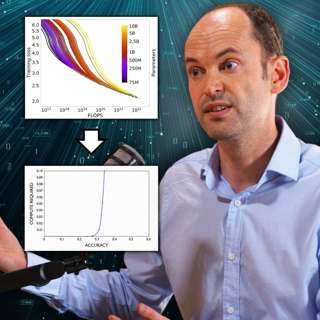
The results are impressive but this extra computing time comes at a cost: OpenAI’s o3 reasoning model achieved stunning results on a famous AI test by writing an Encyclopedia Britannica’s worth of reasoning to solve individual problems at a cost of over $1,000 per question.

This isn’t just technical trivia: if this improvement method sticks, it will change much about how the AI revolution plays out, starting with the fact that we can expect the rich and powerful to get access to the best AI models well before the rest of us.

Toby and host Rob discuss the implications of all that, plus the return of reinforcement learning (and resulting increase in deception), and Toby's commitment to clarifying the misleading graphs coming out of AI companies — to separate the snake oil and fads from the reality of what's likely a "transformative moment in human history."

Recorded on May 23, 2025.

Chapters:

  • Cold open (00:00:00)
  • Toby Ord is back — for a 4th time! (00:01:20)
  • Everything has changed (and changed again) since 2020 (00:01:37)
  • Is x-risk up or down? (00:07:47)
  • The new scaling era: compute at inference (00:09:12)
  • Inference scaling means less concentration (00:31:21)
  • Will rich people get access to AGI first? Will the rest of us even know? (00:35:11)
  • The new regime makes 'compute governance' harder (00:41:08)
  • How 'IDA' might let AI blast past human level — or not (00:50:14)
  • Reinforcement learning brings back 'reward hacking' agents (01:04:56)
  • Will we get warning shots? Will they even help? (01:14:41)
  • The scaling paradox (01:22:09)
  • Misleading charts from AI companies (01:30:55)
  • Policy debates should dream much bigger (01:43:04)
  • Scientific moratoriums have worked before (01:56:04)
  • Might AI 'go rogue' early on? (02:13:16)
  • Lamps are regulated much more than AI (02:20:55)
  • Companies made a strategic error shooting down SB 1047 (02:29:57)
  • Companies should build in emergency brakes for their AI (02:35:49)
  • Toby's bottom lines (02:44:32)


Tell us what you thought! https://forms.gle/enUSk8HXiCrqSA9J8

Video editing: Simon Monsour
Audio engineering: Ben Cordell, Milo McGuire, Simon Monsour, and Dominic Armstrong
Music: Ben Cordell
Camera operator: Jeremy Chevillotte
Transcriptions and web: Katy Moore

Avsnitt(321)

#198 – Meghan Barrett on upending everything you thought you knew about bugs in 3 hours

#198 – Meghan Barrett on upending everything you thought you knew about bugs in 3 hours

"This is a group of animals I think people are particularly unfamiliar with. They are especially poorly covered in our science curriculum; they are especially poorly understood, because people don’t s...

26 Aug 20243h 48min

#197 – Nick Joseph on whether Anthropic's AI safety policy is up to the task

#197 – Nick Joseph on whether Anthropic's AI safety policy is up to the task

The three biggest AI companies — Anthropic, OpenAI, and DeepMind — have now all released policies designed to make their AI models less likely to go rogue or cause catastrophic damage as they approach...

22 Aug 20242h 29min

#196 – Jonathan Birch on the edge cases of sentience and why they matter

#196 – Jonathan Birch on the edge cases of sentience and why they matter

"In the 1980s, it was still apparently common to perform surgery on newborn babies without anaesthetic on both sides of the Atlantic. This led to appalling cases, and to public outcry, and to campaign...

15 Aug 20242h 1min

#195 – Sella Nevo on who's trying to steal frontier AI models, and what they could do with them

#195 – Sella Nevo on who's trying to steal frontier AI models, and what they could do with them

"Computational systems have literally millions of physical and conceptual components, and around 98% of them are embedded into your infrastructure without you ever having heard of them. And an inordin...

1 Aug 20242h 8min

#194 – Vitalik Buterin on defensive acceleration and how to regulate AI when you fear government

#194 – Vitalik Buterin on defensive acceleration and how to regulate AI when you fear government

"If you’re a power that is an island and that goes by sea, then you’re more likely to do things like valuing freedom, being democratic, being pro-foreigner, being open-minded, being interested in trad...

26 Juli 20243h 4min

#193 – Sihao Huang on navigating the geopolitics of US–China AI competition

#193 – Sihao Huang on navigating the geopolitics of US–China AI competition

"You don’t necessarily need world-leading compute to create highly risky AI systems. The biggest biological design tools right now, like AlphaFold’s, are orders of magnitude smaller in terms of comput...

18 Juli 20242h 23min

#192 – Annie Jacobsen on what would happen if North Korea launched a nuclear weapon at the US

#192 – Annie Jacobsen on what would happen if North Korea launched a nuclear weapon at the US

"Ring one: total annihilation; no cellular life remains. Ring two, another three-mile diameter out: everything is ablaze. Ring three, another three or five miles out on every side: third-degree burns ...

12 Juli 20241h 54min

#191 (Part 2) – Carl Shulman on government and society after AGI

#191 (Part 2) – Carl Shulman on government and society after AGI

This is the second part of our marathon interview with Carl Shulman. The first episode is on the economy and national security after AGI. You can listen to them in either order!If we develop artificia...

5 Juli 20242h 20min

Populärt inom Utbildning

historiepodden-se
rss-bara-en-till-om-missbruk-medberoende-2
det-skaver
nu-blir-det-historia
harrisons-dramatiska-historia
rss-viktmedicinpodden
johannes-hansen-podcast
sektledare
not-fanny-anymore
roda-vita-rosen
rss-sjalsligt-avkladd
i-vantan-pa-katastrofen
allt-du-velat-veta
sa-in-i-sjalen
rss-beratta-alltid-det-har
alska-oss
rss-max-tant-med-max-villman
rikatillsammans-om-privatekonomi-rikedom-i-livet
sektpodden
dumforklarat