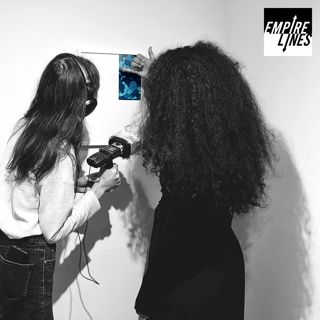
Kern, Amba Sayal-Bennett (2024) (EMPIRE LINES Live at SEEDLINGS, Somerset House Studios)
EMPIRE LINES26 Juni 2025

Kern, Amba Sayal-Bennett (2024) (EMPIRE LINES Live at SEEDLINGS, Somerset House Studios)

In this special episode, contemporary artist Amba Sayal-Bennett joins EMPIRE LINES live, to trace the migrations of rubber seeds between South America, London, and British colonies in South Asia in the 19th century, plus the role of soil in anticolonial resistance, through their digital drawing and sculpture, Kern (2024).

Rubber is a commodity that was once so highly demanded that its value surpassed that of silver. In a mission facilitated by the British government, Henry Wickham stole and trafficked 70,000 rubber seeds from the Amazon rainforest in Brazil in 1876. Transported to Kew Gardens in London, they were then dispersed across Britain’s colonies for cultivation. Its plural uses and potential for profit led to its proliferation across the globe - yet the soil in India, then known as the British Raj, refused to take the seeds, which the artist puts forward as a form of environmental resistance to the colonial project.

Amba Sayal-Bennett’s wall-based sculptures Kern (2024) and Phlo (2024) are part of their investigations into the migrations of forms, bodies, and knowledge across different sites. Presented in SEEDLINGS: Diasporic Imaginaries, currently touring Scotland with Travelling Gallery, we discuss this visual research into how colonial practices often decontextualise and appropriate forms. Amba delves botanical and anatomical drawings, and how these illustrations have been used to commodify and control plants, environments, and people. We consider through the construction and overlapping uses of terms like ‘native’ and, ‘invasive’, ‘indigenous’, ‘naturalisation’, and ‘dispersal’, to challenge binaries between human and more-than-human beings, and consider ideas of home, identity, and belonging in the context of diasporas. Amba details her relationship with ornamentation, abstraction, and displacement, and how she translates her digital drawings into sculptural forms, rendered with biodegradable, but ‘unnatural’, industrial plastics. Drawing on her site-specific works for Geometries of Difference (2022) at Somerset House, and Drawing Room Invites... in London, we also delve into Amba’s critical engagement with sci-fi and modernist architecture, travelling to Le Corbusier’s purpose-built city of Chandigarh in Punjab, the birthplace of her maternal grandparents, to explore tropical modernism.

This episode was recorded live at Somerset House Studios in London, as part of the public programme for SEEDLINGS: Diasporic Imaginaries, curated by Jelena Sofronijevic with Travelling Gallery in Scotland. The group exhibition, featuring Emii Alrai, Iman Datoo, Radovan Kraguly, Zeljko Kujundzic, Remi Jabłecki, Leo Robinson, and Amba Sayal-Bennett, is touring across Scotland, culminating at Edinburgh Art Festival (EAF) in August 2025.

For more information, follow Travelling Gallery and EMPIRE LINES on social media, and visit: linktr.ee/SEEDLINGSTG2025


Drawing Room Invites…: Anna Paterson, Alicia Reyes McNamara, Amba Sayal-Bennett is at the Drawing Room in London until 27 July 2025.


For more about Between Hands and Metal (2024), a group exhibition featuring Amba Sayal-Bennett, Alia Hamaoui, and Raheel Khan at Palmer Gallery in London, read my article in gowithYamo:. gowithyamo.com/blog/palmer-gallery-marylebone


For more science fiction and sci-fi films, hear Tanoa Sasraku on her series of Terratypes (2022-Now) at the Royal Albert Memorial Museum (RAMM) in Exeter: pod.link/1533637675/episode/3083096d6354376421721cfbb49d0ba7


For more from Invasion Ecology (2024), co-curated by Jelena Sofronijevic for Radical Ecology, and Vashti Cassinelli at Southcombe Barn, an arts space and gardens on Dartmoor, visit: ⁠⁠⁠⁠radicalecology.earth/events/invasion-ecology-exhibition⁠⁠⁠⁠ and instagram.com/p/C7lYcigovSN


PRODUCER: Jelena Sofronijevic.


Follow EMPIRE LINES on Instagram: ⁠⁠⁠instagram.com/empirelinespodcast⁠⁠⁠

Support EMPIRE LINES on Patreon: ⁠⁠⁠patreon.com/empirelines

Avsnitt(158)

Story, Place, Tony Albert (2023) (EMPIRE LINES x Sullivan+Strumph, Frieze London)

Story, Place, Tony Albert (2023) (EMPIRE LINES x Sullivan+Strumph, Frieze London)

Artist and curator Tony Albert collects Aboriginalia, colonial kitsch still found in Australia’s second-hand and souvenir shops, to reconstruct historic racial stereotypes and reclaim contemporary Indigenous experiences. From ‘Picanniny Floor Polish’ to ‘Bally Boomerang Pinball Machines’, Sydney-based artist and collector Tony Albert has long been fascinated by Australiana, tourist objects which attempt to define, and commodify, Aboriginal and Torres Strati Islander peoples. Transforming them into grand sculptural installations, his works are political interventions with these vintage objects, and reappropriations of their use and meaning - which refuse to shy away from the shameful status they now hold. One such installation lends its name to Story, Place, a group exhibition in London, which brings together contemporary Indigenous artists from Australia and the diaspora. Tony talks about the plurality of Indigenous identities and lands across Australia, comparing the country’s diversity to that of the European continent, and using ‘dreamtimes’ to dispel the creation myth of Captain James Cook’s Botany Bay landing in 1770. From his working-class upbringing in North Queensland, to working in cities like Brisbane with the likes of Richard Bell and Vernon Ah Kee, he unpacks the importance of collaboration and collective practice. As a member of the Kuku Yalanji peoples, Tony shares his perspectives working within museums and institutions ‘made by white people, for white people’ - and why these particular works must travel to Europe and America, to highlight shared colonial histories, and what Aboriginality means today. Sullivan+Strumpf: Story, Place runs at Frieze No.9 Cork Street in London until 21 October, as part of Frieze London 2023. Join the Gallery this Saturday (12 October), for special exhibition tours and artist talks. For more about terra nullius, listen to EMPIRE LINES Australia Season, marking the 30 year anniversary of the Mabo vs. Queensland Case (1992) and Tate Modern's A Year in Art: Australia 1992, with Jeremy Eccles on Judy Watson (https://pod.link/1533637675/episode/e02b445e9c355b30b90c77df1f39264d) and Dr. Desmond Manderson on Gordon Bennett (https://pod.link/1533637675/episode/8ab2ce0a86704edc573cb86a69e845e1 For more on Cigar Store Indians, listen to Anna Ghadar on Mining the Museum at the Maryland Historical Society, Fred Wilson (1992-1993): https://pod.link/1533637675/episode/e02b445e9c355b30b90c77df1f39264d WITH: Tony Albert, multidisciplinary artist and curator. He is the first Indigenous artist on the board of trustees for the Art Gallery of New South Wales, a First Nations Curatorial Fellow, and a founder member of the Brisbane-based collective, proppaNOW, with artists Richard Bell and Vernon Ah Kee. He is the co-curator of Story, Place, with Jenn Ellis. ART: ‘Story, Place, Tony Albert (2023)’. IMAGE: Installation View. PRODUCER: Jelena Sofronijevic. Follow EMPIRE LINES on Twitter: twitter.com/jelsofron/status/1306563558063271936 And Instagram: instagram.com/empirelinespodcast Support EMPIRE LINES on Patreon: patreon.com/empirelines

12 Okt 202314min

Chorus in Rememory of Flight, Julianknxx (2023) (EMPIRE LINES x Barbican)

Chorus in Rememory of Flight, Julianknxx (2023) (EMPIRE LINES x Barbican)

Curator Eleanor Nairne traces the migrations of contemporary artist Julianknxx, as he travels between European port cities, and back to the Barbican in London, collaborating with Black choirs and musicians. Sierra Leonian artist Julianknxx challenges stereotypes around African art, history, and culture through the lens of his personal experiences. Crossing the boundaries between poetry and music, audio and visual art, his new multichannel installation at the Barbican is born out of a year of travelling over four thousand kilometres across Europe, from Berlin to Barcelona, in a process of collaboration and ‘active listening’ with Black choirs and collectives. Curator Eleanor Nairne shares her experience of working with the artist, and how their interdisciplinary practice challenges the singular ‘Black experience’. We discuss the importance of water and migration, ‘shipwrecked’ cities like Amsterdam, and how the language of historical reckonings is rooted in transatlantic slavery and colonialism. Drawing on academics like Édouard Glissant and Lorna McDaniel, we consider the role of songs as non-conventional sources, sites of community and the intergenerational transfer of knowledge. Plus, Eleanor details the importance of immersion in unsettling narratives - including online. Julianknxx: Chorus in Rememory of Flight runs at the Barbican in London until 11 February 2024. The exhibition is also accessible online via WePresent, the global arts platform of WeTransfer. For more, you can read my article. For more about A World in Common: Contemporary African Photography at Tate Modern, listen to curators Osei Bonsu, Jess Baxter, and Genevieve Barton on EMPIRE LINES: pod.link/1533637675/episode/386dbf4fcb2704a632270e0471be8410 For more about Johny Pitts, hear the artist on Home is Not A Place (2021-Now) at The Photographers’ Gallery on EMPIRE LINES: pod.link/1533637675/episode/70fd7f9adfd2e5e30b91dc77ee811613 Part of EMPIRE LINES at 90, exploring the legacies of the transatlantic slave trade through contemporary art. WITH: Eleanor Nairne, Senior Curator at Barbican Art Gallery, London. She is the curator of Chorus in Rememory of Flight. ART: ‘Chorus in Rememory of Flight, Julianknxx (2023) (EMPIRE LINES x Barbican)’. SOUNDS: Aron Kyne; THABO; Boras Choir. PRODUCER: Jelena Sofronijevic. Follow EMPIRE LINES on Twitter: twitter.com/jelsofron/status/1306563558063271936 And Instagram: instagram.com/empirelinespodcast Support EMPIRE LINES on Patreon: patreon.com/empirelines

4 Okt 202315min

Living in the Wake of the Lust for Sugar, Elsa James (2023) (EMPIRE LINES x Museum of London Docklands)

Living in the Wake of the Lust for Sugar, Elsa James (2023) (EMPIRE LINES x Museum of London Docklands)

Contemporary artist Elsa James moves through the Museum of London Docklands’ London, Sugar & Slavery gallery - and so, the missing histories of the 17th and 18th centuries - in her 2023 film, Living in the Wake of the Lust for Sugar. In 2023, the Museum of London Docklands invited artist and activist Elsa James to make a disruptive intervention in their London, Sugar & Slavery gallery. Finding the enslaved African voice missing - from both this particular space, and museums more widely - Elsa shot a seven-minute film in shades of black and red, embedding in the space her personal, contemporary experience from the British African-Caribbean diaspora, as connected with the long history of the transatlantic slave trade. With movement, dance, and audio, Elsa reimagines the gallery as the galley of a slave ship. Talking about the toppling of statues from Edward Colston to Robert Milligan, she details who controls historical narratives and memory, and why we should reconsider the history of transatlantic slavery as the history of the seventeenth and eighteenth centuries. Elsa illuminates her neon ‘Ode to David Lammy MP’ (2022), influences from Stuart Hall to Windrush thinkers, and the parallel othering of her home base, Essex, made apparent by her research into historical Black women like Princess Dinubolu, Hester Woodley, and Mary Prince. Drawing on her work with the International Slavery Museum, we discuss the importance of local and global collaborations in platforming a plurality of voices, problems with the commercial art market, plus her interdisciplinary practice, from neon signs to performance art. Living in the Wake of the Lust For Sugar is publicly available online, via the Museum of London Docklands website and social media. For more about Carrie Mae Weems, listen to Barbican curator Florence Ostende on From Here I Saw What Happened and I Cried (1995–1996), on EMPIRE LINES: https://pod.link/1533637675/episode/b4e1a077367a0636c47dee51bcbbd3da Part of EMPIRE LINES at 90, exploring the legacies of the transatlantic slave trade through contemporary art. WITH: Elsa James, British African-Caribbean conceptual artist and activist. Born in London, she has lived in Essex since 1999; working across media, much of her current practice considers what it means to be Black in Essex today. ART: ‘Living in the Wake of the Lust for Sugar, Elsa James (2023)’. SOUNDS: Elsa James. PRODUCER: Jelena Sofronijevic. Follow EMPIRE LINES on Twitter: twitter.com/jelsofron/status/1306563558063271936 And Instagram: instagram.com/empirelinespodcast Support EMPIRE LINES on Patreon: patreon.com/empirelines

28 Sep 202315min

Black Atlantic: Power, People, Resistance (2023) (EMPIRE LINES x Fitzwilliam Museum)

Black Atlantic: Power, People, Resistance (2023) (EMPIRE LINES x Fitzwilliam Museum)

Curators Jake Subryan Richards and Vicky Avery locate Cambridge within the transatlantic slave trade, connecting global commodities and local consumption, historic and contemporary art, to reveal how five hundred years of colonial resistance constructed new cultures, known as the Black Atlantic. Between 1400 and 1900, European empires colonised much of the Americas, transporting over 12.5 million people to these colonies from Africa as slaves. It’s a history often recounted as something singular, concluded in the past - detached as happening ‘then, and over there’ - else told from the perspective of imperial powers. But in their resistance of colonial slavery, people also produced new cultures that continue to shape our present. Black Atlantic, a new exhibition at Cambridge’s Fitzwilliam Museum, reconnects the institution’s collection, university, and city more widely with these global histories. Installed within the Founder’s Galleries, part-funded by the profits from the transatlantic slave trade, it builds on the ‘grandeur and smugness’ of the Fitzwilliam’s architecture - an intervention which asks whether it is possible to decolonise museums, as imperial infrastructures. Co-curators Jake Subryan Richards and Vicky Avery consider contrasts and continuities between historic and modern works, with contemporary Black artists like Barbara Walker and Keith Piper, Alberta Whittle and Donald Locke commenting on visibility, racism, and colourism, and how visual representations of Black people have shifted over time. Vicky smashes stereotypes about abolitionism, ceramics, and popular culture, from the UK’s largest pro-slavery punch bowl, to Jacqueline Bishop’s new Wedgwood dinner set. Plus, with a botanical painting from a Caribbean plantation - one of the first signed works by a Black artist of a Black subject - we travel between environments in West Africa, North and South America, and Europe, finding examples of exploitation, agency, and self-liberation - and pathways to future ‘repair’. Black Atlantic: Power, People, Resistance runs at the Fitzwilliam Museum in Cambridge until 7 January 2024, the first in a series of exhibitions and gallery interventions planned until 2026. For more on the South Sea Bubble, listen to Dr. Helen Paul on ⁠The Luxborough Gallery on Fire (c. 18th Century)⁠: ⁠https://pod.link/1533637675/episode/c02b6b82097b9ce34d193c771f772152 Part of EMPIRE LINES at 90, exploring the legacies of the transatlantic slave trade through contemporary art. WITH: Dr. Jake Subryan Richards, Assistant Professor of International History at the London School of Economics and Political Science. Dr. Victoria Avery, Keeper of European Sculpture and Decorative Arts at the Fitzwilliam Museum. They are co-curators of Black Atlantic: Power, People, Resistance. ART: ‘The Coloureds’ Codex, Keith Piper (2023); Vanishing Point 25 (Costanzi), Barbara Walker (2021); Breadfruit Tree, John Tyley (1793-1800); History of the Dinner Table, Jacqueline Bishop (2021)’. IMAGE: Installation View. SOUNDS: Jacqueline Bishop: History at the Dinner Table. Produced by Storya.co. With special thanks to the Paul Mellon Centre for Studies in British Art. PRODUCER: Jelena Sofronijevic. Follow EMPIRE LINES on Twitter: twitter.com/jelsofron/status/1306563558063271936 And Instagram: instagram.com/empirelinespodcast Support EMPIRE LINES on Patreon: patreon.com/empirelines

21 Sep 202326min

UNRWA Dress from Ramallah, Palestine (1930s) (EMPIRE LINES x Kettle’s Yard)

UNRWA Dress from Ramallah, Palestine (1930s) (EMPIRE LINES x Kettle’s Yard)

Curator Rachel Dedman unpicks the personal and political histories woven into Palestinian textiles, the role of the ‘embroidered woman’ and tatreez in resistance movements, and how the British Mandate changed clothes after the collapse of the Ottoman Empire in the 20th century.With a century of dresses, jackets and coats - ‘hundred-year-old sisters’ - from Lebanon, Jordan, and the West Bank, a new exhibition in Cambridge shows embroidery as both a historic and living tradition, and why clothing could be some of the most significant cultural sources from Palestine today. A split-front jellayeh, stitched up after World War I, reveals how British occupation of the former Ottoman territories affected social codes. Studio photographs of urban, middle-class Jerusalemites wearing European imports - and ‘traditional’ clothes like costumes - speak to class and regional inequalities, as much as diversity.Reading textiles like history books, curator Rachel Dedman reveals how women’s bodies have long been sites of national identity, through the Nakba (catastrophe) in 1948, Naksa (setback) in 1967, to the first Intifada against Israel. We look at a dress patched up with a United Nations Relief and Works Agency-issued bag of flour, to find histories of resistance, transnational solidarity, and economic empowerment. Plus, Rachel explains ‘auto-orientalism’, and refashions the keffiyeh, revealing the role of men in this women’s work, and deconstructing binaries between genders, arts and crafts.Material Power: Palestinian Embroidery runs at Kettle’s Yard in Cambridge until 29 October 2023, then the Whitworth in Manchester into 2024.For more, you can read my article in gowithYamo: https://www.gowithyamo.com/blog/textiles-in-cambridge-palestinian-embroidery-at-kettles-yardWITH: Rachel Dedman, curator, writer, and art historian, and Jameel Curator of Contemporary Art from the Middle East at Victoria and Albert Museum. Rachel is the curator of Material Power, and previously curated Labour of Love: New Approaches to Palestinian Embroidery at the Palestinian Museum, West Bank, 2018.ART: ‘UNRWA Dress from Ramallah, Palestine (1930s)’.PRODUCER: Jelena Sofronijevic.Follow EMPIRE LINES on Twitter: twitter.com/jelsofron/status/1306563558063271936And Instagram: instagram.com/empirelinespodcastSupport EMPIRE LINES on Patreon: patreon.com/empirelines

14 Sep 202317min

Home is Not a Place, Johny Pitts and Roger Robinson (2021-Now) (EMPIRE LINES x The Photographers’ Gallery)

Home is Not a Place, Johny Pitts and Roger Robinson (2021-Now) (EMPIRE LINES x The Photographers’ Gallery)

Writer and photographer Johny Pitts captures everyday experiences from Black communities around the British coast, bringing together the sights, sounds, and sofas shared from Liverpool to London, in his touring installation, Home is Not a Place.In 2021, Johny Pitts and the poet Roger Robinson set off on a journey clockwise around the British coast, to answer the question: 'What is Black Britain?' Their collaboration, Home is Not is Place, captures contemporary, everyday experiences of Blackness between Edinburgh and Belfast, Liverpool and Tilbury, where the Empire Windrush docked in 1948.Setting out from London, the multidisciplinary artist challenges the ‘Brixtonisation’ of Black experiences, and binary media representations of Black excellence, or criminality. Johny shares stories of migration, how Brexit and COVID changed his perceptions of local environments, and archive albums from his own childhood in multicultural, working-class Sheffield. Flicking through shots of Yorkshire puddings and Mount Fuji, we find his travels-past in 1980s bubble-era Japan. And in his Living Room, we sit down to discuss Afropean, inspirations like James Baldwin, Paul Gilroy, and Caryl Phillips, plus his sister Chantal’s pirate radio playlists, and the role of family and community in his practice.Johny Pitts: Home is Not a Place runs at The Photographers’ Gallery in London until 24 September 2023. Join the Gallery this Thursday (7 September), and next, for special exhibition tours and artist talks.For more, you can read my article in gowithYamo: gowithyamo.com/blog/johny-pittsFor more about Autograph, hear artist Ingrid Pollard’s EMPIRE LINES on Carbon Slowly Turning (2022): https://pod.link/1533637675/episode/e00996c8caff991ad6da78b4d73da7e4WITH: Johny Pitts, photographer, writer, and broadcaster from Sheffield, England. He is the curator of the European Network Against Racism (ENAR) award-winning Afropean.com, and the author of Afropean: Notes from Black Europe (2021).ART: ‘Home is Not a Place, Johny Pitts and Roger Robinson (2021-Now)’.PRODUCER: Jelena Sofronijevic.Follow EMPIRE LINES on Twitter: twitter.com/jelsofron/status/1306563558063271936And Instagram: instagram.com/empirelinespodcastSupport EMPIRE LINES on Patreon: patreon.com/empirelines

7 Sep 202314min

What Remains at the End of the Earth?, Imani Jacqueline Brown (2022) (EMPIRE LINES x Hayward Gallery)

What Remains at the End of the Earth?, Imani Jacqueline Brown (2022) (EMPIRE LINES x Hayward Gallery)

Multimedia artist and activist Imani Jacqueline Brown maps out the long history of extractivism in southern America, constellating 18th century settler colonialism, oil and gas extraction, and contemporary environmental crises. South of the Mississippi River sits the US state of Louisiana, a place transformed from ‘Plantation County’ in the 1700s, to an ‘apartheid state’, and today, ‘Cancer Alley’, for its polluted land and water. Colonial legacies have contributed to contemporary environment problems - including Hurricane Katrina - and continue to shape community planning and housing, a phenomenon known as ‘extractivism’. Artist Imani Jacqueline Brown pushes back against the ‘segregation’ of human/nature, and Black humans from humanity, in her multidisciplinary practice. The artist shares how culture is too ‘entangled’ with public political action, and her ‘grassroots research’ in permit applications awarded to fossil fuel businesses like Texaco (now Chevron) and the Colonial Pipeline Company. The artist describes how she has collaborated to map enslaved peoples’ burial grounds, as marked by magnolia trees, highlighting pan-African traditions of ecological regeneration. Drawing on her work with Follow the Oil and Occupy Museums, Brown suggests that culture and capitalism are often closely linked - and the unique power of repackaging these projects in the form of artistic constellations. What Remains at the End of the Earth? (2022) is on view at Dear Earth: Art and Hope in a Time of Crisis, which runs at the Hayward Gallery in London until 3 September 2023, part of the Southbank Centre’s Planet Summer with Gaia Art Foundation. WITH: Imani Jacqueline Brown, artist, activist, writer, and researcher from New Orleans, now based in London. She is a research fellow at Forensic Architecture. ART: ‘What Remains at the End of the Earth?, Imani Jacqueline Brown (2022)’. IMAGE: Installation View. PRODUCER: Jelena Sofronijevic. Follow EMPIRE LINES on Twitter: twitter.com/jelsofron/status/1306563558063271936 And Instagram: instagram.com/empirelinespodcast Support EMPIRE LINES on Patreon: patreon.com/empirelines

31 Aug 202318min

Lagos Soundscapes, Emeka Ogboh (2023) (EMPIRE LINES x South London Gallery, Southbank Centre)

Lagos Soundscapes, Emeka Ogboh (2023) (EMPIRE LINES x South London Gallery, Southbank Centre)

Curator Folakunle Oshun links Peckham in the UK, and Lagos in Nigeria, with water and two centuries of shared colonial histories. Artist David Sanya captures European statues and lingering stereotypes in West Africa. Plus, Emeka Ogboh projects the sounds of the megacity onto the streets of south east London, and recreates the taste of migration with a brand new beer. Often called ‘Little Lagos’, Peckham in south east London is home to one of the largest Nigerian diaspora communities. When the West African country declared independence after a century of British colonial rule in 1960, the flow of migration soon increased, with economic crises and civil unrest in the country. But individuals and families have long moved between both places. As a port city, Lagos became key to the transatlantic slave trade; its name meaning ‘lake’, after the Portuguese, the first Europeans in the area. Using water as a channel to connect Lagos and London, a new exhibition at the South London Gallery brings together both Nigerian and British-Nigerian artists like Yinka Shonibare, crossing generations and diasporas. Its curator Folakunle Oshun, founder and director of the Lagos Biennal, describes growing up with CNN, navigating imperial architectures in Berlin and Paris, and why he’d never drive in London. Artist Emeka Ogboh takes us beyond the museum space, using loudspeakers to project the sound of Lagos’ Danfo bus drivers onto the streets of Peckham. We sip his ‘bittersweet’ beer made in collaboration with local brewery Orbit, a blend of English hops and Nigerian alligator pepper, and discuss how food and art can together capture the ‘multisensorial’ experience of migration. Plus, closer to the River Thames, Birmingham-based artist David Sanya traces his travels from Nigeria to the UK, and how he combines the European artistic tradition of the sublime with Lagos’ distinctive lake and seascapes, creating contemporary photographs of his own environments. Lagos, Peckham, Repeat: Pilgrimage to the Lakes runs at South London Gallery until 29 October 2023. Reframe: The Residency Exhibition runs at the Southbank Centre until 27 August 2023, part of the Southbank Centre’s Planet Summer. For more, you can read my article. For more on A History of City in a Box, hear artist Ndidi Dike on EMPIRE LINES: https://pod.link/1533637675/episode/386dbf4fcb2704a632270e0471be8410 WITH: Folakunle Oshun, artist, curator, and founder and director of the Lagos Biennal. He is the co-curator of Lagos, Peckham, Repeat. Emeka Ogboh, sound and installation artist best known for his soundscapes of life in Lagos. Born in Nigeria and based between Lagos and Berlin, he creates multisensory work that takes the form of audio, installation, sculpture, and food and drink. David Sanya, artist and photographer. Born and raised in Lagos, he migrated to the UK in 2016, and practices between Birmingham and London. His collaborative work, I AM YOUR MOTHER DISMANTLED, is on view as part of Reframe: The Residency. ART: ‘Lagos Soundscapes, Emeka Ogboh (2023)’. PRODUCER: Jelena Sofronijevic. Follow EMPIRE LINES on Twitter: twitter.com/jelsofron/status/1306563558063271936 And Instagram: instagram.com/empirelinespodcast Support EMPIRE LINES on Patreon: patreon.com/empirelines

24 Aug 202325min

Populärt inom Samhälle & Kultur

podme-dokumentar
p3-dokumentar
mardromsgasten
svenska-fall
en-mork-historia
nemo-moter-en-van
creepypodden-med-jack-werner
skaringer-nessvold
killradet
flashback-forever
rattsfallen
hor-har
p3-historia
sanna-berattelser
rss-mer-an-bara-morsa
p3-id
aftonbladet-krim
badfluence
blenda-2
rss-kod-rod-2