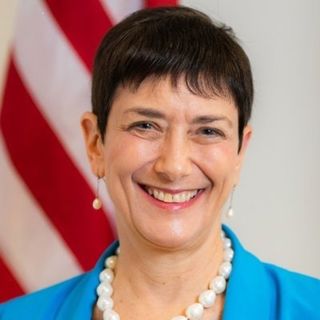

US-Pacific relations under Trump: a conversation with Judith Cefkin
Devpolicy Talks26 Juli 2025

US-Pacific relations under Trump: a conversation with Judith Cefkin

Former US Ambassador Judith Cefkin provides a sobering assessment of how the Trump administration's foreign policy shifts are reshaping American engagement with Pacific Island nations. Drawing on her 35-year diplomatic career and experience as US Ambassador to Fiji, Kiribati, Nauru, Tonga and Tuvalu from 2015-2018, Cefkin warns that the administration's withdrawal from the Paris Agreement, dismantling of USAID, and proposed 85% cuts to international affairs funding threaten to undermine decades of carefully built relationships. She contrasts America's retreat from soft power engagement with China's consistent approach to the region, while noting that some programs like the Millennium Challenge Corporation's work in Kiribati may survive. Overall, the US’s trajectory represents a dramatic scaling back at precisely the moment when strategic competition in the Pacific is intensifying.

The conversation opens with Cefkin outlining the fundamental challenges facing US-Pacific relations under the second Trump administration. She identifies two immediate concerns that have deeply unsettled Pacific Island nations: the US withdrawal from the Paris Agreement, which she describes as a "bitter pill" for countries that view climate change as their primary security threat, and the freeze on aid programs coupled with the dismantling of USAID. These moves come after years of increased American attention to the region that began during the first Trump administration and accelerated under President Biden, making the reversal particularly jarring for Pacific partners who had grown accustomed to expanded US engagement.

Cefkin provides stark details about the scale of proposed cuts to American foreign assistance. The administration has requested a 49% reduction in the International Affairs Budget for fiscal year 2026, while simultaneously attempting to claw back funding already appropriated for the current fiscal year. If both measures succeed, the result would be an unprecedented 85% cut to programs that fund both diplomatic operations and development assistance. While these are global figures that don't specify Pacific impacts, Cefkin emphasises that competition for increasingly scarce resources will make it difficult for Pacific programs to maintain funding levels. The human cost extends beyond aid recipients to include a brain drain within the State Department itself, as experienced professionals retire early or leave government service just when their expertise is most needed.

The discussion reveals how comprehensively the cuts would affect US engagement tools in the Pacific. Educational exchange programs face potential budget reductions of up to 93%, threatening scholarships that bring Pacific students to American universities and short-term training programs that have built people-to-people connections for decades. The East-West Center in Honolulu, which Cefkin describes as "a vital platform for convening US and Pacific Island officials and citizens," faces existential threats from budget cutbacks. Even successful programs aren't immune — while the Millennium Challenge Corporation's threshold program in Kiribati continues to help young people develop workforce skills, the institution itself was targeted for elimination by the administration's efficiency commission, though it has survived thus far.

Geopolitical implications emerge as a central concern throughout the conversation. Cefkin notes that China has already begun capitalising on perceived American disengagement, with the Chinese foreign minister recently hosting officials from eleven Pacific Island countries in Beijing where he "painted the United States as being disengaged and disinterested" while announcing new assistance programs. She describes China's approach as consistent and long-term, contrasting it with what Fiji's former ambassador to the US termed America's "stop-start relationships" that Pacific nations find deeply frustrating. This dynamic plays out against a backdrop of increasing Chinese economic leverage, with 2025 marking a critical year when ten Pacific Island countries must make record-high debt repayments to China based on loans accepted in the 2010s.

The interview explores the unique relationships with the Freely Associated States — Federated States of Micronesia, Palau, and the Marshall Islands — which receive the bulk of US assistance to the Pacific. Cefkin explains how these countries maintain sovereignty while granting the US defence rights in exchange for substantial financial support administered through multiple federal agencies rather than traditional foreign aid channels. She expresses concern about implementation capacity as the agencies managing these programs face their own staff and budget reductions, though the compact funding itself appears more secure than other assistance programs. The discussion also touches on the stalled US tuna treaty, which remains stuck in Congress despite its economic importance to Pacific Island nations and symbolic value as a concrete expression of partnership.

Military engagement emerges as the one area where US involvement continues to grow, with Cefkin acknowledging the strategic importance of defence partnerships while warning against an overly militarised approach. She describes valuable programs like ship-rider agreements that help Pacific nations patrol their vast maritime territories and counter illegal fishing that costs them millions in lost revenue. However, she emphasises that military cooperation alone cannot substitute for the comprehensive engagement that includes development assistance, educational exchanges, and diplomatic presence. The shift from soft power to hard power tools risks making the US a less attractive partner for Pacific nations seeking balanced relationships that address their development needs while respecting their sovereignty.

The conversation concludes with Cefkin's reflections on the future of US-Pacific relations and the role of Congress in potentially moderating the administration's approach. She notes that bipartisan support for Pacific engagement has traditionally transcended party lines, citing testimony before Congress where both Democratic and Republican members expressed strong interest in strengthening regional relationships. Her hope is that Congress will recognise that maintaining Pacific programs requires relatively modest investments that yield disproportionate benefits for US interests. However, she acknowledges the fluid and uncertain nature of the current situation, with much depending on how Congress responds to the administration's budget requests and whether traditional supporters of Pacific engagement can make their voices heard above competing priorities.

Devpolicy Talks is the podcast of the Australian National University's Development Policy Centre.

Read and subscribe to our daily blogs at devpolicy.org.

Learn more about our research and join our public events at devpolicy.anu.edu.au.

Follow us on Twitter, Facebook, LinkedIn and Instagram for latest updates on our blogs, research and events.

You can send us feedback, and ideas for episodes too, to devpolicy@anu.edu.au.

Det här avsnittet är hämtat från ett öppet RSS-flöde och publiceras inte av Podme. Det kan innehålla reklam.

Avsnitt(360)

Murder in the Pacific: Matt Francis on aid and agency in Vanuatu

Murder in the Pacific: Matt Francis on aid and agency in Vanuatu

In this episode, Gordon Peake speaks with the pseudonymous crime writer Matt Francis about the Murder in the Pacific series, four novels set across the provinces of Vanuatu and featuring Sergeant Geor...

3 Aug 58min

The Memorandum of Understanding podcast archive is now in this feed, filed under 2021

The Memorandum of Understanding podcast archive is now in this feed, filed under 2021

Gordon Peake's Memorandum of Understanding documentary podcast series, while produced by the Development Policy Centre, was formerly separate from Devpolicy Talks. Its back catalogue has now been adde...

1 Aug 1min

Humanitarianism and public health: an interview with Rick Brennan

Humanitarianism and public health: an interview with Rick Brennan

Rick Brennan, an Australian emergency physician appointed a Member of the Order of Australia in 2025, recounts the pivotal early decision that shaped his professional life — choosing public health and...

4 Juli 50min

2026 aid budget breakfast

2026 aid budget breakfast

Recorded the morning after the 2026–27 federal budget, this first episode of the 2026 season brings you the Development Policy Centre's fourteenth annual aid budget breakfast, hosted by Devpolicy Blog...

15 Maj 58min

Navigating China and the Global South: a conversation with Eric Olander

Navigating China and the Global South: a conversation with Eric Olander

Eric Olander, Editor-in-Chief of the China Global South Project, offers a nuanced perspective on China’s engagement with developing countries across Africa, Southeast Asia, Latin America and the Pacif...

15 Dec 20251h 34min

Pacific democracy: global indices and lived realities

Pacific democracy: global indices and lived realities

This episode explores the state of democracy in the Pacific, focusing on a joint report by International IDEA and the Australia National University's Department of Pacific Affairs (DPA). The report, r...

6 Dec 20251h 18min

Global public goods and the architecture of cooperation: a conversation with Inge Kaul

Global public goods and the architecture of cooperation: a conversation with Inge Kaul

Inge Kaul, pioneering development economist and architect of the global public goods framework, discusses her groundbreaking work on international cooperation and development financing in this 2015 in...

14 Nov 20252h 12min

Water, climate and adaptation: a conversation with Dr Aditi Mukherji

Water, climate and adaptation: a conversation with Dr Aditi Mukherji

Dr Aditi Mukherji, Principal Scientist at the International Livestock Research Institute and coordinating lead author of the Intergovernmental Panel on Climate Change's water chapter, discusses her ca...

1 Nov 202535min

Populärt inom Politik & nyheter

p3-krim
rss-krimstad
aftonbladet-daily
svenska-fall
aftonbladet-krim
flashback-forever
tv4-nyheterna-story
motiv
svd-ledarredaktionen
politiken
rss-vad-fan-hande
mannen-utan-spar
de-fyras-gang
rss-sanning-konsekvens
rss-krimreportrarna
spar
fordomspodden
rss-aftonbladet-krim
rss-flodet
olyckan-inifran