Space Telescopes with Dr. Alexandra Greenbaum

Space Telescopes with Dr. Alexandra Greenbaum

Are we living in a golden age of space telescopes? As our minds are being collectively blown by the images of our universe beginning to come from the JWST, our host Dr. Charles Liu and co-host Allen Liu explore the next space telescope on the horizon, the Nancy Grace Roman Space Telescope, with our guest, astronomer Dr. Alexandra Greenbaum, PhD.

Dr. Greenbaum is an astronomer at Caltech working on the NGRST, which is set to launch in 2027. Named after Nancy Roman, who created NASA's space astronomy program and is known to many as the “Mother of Hubble,” it’s a NASA observatory designed to unravel the secrets of dark energy and dark matter, search for and image exoplanets, and explore many topics in infrared astrophysics.

As always, though, we jump into the day’s joyfully cool cosmic thing, the incredible first picture of Sagittarius A Star, (Sgr A*), the supermassive black hole at the center of our Milky Way galaxy taken by the Event Horizon Telescope. Dr. Greenbaum explains that the EHT uses signals from many telescopes around the world to gather the data that is combined into images like this stunning photo.

Alexandra works at IPAC, the Infrared Processing and Analysis Center at Caltech, on the Roman Telescope’s coronagraph instrument, which is going to pave the way for future space photography of exoplanets. The coronagraph eliminates the glare that stars produce and allows astronomers to directly image planets in orbit around them. It will be far more powerful than any other coronagraph ever flown, seeing planets that are almost a billion times fainter than their host star.

Our first question this week comes from Isaac, who asks how the JWST differs from the Hubble. Dr. Greenbaum explains how the JWST’s mirror is made of 18 different mirror segments, whereas Hubble has a single mirror. Also, JWST is an infrared telescope, while Hubble functions primarily with the optical and ultraviolet portions of the spectrum. That means that JWST can see the light from stars stretching back to the earliest periods of our universe.

Chuck and Alex also discuss how the NGRST differs from Hubble and the JWST. It primarily features a wide-field instrument that can look at a huge portion of the sky with different kinds of detectors. The coronagraph instrument is actually a technology demonstration that will help us develop the optical systems to see planets that are otherwise obscured by the overpowering light of the sun they orbit. Dr. Greenbaum also worked on the JWST, and she explains how each one worked to remove solar interference from planets or brown dwarfs orbiting stars.

For our second question, Jayla from North Andover wants to know what’s most exciting about Alexandra’s job as an astronomer. She describes traveling to telescopes all around the world as an observational astronomer before the pandemic, and how wonderfully open and collaborative the field of astronomy is.

Last but not least, Chuck, Alexandra, and Allen talk about what she’s just read: “Parable of the Sower” by Octavia E. Butler, and how that book helped strengthen her commitment to her career studying the universe.

If you’d like to know more about Dr. Greenbaum’s work and keep up on the developments with the Nancy Grace Roman Space Telescope, you can check out roman.ipac.caltech.edu.

We hope you enjoy this episode of The LIUniverse, and, if you do, please support us on Patreon.

Det här avsnittet är hämtat från ett öppet RSS-flöde och publiceras inte av Podme. Det kan innehålla reklam.

Avsnitt(78)

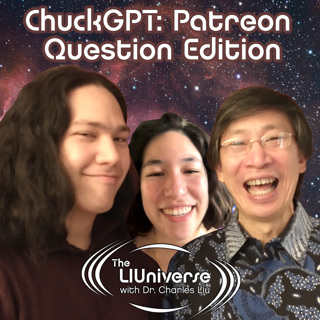
ChuckGPT - Patreon Question Edition

ChuckGPT - Patreon Question Edition

It’s time for the Season 5 finale of The LIUniverse, which means another episode of ChuckGPT where we answer our audience’s most vexing questions – this time via video from our Patreon Patrons. And to...

13 Juni 38min
Our Weird, Wondrous Universe with Erika Hamden

Our Weird, Wondrous Universe with Erika Hamden

How do distant galaxies form? If you have two distant clouds of hydrogen, why does one turn into a star and another doesn’t? To find out, Dr. Charles Liu and co-host Allen Liu welcome Dr. Erika Hamden...

30 Maj 43min
Ruby Raindrops and Painted Peacocks with Munazza Alam

Ruby Raindrops and Painted Peacocks with Munazza Alam

Are there really exoplanets with where it rains ruby and emerald raindrops? How do we measure the atmospheres of exoplanets light years away? To find out, Dr. Charles Liu and co-host Allen Liu welcome...

16 Maj 45min
Astrophotography with Astronaut Don Pettit

Astrophotography with Astronaut Don Pettit

Can the physics you learned in High School take you to the stars? Who is behind many of your favorite pictures of space? What is it actually like to live and work in space? You might be surprised to k...

2 Maj 47min
Finding the “Bubbles” Exoplanet and Crocheting Dinosaurs with Victoria DiTomasso

Finding the “Bubbles” Exoplanet and Crocheting Dinosaurs with Victoria DiTomasso

How do we find exoplanets? What is the Milky Way’s “Thick Disk” and what makes it so special? To find out, Dr. Charles Liu and co-host Allen Liu welcome Harvard astronomer Dr. Victoria DiTomasso, who ...

11 Apr 47min
Supernovas and Space Gold with Dr. Ashley Villar

Supernovas and Space Gold with Dr. Ashley Villar

How do stars die? And what happens when they do? To find out, Dr. Charles Liu and co-host Allen Liu welcome Dr. Ashley Villar, who teaches astronomy at Harvard and whose team studies supernovas as the...

21 Mars 40min
Building Worlds with Luke Skywatcher

Building Worlds with Luke Skywatcher

How do planetary systems form? If you wanted to observe them, where would you look and what would you look for? To find out, Dr. Charles Liu and co-host Allen Liu welcome Luke Keller, professor of Ast...

8 Mars 43min
Chuck GPT: Astrotech

Chuck GPT: Astrotech

How can a helicopter fly in space? How does LIGO detect gravitational waves? How do quantum electronic devices like Josephson junctions work? Could AI turn evil and destroy humanity? What about those ...

8 Feb 55min

Populärt inom Vetenskap

p3-dystopia
dumma-manniskor
allt-du-velat-veta
hacka-livet
ufo-sverige
bildningspodden
rss-vetenskapsradion
medicinvetarna
rss-ufobortom-rimligt-tvivel
det-morka-psyket
sexet
halsorevolutionen
rss-kriminologerna
rss-vetenskapsradion-2
ufo-sverige-2
svd-nyhetsartiklar
dumforklarat
paranormalt-med-caroline-giertz
doden-hjarnan-kemisten
vetenskapsradion