Simulating Galaxies with Paco Holguin

Simulating Galaxies with Paco Holguin

How can we create accurate models of galaxies, both ours and others? To find out, Dr. Charles Liu and co-host Allen Liu welcome Paco Holguin, a graduate researcher at the University of Michigan Dept. of Astronomy who specializes in computational astrophysics and galactic simulations.

As always, though, we start off with the day’s joyfully cool cosmic thing: neutron decay. The scientists at Los Alamos National Lab have recently determined that the half-life of a neutron is 877+/- 0.5 seconds, or about 14.5 minutes!

Moving on, Paco tells us how his love for video games and simulations led him to his field of studies, which includes the study of cosmic rays, charged particles and magnetic fields as he models galaxies. And of course, no discussion of Cosmic Rays can possibly pass without a discussion of the Fantastic Four, whose superpowers in the Marvel Comics derived from their exposure to cosmic rays.

For our first student question, Will from the Pingree School Astronomy Club wants to know about other extreme objects other than black holes and neutron stars in our galaxy. Paco starts by explaining how some types of cosmic rays, called ultra-high energy cosmic rays, qualify as extreme objects. Find out about the “Oh My God” particle, which moves so close to the speed of light that if it raced a photon across the galaxy, the photon would only be ahead by a meter after 300,000 years. (To avoid possible confusion, we’re not talking about the so-called “God Particle”, aka the Higgs boson.)

Paco explains how sometimes when he models a galaxy, it’s going along well and all of a sudden, it simply explodes. Because he uses extremely complex equations to simulate galaxies, Paco decided to take a graduate math class to better understand those equations.

Next up, Jayla from North Andover asks if there is an upper limit to the size of a black hole. As Paco and Charles discuss the possibility, agreeing that while we don’t know whether there is an actual upper limit, or we just haven’t found it yet, we have measured black holes that have billions of times the mass of our Sun.

Finally, Paco discusses what he’s been doing recently at Los Alamos, where for the past two summers he worked on machine learning projects with a diverse set of scientists and researchers. One of the projects he worked on was analyzing data from the Mars Curiosity Rover’s Chemcam using machine learning with mathematicians and computer scientists. Paco also shared with us that now that he’s finishing up his PhD, he’s off to the Applied Physics Lab at Johns Hopkins University to work on projects including exploratory space probe missions, national security issues, and more.

We hope you enjoy this episode of The LIUniverse, and, if you do, please support us on Patreon.

Credits for Images Used in this Episode:

Curiosity's Chemcam – Credit: NASA, Public Domain

Los Alamos National Labs, aerial view – Credit: Los Alamos National Labs

Det här avsnittet är hämtat från ett öppet RSS-flöde och publiceras inte av Podme. Det kan innehålla reklam.

Avsnitt(79)

Bonus Episode: The Secret Fortress of Ag-Karrah, Part 1 (Actual Play)

Bonus Episode: The Secret Fortress of Ag-Karrah, Part 1 (Actual Play)

What happens when an astronomer, a mathematician, an educator, a physics student and a biomedical engineer set off to explore the Secret Fortress of Ag-Karrah? You get Part One of this summer’s bonus ...

16 Aug 48min
ChuckGPT - Patreon Question Edition

ChuckGPT - Patreon Question Edition

It’s time for the Season 5 finale of The LIUniverse, which means another episode of ChuckGPT where we answer our audience’s most vexing questions – this time via video from our Patreon Patrons. And to...

13 Juni 38min
Our Weird, Wondrous Universe with Erika Hamden

Our Weird, Wondrous Universe with Erika Hamden

How do distant galaxies form? If you have two distant clouds of hydrogen, why does one turn into a star and another doesn’t? To find out, Dr. Charles Liu and co-host Allen Liu welcome Dr. Erika Hamden...

30 Maj 43min
Ruby Raindrops and Painted Peacocks with Munazza Alam

Ruby Raindrops and Painted Peacocks with Munazza Alam

Are there really exoplanets with where it rains ruby and emerald raindrops? How do we measure the atmospheres of exoplanets light years away? To find out, Dr. Charles Liu and co-host Allen Liu welcome...

16 Maj 45min
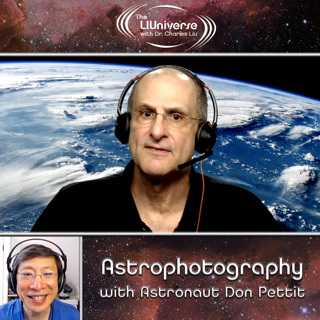
Astrophotography with Astronaut Don Pettit

Astrophotography with Astronaut Don Pettit

Can the physics you learned in High School take you to the stars? Who is behind many of your favorite pictures of space? What is it actually like to live and work in space? You might be surprised to k...

2 Maj 47min
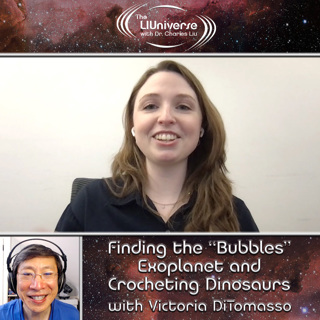
Finding the “Bubbles” Exoplanet and Crocheting Dinosaurs with Victoria DiTomasso

Finding the “Bubbles” Exoplanet and Crocheting Dinosaurs with Victoria DiTomasso

How do we find exoplanets? What is the Milky Way’s “Thick Disk” and what makes it so special? To find out, Dr. Charles Liu and co-host Allen Liu welcome Harvard astronomer Dr. Victoria DiTomasso, who ...

11 Apr 47min
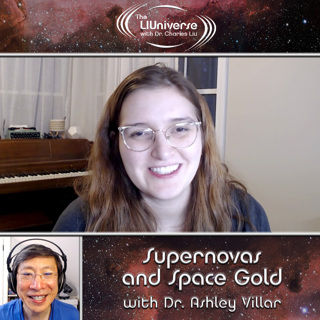
Supernovas and Space Gold with Dr. Ashley Villar

Supernovas and Space Gold with Dr. Ashley Villar

How do stars die? And what happens when they do? To find out, Dr. Charles Liu and co-host Allen Liu welcome Dr. Ashley Villar, who teaches astronomy at Harvard and whose team studies supernovas as the...

21 Mars 40min
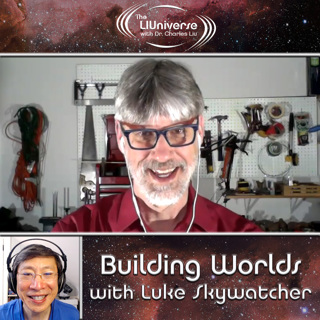
Building Worlds with Luke Skywatcher

Building Worlds with Luke Skywatcher

How do planetary systems form? If you wanted to observe them, where would you look and what would you look for? To find out, Dr. Charles Liu and co-host Allen Liu welcome Luke Keller, professor of Ast...

8 Mars 43min
Populärt inom Vetenskap

p3-dystopia
dumma-manniskor
allt-du-velat-veta
hacka-livet
bildningspodden
rss-vetenskapsradion
medicinvetarna
rss-ufobortom-rimligt-tvivel
sexet
ufo-sverige
rss-vetenskapsradion-2
halsorevolutionen
paranormalt-med-caroline-giertz
svd-nyhetsartiklar
det-morka-psyket
vetenskapsradion
ufo-sverige-2
rss-spraket
dumforklarat
rss-kriminologerna