Planet Formation with Dr. Holly Capelo

Planet Formation with Dr. Holly Capelo

How do planets form out of dust particles? And what does that have to do with fluid dynamics? To find out, Dr. Charles Liu and co-host Allen Liu welcome astrophysicist Dr. Holly Capelo from the University of Bern in Switzerland.

As always, though, we start off with the day’s joyfully cool cosmic thing, which takes us to the Observatory of Paris, where a group of scientists are delving into the formation of planetesimals. What are they, where do they come from, and when do they form? Holly dives right in to explain what we know about them, and what forces might prevent planetesimals from growing into planets. Along the way, she blows Chuck’s mind about planet formation and accretion disks.

Next, Dr. Capelo uses Alice in Wonderland to help describe her extensive experiments flying on Novespace’s Air Zero-G (the European equivalent of NASA’s “Vomit Comet”) flying in parabolas in order to better understand fluid dynamics, aerodynamic drag and the impact of freefall, microgravity and hypergravity on dust particles.

For our first question this episode, Allen asks Holly about what makes up interplanetary debris, now and in the past. You’ll learn all about ice lines, the impact of vacuum on water vapor and dust particles, minimum mass solar nebulas, density distributions and how much debris there actually is floating around our solar system.

You’ll also hear a little bit about Holly’s other experiences, as a dancer, and how grad school made it harder to stay in shape.

Our next question revolves around the possible atmospheres of the Moon, comets and planetesimals. Holly explains how we have evidence of transitory events, like outgassing. She also tells us about an upcoming “comet interceptor” mission to study comets that will place a satellite at a Lagrange point to wait for a comet to enter our solar system and then fly to meet it.

If you’d like to know more about Holly and her experiments, you can follow her on Twitter @hollycapelo.

We hope you enjoy this episode of The LIUniverse, and, if you do, please support us on Patreon.

Credits for Images Used in this Episode:

Accretion disks imaged by ALMA – European Southern Observatory, CC BY 4.0 Phase diagram of water – Hokanomono & Cmglee on Wikimedia, CC BY-SA 3.0 Novespace’s Air Zero-G aircraft – Marc Lacoste, CC BY-SA 4.0 Illustration of Rosetta at comet 67P – Deutsches Zentrum für Luft- und Raumfahrt, CC-BY 3.0

Det här avsnittet är hämtat från ett öppet RSS-flöde och publiceras inte av Podme. Det kan innehålla reklam.

Avsnitt(79)

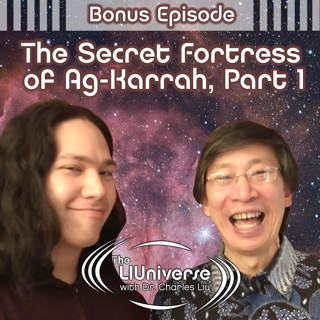
Bonus Episode: The Secret Fortress of Ag-Karrah, Part 1 (Actual Play)

Bonus Episode: The Secret Fortress of Ag-Karrah, Part 1 (Actual Play)

What happens when an astronomer, a mathematician, an educator, a physics student and a biomedical engineer set off to explore the Secret Fortress of Ag-Karrah? You get Part One of this summer’s bonus ...

16 Aug 48min
ChuckGPT - Patreon Question Edition

ChuckGPT - Patreon Question Edition

It’s time for the Season 5 finale of The LIUniverse, which means another episode of ChuckGPT where we answer our audience’s most vexing questions – this time via video from our Patreon Patrons. And to...

13 Juni 38min
Our Weird, Wondrous Universe with Erika Hamden

Our Weird, Wondrous Universe with Erika Hamden

How do distant galaxies form? If you have two distant clouds of hydrogen, why does one turn into a star and another doesn’t? To find out, Dr. Charles Liu and co-host Allen Liu welcome Dr. Erika Hamden...

30 Maj 43min
Ruby Raindrops and Painted Peacocks with Munazza Alam

Ruby Raindrops and Painted Peacocks with Munazza Alam

Are there really exoplanets with where it rains ruby and emerald raindrops? How do we measure the atmospheres of exoplanets light years away? To find out, Dr. Charles Liu and co-host Allen Liu welcome...

16 Maj 45min
Astrophotography with Astronaut Don Pettit

Astrophotography with Astronaut Don Pettit

Can the physics you learned in High School take you to the stars? Who is behind many of your favorite pictures of space? What is it actually like to live and work in space? You might be surprised to k...

2 Maj 47min
Finding the “Bubbles” Exoplanet and Crocheting Dinosaurs with Victoria DiTomasso

Finding the “Bubbles” Exoplanet and Crocheting Dinosaurs with Victoria DiTomasso

How do we find exoplanets? What is the Milky Way’s “Thick Disk” and what makes it so special? To find out, Dr. Charles Liu and co-host Allen Liu welcome Harvard astronomer Dr. Victoria DiTomasso, who ...

11 Apr 47min
Supernovas and Space Gold with Dr. Ashley Villar

Supernovas and Space Gold with Dr. Ashley Villar

How do stars die? And what happens when they do? To find out, Dr. Charles Liu and co-host Allen Liu welcome Dr. Ashley Villar, who teaches astronomy at Harvard and whose team studies supernovas as the...

21 Mars 40min
Building Worlds with Luke Skywatcher

Building Worlds with Luke Skywatcher

How do planetary systems form? If you wanted to observe them, where would you look and what would you look for? To find out, Dr. Charles Liu and co-host Allen Liu welcome Luke Keller, professor of Ast...

8 Mars 43min

Populärt inom Vetenskap

p3-dystopia
dumma-manniskor
allt-du-velat-veta
hacka-livet
bildningspodden
rss-vetenskapsradion
medicinvetarna
rss-ufobortom-rimligt-tvivel
sexet
ufo-sverige
rss-vetenskapsradion-2
halsorevolutionen
paranormalt-med-caroline-giertz
svd-nyhetsartiklar
det-morka-psyket
vetenskapsradion
ufo-sverige-2
rss-spraket
dumforklarat
rss-kriminologerna