Final Frontiers with Jeyhan Kartaltepe

Final Frontiers with Jeyhan Kartaltepe

In this episode of The LIUniverse, Dr. Charles Liu and co-host Allen Liu welcome Dr. Jeyhan Kartaltepe, an astronomer and professor at the Rochester Institute of Technology, who studies galactic evolution, including galactic collisions and the growth of black holes, to explore final frontiers, both real and fictional.

As always, though, we start off with the day’s joyfully cool cosmic thing, the first data drop from COSMOS-Web, a database of the deepest, coolest, largest field of deep space ever imaged by JWST, and the largest scientific project yet to be conducted by the James Webb Space Telescope.

Dr. Jeyhan Kartaltepe was co-leader of the effort and an integral part of the COSMOS team, which started with 50 people and has grown since then, and which started working on this project long before the JWST launched. Jeyhan also talks about the Redshift Wrangler project, a citizen science project that’s part of the COSMOS-Web and that anyone can contribute to.

We jump into our first student question, from Jonathan, who asks, “Why is there a black hole in the center of our galaxy, and how many galaxies are there in the universe?” Dr. Kartaltepe explains that we think there’s a supermassive black hole in the center of every galaxy, but where they come from is still a mystery. We understand where “regular” black holes come from, but these are still “head scratchers.” And as to how many galaxies there are, the current estimate is in the trillions, and that doesn’t even count the ones that are too far away even to see.

Next, Chuck takes the opportunity to ask Jeyhan about whether or not there really is a galactic barrier like the one shown in Star Trek V – The Final Frontier. And while we don’t actually know where our galaxy ends, Dr. Kartaltepe explains that there is no hard barrier around it. Jeyhan shares how as a child she watched Star Trek: The Original Series with her father, and has watched all of the subsequent series since, and that it helped shape her love of science and her social experience. And get this – Chuck shares that his wife is an even bigger Star Trek geek than he is, and his love of Trek helped him win her over!

Jeyhan, like Chuck, is on Team Star Trek vs. Team Star Wars, and the pair discuss what they like and don’t like about each, ending up in a three-way discussion with Allen about the morality of different races in Star Trek, and the similarities and differences between the Borg Collective and our concerns about Artificial Intelligence. Oh, and which Captain of the Enterprise does Jeyhan think is the best? You’ll have to watch/listen to the episode to find out.

Then it’s time for another student question, from Cynthia: “In a way, the brain has a bunch of similarities to the universe. Is there a connection between the two, logically or illogically?” According to Jeyhan, one of the biggest similarities is how little we know about each. Philosophical pondering about understanding complexity ensues.

Chuck has his own question for Jeyhan: How often do galaxies interact with each other? She says it’s fairly common: our Milky Way galaxy is already interacting with the small galaxies next to us, the Small and Large Magellanic Clouds, and has interacted with other small galaxies in the past. And, as we all know, there’s a collision with Andromeda galaxy heading our way in billions of years, and Dr. Kartaltepe describes what might happen when it does.

Finally, we turn to the impending Great North American Eclipse, a total solar eclipse that will be passing directly over Rochester on April 8, 2024.

If you’d like to know more about Dr. Kartaltepe’s work, you can follower her on Twitter/X at @jeyhan, or follow COSMOS-Web at @cosmosastro. You can also find out more on the web at https://cosmos.astro.caltech.edu/.

You can find out more about the Redshift Wrangler citizen science project here on Zooniverse.org: https://www.zooniverse.org/projects/jeyhansk/redshift-wrangler.

We hope you enjoy this episode of The LIUniverse, and, if you do, please support us on Patreon.

Credits for Images Used in this Episode:

– The first image data from COSMOS-Web– Kartaltepe/Casey/Franco/Larson, RIT/UT Austin/CANDIDE

– Spectrum of galaxy ARP 193 – Charles Liu

– Simulation of a dark matter halo around a galaxy – Cosmo0 on Wikipedia, Public DOmain

– An EEG recording of brain activity – Laurens R. Krol, Public Domain

– The Magellanic Clouds – ESO, CC BY 4.0

Det här avsnittet är hämtat från ett öppet RSS-flöde och publiceras inte av Podme. Det kan innehålla reklam.

Avsnitt(78)

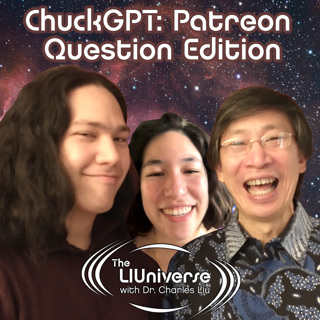
ChuckGPT - Patreon Question Edition

ChuckGPT - Patreon Question Edition

It’s time for the Season 5 finale of The LIUniverse, which means another episode of ChuckGPT where we answer our audience’s most vexing questions – this time via video from our Patreon Patrons. And to...

13 Juni 38min
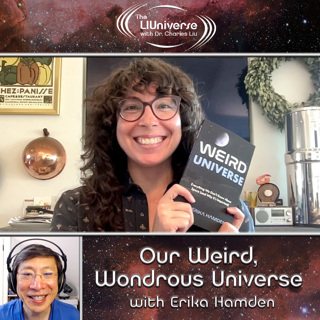
Our Weird, Wondrous Universe with Erika Hamden

Our Weird, Wondrous Universe with Erika Hamden

How do distant galaxies form? If you have two distant clouds of hydrogen, why does one turn into a star and another doesn’t? To find out, Dr. Charles Liu and co-host Allen Liu welcome Dr. Erika Hamden...

30 Maj 43min
Ruby Raindrops and Painted Peacocks with Munazza Alam

Ruby Raindrops and Painted Peacocks with Munazza Alam

Are there really exoplanets with where it rains ruby and emerald raindrops? How do we measure the atmospheres of exoplanets light years away? To find out, Dr. Charles Liu and co-host Allen Liu welcome...

16 Maj 45min
Astrophotography with Astronaut Don Pettit

Astrophotography with Astronaut Don Pettit

Can the physics you learned in High School take you to the stars? Who is behind many of your favorite pictures of space? What is it actually like to live and work in space? You might be surprised to k...

2 Maj 47min
Finding the “Bubbles” Exoplanet and Crocheting Dinosaurs with Victoria DiTomasso

Finding the “Bubbles” Exoplanet and Crocheting Dinosaurs with Victoria DiTomasso

How do we find exoplanets? What is the Milky Way’s “Thick Disk” and what makes it so special? To find out, Dr. Charles Liu and co-host Allen Liu welcome Harvard astronomer Dr. Victoria DiTomasso, who ...

11 Apr 47min
Supernovas and Space Gold with Dr. Ashley Villar

Supernovas and Space Gold with Dr. Ashley Villar

How do stars die? And what happens when they do? To find out, Dr. Charles Liu and co-host Allen Liu welcome Dr. Ashley Villar, who teaches astronomy at Harvard and whose team studies supernovas as the...

21 Mars 40min
Building Worlds with Luke Skywatcher

Building Worlds with Luke Skywatcher

How do planetary systems form? If you wanted to observe them, where would you look and what would you look for? To find out, Dr. Charles Liu and co-host Allen Liu welcome Luke Keller, professor of Ast...

8 Mars 43min
Chuck GPT: Astrotech

Chuck GPT: Astrotech

How can a helicopter fly in space? How does LIGO detect gravitational waves? How do quantum electronic devices like Josephson junctions work? Could AI turn evil and destroy humanity? What about those ...

8 Feb 55min

Populärt inom Vetenskap

p3-dystopia
dumma-manniskor
allt-du-velat-veta
hacka-livet
ufo-sverige
bildningspodden
rss-vetenskapsradion
medicinvetarna
rss-ufobortom-rimligt-tvivel
det-morka-psyket
sexet
halsorevolutionen
rss-kriminologerna
rss-vetenskapsradion-2
ufo-sverige-2
svd-nyhetsartiklar
dumforklarat
paranormalt-med-caroline-giertz
doden-hjarnan-kemisten
vetenskapsradion