Ancient Astronomy with Hannah Liu

Ancient Astronomy with Hannah Liu

What does the study of archeology, the study of the human past, offer to the astronomers of today? To find out, Dr. Charles Liu and co-host Allen Liu welcome archaeology expert Hannah Liu, MEd, to connect the past, the present, and the future of astronomy in an episode Allen has described as, “A Fistful of Lius.”

As always, though, we start off with the day’s joyfully cool cosmic thing, a recent scientific paper just published by archaeologist Federico Bernardini and astronomer Paolo Molaro which suggests that a 3,000-year-old stone tablet discovered near Trieste, Italy may be the oldest European star chart yet discovered.

Hannah, who is an expert in archaeology, takes us back to the hilltop area where the tablet was found, which had been occupied since the Iron Age, and was more than likely a farming area. She explains how early civilizations used the stars to keep track of planting and threshing seasons, which could support the theory that the tablet has an astronomical purpose.

Then, it’s time for our first question. Hannah teaches History at the Pingree School in South Hamilton, Massachusetts, which is where we got the questions we answer on today’s episode. Maeve asks, “Are we the only living things on earth who have a sense of how small we are in the universe?”

The Lius answer includes ancient Greeks, sea turtles who use stars for directions and moths that fly towards light thinking it’s the moon, and the beginnings of astronomy and astrology! Hannah explains how constellations and asterisms are cross-cultural, even though they have different names. In particular, The Pleiades is an example of star cluster relevant to cultures around the world.

Coming back to that 3000-year-old star chart, Hannah breaks down the 29 markings on the tablet, and how 28 of them are connectable to constellations that we know like Scorpius, Cassiopeia The Pleiades, and Orion. However, the 29th marking, near Orion’s Belt, still remains a mystery, and until we can pin it down, we can’t definitively claim it’s really a star chart.

Our next question comes from Abby, who asks, “Where do you think human involvement in space exploration is going?” Allen runs down the planned manned missions beyond low Earth orbit, where we haven’t gone since our last trip to the moon in 1972, along with the reasons we haven’t. We also hear how the stars were very important to ancient explorers like the Greeks and the Phoenicians, as well as the ancient Polynesian Wayfinders, who used the stars as their guides in their ongoing excursions around the world.

After brief sojourns into Star Trek and The Odyssey, we dive into ancient alien visitors, gods, and supernatural forces. Hannah points out the inherent Western biases in theories that “ancient aliens” were responsible for building the Pyramids and other impressive accomplishments that just happened to have been created in non-Western cultures of the past.

Charles explains that in the past, some people who used science and astronomy, like midwives and scientists, were accused of witchcraft and other equally disparaging and unfounded claims. This could create a divide between science and religion, but luckily, not an unbridgeable one – you’ll hear about Gerbert of Aurillac, a scientist who became Pope Sylvester II and brought the Abacus back to Europe, and how the Catholic Church itself established the Vatican Observatory which has made numerous discoveries over the years.

Finally, we get into the history and anthropology of museums, a subject about which Hannah will be teaching a course in the upcoming semester. What is the role of a museum? Is it science, education, or something else? Is it a place where we hold our treasures, or, increasingly, one where we recognize we hold other people’s treasures, some of which were once plundered and taken from those people against their desires? And yes, we do bring up situations like the Elgin Marbles and the British Museum’s refusal to return those artifacts to Greece... especially in light of the new U.S. law regarding repatriation of artifacts.

We hope you enjoy this episode of The LIUniverse, and, if you do, please support us on Patreon.

Credits for Images Used in this Episode:

– 3,000-year-old stone tablet from Italy – Bernardini et al., CC BY-SA 4.0

– Trieste in Italy – F l a n k e r, Yiyi, and Allen Liu, Public Domain

– Sirius (bottom) in the night sky – Akira Fujii, Public Domain

– A thresher (Thanks Jon.) – SteveStrummer, Public Domain

– NASA’s SLS Rocket – NASA/Joel Kowsky, Public Domain

– SpaceX’s Starship rocket under construction – NASA, Public Domain

– Austronesian societies range – Obsidian Soul, CC BY 4.0

– Gerbert of Aurillac, Pope Sylvester II – Meister der Reichenauer Schule, Public Domain

– Vatican Advanced Technology Telescope in Arizona – Andromeda321, Public Domain

– Parthenon Marbles at the British Museum – Ejectgoose, Public Domain

– Map of Latin-descended languages in Europe – Servitje, Public Domain

#TheLIUniverse #CharlesLiu #AllenLiu #SciencePodcast #AstronomyPodcast #starchart #astrology #astronomy #TheOdyssey #Scorpius #Cassiopeia #ThePleiades #Orion #OrionsBelt #GerbertofAurillac #PopeSylvesterII #CatholicChurch #VaticanObservatory #NASA #SLS #SpaceX #Starship #ElginMarbles #BritishMuseum #PolynesianWayfinders #Greeks #Phoenicians

Det här avsnittet är hämtat från ett öppet RSS-flöde och publiceras inte av Podme. Det kan innehålla reklam.

Avsnitt(78)

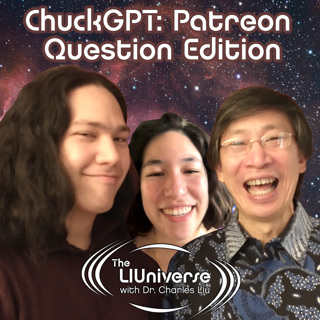
ChuckGPT - Patreon Question Edition

ChuckGPT - Patreon Question Edition

It’s time for the Season 5 finale of The LIUniverse, which means another episode of ChuckGPT where we answer our audience’s most vexing questions – this time via video from our Patreon Patrons. And to...

13 Juni 38min
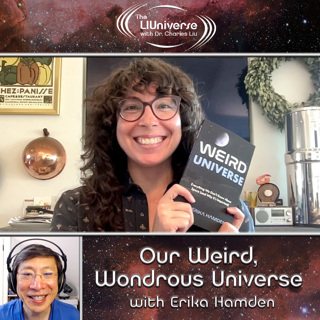
Our Weird, Wondrous Universe with Erika Hamden

Our Weird, Wondrous Universe with Erika Hamden

How do distant galaxies form? If you have two distant clouds of hydrogen, why does one turn into a star and another doesn’t? To find out, Dr. Charles Liu and co-host Allen Liu welcome Dr. Erika Hamden...

30 Maj 43min
Ruby Raindrops and Painted Peacocks with Munazza Alam

Ruby Raindrops and Painted Peacocks with Munazza Alam

Are there really exoplanets with where it rains ruby and emerald raindrops? How do we measure the atmospheres of exoplanets light years away? To find out, Dr. Charles Liu and co-host Allen Liu welcome...

16 Maj 45min
Astrophotography with Astronaut Don Pettit

Astrophotography with Astronaut Don Pettit

Can the physics you learned in High School take you to the stars? Who is behind many of your favorite pictures of space? What is it actually like to live and work in space? You might be surprised to k...

2 Maj 47min
Finding the “Bubbles” Exoplanet and Crocheting Dinosaurs with Victoria DiTomasso

Finding the “Bubbles” Exoplanet and Crocheting Dinosaurs with Victoria DiTomasso

How do we find exoplanets? What is the Milky Way’s “Thick Disk” and what makes it so special? To find out, Dr. Charles Liu and co-host Allen Liu welcome Harvard astronomer Dr. Victoria DiTomasso, who ...

11 Apr 47min
Supernovas and Space Gold with Dr. Ashley Villar

Supernovas and Space Gold with Dr. Ashley Villar

How do stars die? And what happens when they do? To find out, Dr. Charles Liu and co-host Allen Liu welcome Dr. Ashley Villar, who teaches astronomy at Harvard and whose team studies supernovas as the...

21 Mars 40min
Building Worlds with Luke Skywatcher

Building Worlds with Luke Skywatcher

How do planetary systems form? If you wanted to observe them, where would you look and what would you look for? To find out, Dr. Charles Liu and co-host Allen Liu welcome Luke Keller, professor of Ast...

8 Mars 43min
Chuck GPT: Astrotech

Chuck GPT: Astrotech

How can a helicopter fly in space? How does LIGO detect gravitational waves? How do quantum electronic devices like Josephson junctions work? Could AI turn evil and destroy humanity? What about those ...

8 Feb 55min

Populärt inom Vetenskap

p3-dystopia
dumma-manniskor
allt-du-velat-veta
hacka-livet
ufo-sverige
bildningspodden
rss-vetenskapsradion
medicinvetarna
rss-ufobortom-rimligt-tvivel
det-morka-psyket
sexet
halsorevolutionen
rss-kriminologerna
rss-vetenskapsradion-2
ufo-sverige-2
svd-nyhetsartiklar
dumforklarat
paranormalt-med-caroline-giertz
doden-hjarnan-kemisten
vetenskapsradion