Space Lasers, Solar Panels and Stochastic Parrots with Leah Voytovich

Space Lasers, Solar Panels and Stochastic Parrots with Leah Voytovich

How far can following your passions take you in science? To find out, Dr. Charles Liu and co-host Allen Liu welcome the multi-faceted Leah Voytovich, a software development engineer for Project Kuiper who planned on going to med school but instead ended up working on space lasers for Amazon’s satellite internet constellation.

As always, though, we start off with the day’s joyfully cool cosmic thing: the use of deuterium levels in the search for exoplanets with advanced civilizations. That’s because signs of deuterium depletion can indicate that a planet has developed nuclear fission power.

After that, Leah tells us a little about Amazon’s Project Kuiper. She explains the wide variety of challenges to keeping the satellites, which are in low earth orbit, in communication with the ground. The project she’s working on now is using infrared space lasers to communicate more securely within the satellite constellation.

Chuck brings up the impact that these massive groups of satellites like Starlink are having on astronomy, from satellite streaks on dark sky surveys to image-destroying flares. Leah said there are people working on reducing Project Kuiper’s impacts across multiple areas of concern.

For our first question. Yasmin asks, “Will our satellites all be controlled by AI someday? If so, when? And is this a good idea?”

Leah speculates that there may be some projects already using Machine Learning here on Earth, but that it will be further down the line before there’s AI actually present in satellites themselves. Leah doesn’t see a problem with the use of ML tools for science, as long as there are protections in place and that humans are still writing the software.

After our break, Leah tells us about what she does outside her work – literally – from climbing Mount St. Helens in winter using an ice ax and crampons, to skiing, to running marathons – 3 so far!

Then we’re back to AI, ML, and the differences between the two. Charles talks about how important AI has beome as a tool for astronomers and other scientists. Leah explains the “Chinese Room Argument” and why it’s a good analogy for machine learning, Allen shares the description of AI as a “stochastic parrot.”

Our next question comes from Jonathan, who asks, “With so many problems facing the world like poverty, war and the climate crisis here on Earth, why should we spend money and resources on space exploration and astronomy?”

Leah talks about how Project Kuiper is intended to serve underserved communities by providing internet access to people who don’t already have it. That in turn increases global communication and connectivity and can then help address those other problems. And of course, to launch those satellites, we need rockets.

She also explains how valuable internet access is to communities– something she knows a little about. She and Martin Leet co-founded Maji, a nonprofit in Uganda that uses solar power to make clean water easily accessible for refugee communities. Leah, a former EMT, explains how Maji also provides first aide medical training and agricultural training to the communities. The story of how Maji came to be is remarkable – we’ll leave it to Leah to share that with you in the episode.

We end with Leah recounting what it was like to be in Mission Control for the launch of the first Project Kuiper satellites. She was the representative for her team in the Mission Control room, so she was the one who actually got to say “Go” for her service during the final pre-launch Go/No Go review.

If you’d like to know more about Maji, you can check out the nonprofit’s website here.

We hope you enjoy this episode of The LIUniverse, and, if you do, please support us on Patreon.

Credits for Images Used in this Episode:

  • Illustration of Kepler-138 exoplanets– NASA, ESA, Leah Hustak (STScI)
  • Deuterium, aka hydrogen-2 (²H or D) – Center for Deuterium Depletion
  • An axonometric view displays various Earth orbits, illustrating space debris and active satellites – WikiCommons/Pablo Carlos Budassi
  • The history of the universe since the Big Bang – NASA
  • Satellite streaks in an astronomical image – University of Washington/ Abhilash Biswas, Kilando Chambers, and Ashley Santos
  • Space-based lasers – IEEE Spectrum
  • Illustration of NASA’s Laser Communications Relay Demonstration (LCRD) communicating with the I.S.S. over laser links – NASA’s Goddard Space Flight Center
  • Illustration of machine learning and artificial intelligence – Creative Commons / mikemacmarketing
  • Computer simulation of dendrites of pyramidal neurons – Hermann Cuntz/ PLoS Computational Biology, Vol. 6(8) August 2010.
  • Earth illuminated time-lapse video if ISS over Earth – NASA
  • Martin Leet and Leah Voytovich – University of Pennsylvania
  • The Maji water tank for the Olua I community – University of Pennsylvania/Martin Leet

Det här avsnittet är hämtat från ett öppet RSS-flöde och publiceras inte av Podme. Det kan innehålla reklam.

Avsnitt(79)

Bonus Episode: The Secret Fortress of Ag-Karrah, Part 1 (Actual Play)

Bonus Episode: The Secret Fortress of Ag-Karrah, Part 1 (Actual Play)

What happens when an astronomer, a mathematician, an educator, a physics student and a biomedical engineer set off to explore the Secret Fortress of Ag-Karrah? You get Part One of this summer’s bonus ...

16 Aug 48min
ChuckGPT - Patreon Question Edition

ChuckGPT - Patreon Question Edition

It’s time for the Season 5 finale of The LIUniverse, which means another episode of ChuckGPT where we answer our audience’s most vexing questions – this time via video from our Patreon Patrons. And to...

13 Juni 38min
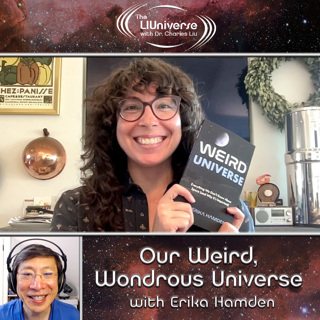
Our Weird, Wondrous Universe with Erika Hamden

Our Weird, Wondrous Universe with Erika Hamden

How do distant galaxies form? If you have two distant clouds of hydrogen, why does one turn into a star and another doesn’t? To find out, Dr. Charles Liu and co-host Allen Liu welcome Dr. Erika Hamden...

30 Maj 43min
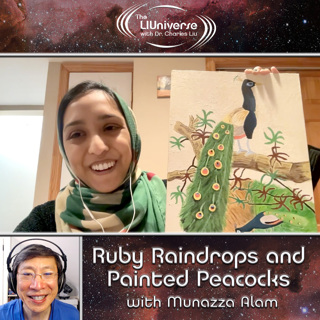
Ruby Raindrops and Painted Peacocks with Munazza Alam

Ruby Raindrops and Painted Peacocks with Munazza Alam

Are there really exoplanets with where it rains ruby and emerald raindrops? How do we measure the atmospheres of exoplanets light years away? To find out, Dr. Charles Liu and co-host Allen Liu welcome...

16 Maj 45min
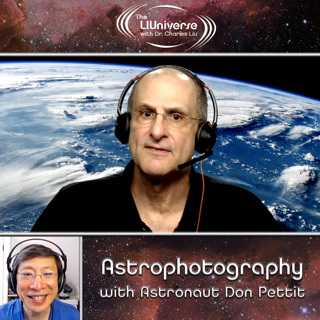
Astrophotography with Astronaut Don Pettit

Astrophotography with Astronaut Don Pettit

Can the physics you learned in High School take you to the stars? Who is behind many of your favorite pictures of space? What is it actually like to live and work in space? You might be surprised to k...

2 Maj 47min
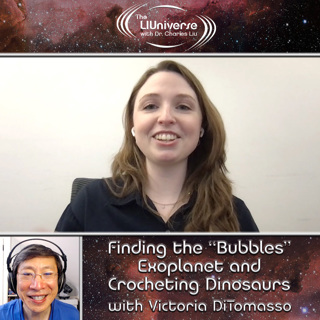
Finding the “Bubbles” Exoplanet and Crocheting Dinosaurs with Victoria DiTomasso

Finding the “Bubbles” Exoplanet and Crocheting Dinosaurs with Victoria DiTomasso

How do we find exoplanets? What is the Milky Way’s “Thick Disk” and what makes it so special? To find out, Dr. Charles Liu and co-host Allen Liu welcome Harvard astronomer Dr. Victoria DiTomasso, who ...

11 Apr 47min
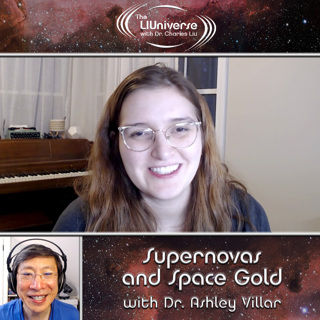
Supernovas and Space Gold with Dr. Ashley Villar

Supernovas and Space Gold with Dr. Ashley Villar

How do stars die? And what happens when they do? To find out, Dr. Charles Liu and co-host Allen Liu welcome Dr. Ashley Villar, who teaches astronomy at Harvard and whose team studies supernovas as the...

21 Mars 40min
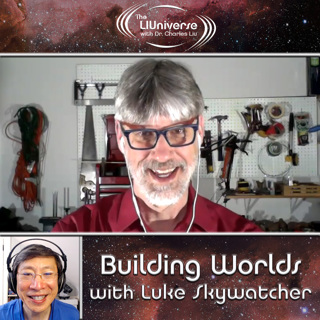
Building Worlds with Luke Skywatcher

Building Worlds with Luke Skywatcher

How do planetary systems form? If you wanted to observe them, where would you look and what would you look for? To find out, Dr. Charles Liu and co-host Allen Liu welcome Luke Keller, professor of Ast...

8 Mars 43min
Populärt inom Vetenskap

p3-dystopia
dumma-manniskor
allt-du-velat-veta
hacka-livet
bildningspodden
ufo-sverige
rss-vetenskapsradion
rss-ufobortom-rimligt-tvivel
sexet
medicinvetarna
halsorevolutionen
rss-vetenskapsradion-2
det-morka-psyket
svd-nyhetsartiklar
paranormalt-med-caroline-giertz
ufo-sverige-2
rss-kriminologerna
vetenskapsradion
rss-spraket
rss-tidslinjen-podcast