Finding Your Place in Space with Sadie Coffin

Finding Your Place in Space with Sadie Coffin

Who are the “Redshift Wranglers” and what can they tell us about the evolution of our universe? To find out, Dr. Charles Liu and co-host Allen Liu welcome back astrophysics PhD candidate Sadie Coffin from the Rochester Institute of Technology whose focus is galactic evolution, and in particular, the spectroscopy of galaxies and their lights.

As always, though, we start off with the day’s joyfully cool cosmic thing: the Lucy spacecraft fly-by of asteroid 52246 Donaldjohanson, which was named after the American paleoanthropologist who discovered the Australopithecus afarensis “Lucy” fossil the spacecraft was named after.

Then it’s time to learn a little about Sadie, who explains how questioning the unknown is what drove her to study astronomy. Chuck, Allen and Sadie talk about the awe embodied in the study of the universe and the universe itself. Like Chuck, Sadie studies galaxy evolution, but Sadie focuses on a galaxy’s light, spread into spectra, and dissecting different features in that light.

You’ll hear about the citizen science project called “Red Shift Wranglers” that helps Sadie sift through all the spectroscopic data, and get an awesome explanation of the doppler effect and the way red shift, which measures speed, can be used to help build better maps of galactic evolution.

Find out how you can get involved with the project and join the ranks of the 3,500 Redshift Wranglers who’ve participated so far in “Wrangling galaxies and the universe together.” (See below for links.) You’ll also hear about other citizen science projects on Zooniverse like Galaxy Zoo. Sadie talks about the value of non-experts engaging with experts in a community, and the surprising number of people who want to get involved.

For our first audience question, Nina asks, “If nothing can go faster than the speed of light, why can galaxies have Z greater than 1?” Sadie’s explanation gets pretty technical, so we’ll let her do it in the episode.

Our next question comes from Jerry, who asks, “Will we someday no longer need scientists and have AI do all our research?” Sadie, who gets similar questions all the time relative to citizen science, believes these two things can be complimentary, and that in the name of improving science we can’t forgo either for the other.

We finish with a discussion about what defines an act of science and a work of art, the process of questioning, and the roles of humans and machines in these processes. Plus, Sadie tells us about the science-themed travel posters by Dr. Tyler Nordgren on her walls. Chuck also gets Sadie to talk about rowing and the lessons she’s taken from the sport into other aspects of her life and journey as a scientist.

If you’d like to know more about the Redshift Wrangler project on The Zooniverse and get involved, or to reach Sadie, visit https://www.zooniverse.org/projects/jeyhansk/redshift-wrangler or find Redshift Wrangler on Facebook and X (Twitter).

Listen to the COSMOS project episode referenced in this show with Dr. Jeyhan Kartaltepe, an astronomer and professor at the Rochester Institute of Technology.

Watch Sadie’s previous appearance in this short video shot at the COSMOS Team Meeting 2023.

We hope you enjoy this episode of The LIUniverse, and, if you do, please support us on Patreon.

Credits for Images Used in this Episode:

  • The inner Solar System, with the Jupiter Trojan asteroids shown in green. – Credit: Mdf at Wikipedia/Public Domain.
  • Lucy skeleton (AL 288-1) Australopithecus afarensis, cast from Museum national d'histoire naturelle, Paris. – Credit: Creative Commons.
  • Absorption lines in the optical spectrum of a supercluster of distant galaxies (BAS11) (right), as compared to those in the optical spectrum of the Sun (left). Arrows indicating Redshift. – Credit: Creative Commons / Georg Wiora (Dr. Schorsch) created this image from the original JPG. Derivative work:Kes47.
  • Color composite JWST NIRCam image of distant galaxy JADES-GS-z13-0. – Credit: NASA, ESA, CSA, and STScI, M. Zamani (ESA/Webb), L. Hustak (STScI). Science: B. Robertson (UCSC), S. Tacchella (Cambridge), E. Curtis-Lake (Hertfordshire), S. Carniani (Scuola Normale Superiore), and the JADES Collaboration.
  • Dr Tyler Nordgren’s VLA NRAO travel poster – Credit: NRAO/Tyler Nordgren.

#liuniverse #charlesliu #allenliu #sciencepodcast #astronomypodcast #sadiecoffin #redshiftwranglers #citizenscience #zooniverse #galaxyzoo #spectra #dopplereffect #redshift #galaxyevolution #tylernordgren #jeyhankartaltepe

Det här avsnittet är hämtat från ett öppet RSS-flöde och publiceras inte av Podme. Det kan innehålla reklam.

Avsnitt(79)

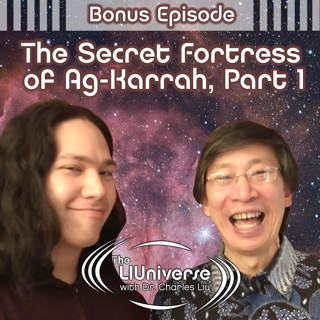
Bonus Episode: The Secret Fortress of Ag-Karrah, Part 1 (Actual Play)

Bonus Episode: The Secret Fortress of Ag-Karrah, Part 1 (Actual Play)

What happens when an astronomer, a mathematician, an educator, a physics student and a biomedical engineer set off to explore the Secret Fortress of Ag-Karrah? You get Part One of this summer’s bonus ...

16 Aug 48min
ChuckGPT - Patreon Question Edition

ChuckGPT - Patreon Question Edition

It’s time for the Season 5 finale of The LIUniverse, which means another episode of ChuckGPT where we answer our audience’s most vexing questions – this time via video from our Patreon Patrons. And to...

13 Juni 38min
Our Weird, Wondrous Universe with Erika Hamden

Our Weird, Wondrous Universe with Erika Hamden

How do distant galaxies form? If you have two distant clouds of hydrogen, why does one turn into a star and another doesn’t? To find out, Dr. Charles Liu and co-host Allen Liu welcome Dr. Erika Hamden...

30 Maj 43min
Ruby Raindrops and Painted Peacocks with Munazza Alam

Ruby Raindrops and Painted Peacocks with Munazza Alam

Are there really exoplanets with where it rains ruby and emerald raindrops? How do we measure the atmospheres of exoplanets light years away? To find out, Dr. Charles Liu and co-host Allen Liu welcome...

16 Maj 45min
Astrophotography with Astronaut Don Pettit

Astrophotography with Astronaut Don Pettit

Can the physics you learned in High School take you to the stars? Who is behind many of your favorite pictures of space? What is it actually like to live and work in space? You might be surprised to k...

2 Maj 47min
Finding the “Bubbles” Exoplanet and Crocheting Dinosaurs with Victoria DiTomasso

Finding the “Bubbles” Exoplanet and Crocheting Dinosaurs with Victoria DiTomasso

How do we find exoplanets? What is the Milky Way’s “Thick Disk” and what makes it so special? To find out, Dr. Charles Liu and co-host Allen Liu welcome Harvard astronomer Dr. Victoria DiTomasso, who ...

11 Apr 47min
Supernovas and Space Gold with Dr. Ashley Villar

Supernovas and Space Gold with Dr. Ashley Villar

How do stars die? And what happens when they do? To find out, Dr. Charles Liu and co-host Allen Liu welcome Dr. Ashley Villar, who teaches astronomy at Harvard and whose team studies supernovas as the...

21 Mars 40min
Building Worlds with Luke Skywatcher

Building Worlds with Luke Skywatcher

How do planetary systems form? If you wanted to observe them, where would you look and what would you look for? To find out, Dr. Charles Liu and co-host Allen Liu welcome Luke Keller, professor of Ast...

8 Mars 43min

Populärt inom Vetenskap

p3-dystopia
dumma-manniskor
allt-du-velat-veta
hacka-livet
bildningspodden
ufo-sverige
rss-vetenskapsradion
rss-ufobortom-rimligt-tvivel
sexet
medicinvetarna
halsorevolutionen
rss-vetenskapsradion-2
det-morka-psyket
svd-nyhetsartiklar
paranormalt-med-caroline-giertz
ufo-sverige-2
rss-kriminologerna
vetenskapsradion
rss-spraket
rss-tidslinjen-podcast