Experts warn bird flu poses 'an existential threat' to biodiversity, and a possible threat to humans

Experts warn bird flu poses 'an existential threat' to biodiversity, and a possible threat to humans

The current clade of H5N1 or bird flu is an "existential threat" to the world's biodiversity, experts say. While it has infected more than 500 bird and mammal species on every continent except Australia, the number of human infections from the current clade (grouping) 2.3.4.4b is still comparatively small. U.S. dairy workers have recently become infected, and the virus could easily mutate to become more virulent, our guest says.

Joining the Mongabay Newscast to talk about it is Apoorva Mandavilli, a global health reporter for The New York Times. Mandavilli details what virologists and experts know about the human health risks associated with this latest clade, what nations are doing (or not doing) to help contain its spread, and why. She also details how environmental degradation and industrial agriculture help create the conditions for outbreaks like this to occur.

Read Sharon Guynup's reporting on it here.

Like this podcast? Please share it with a friend and help spread the word about the Mongabay Newscast.

Subscribe to or follow the Mongabay Newscast wherever you listen to podcasts, from Apple to Spotify, and you can also listen to all episodes here on the Mongabay website, or download our free app for Apple and Android devices to gain instant access to our latest episodes and all of our previous ones.

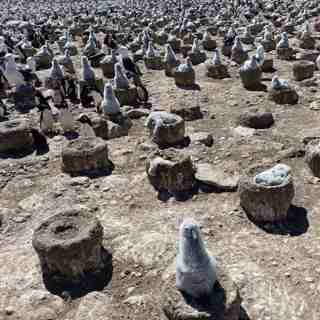
Image Credit: Highly pathogenic avian influenza killed thousands of black-browed albatross (Thalassarche melanophris) chicks in the Falkland Islands and Islas Malvinas, where two-thirds of the entire population lives. Image © Julia Emerit and Augustin Clessin.

Time Codes

---

(00:00) Introduction

(02:44) The evolution of H5N1

(05:47) Clade 2.3.4.4b

(08:21) Challenges in monitoring the spread

(11:10) What are the human health risks?

(16:34) A spotlight on industrialized animal agriculture

(18:26) A vaccination strategy?

(20:05) What lessons are we learning from other pandemics?

(23:08) The degradation of nature and the frequency of disease outbreaks

(25:57) Credits

Det här avsnittet är hämtat från ett öppet RSS-flöde och publiceras inte av Podme. Det kan innehålla reklam.

Avsnitt(370)

'Remembering Wildlife' before it goes extinct

'Remembering Wildlife' before it goes extinct

British wildlife photographer Margot Raggett says she created the book Remembering Elephants after she heard David Attenborough say, "The question is, are we happy to suppose that our grandchildren ma...

18 Aug 46min

Historic fire seasons are the 'new normal' without 'serious action' on climate change

Historic fire seasons are the 'new normal' without 'serious action' on climate change

Elizabeth Goldman is a co-director of Global Nature Watch, previously known as Global Forest Watch, a database measuring forest loss that's frequently cited in Mongabay reporting. She joins this week'...

11 Aug 28min

The 'quiet revolution' inspired by Delhi's urban wildlife

The 'quiet revolution' inspired by Delhi's urban wildlife

In her upcoming book, My Wild City: Finding Nature, Meaning, and Hope in India's Capital, conservation biologist Neha Sinha takes readers to the hidden and not-so-hidden ecosystems of India's largest...

4 Aug 54min

Why are forests in Liberia disappearing?

Why are forests in Liberia disappearing?

On this week's episode of the Mongabay Newscast, we speak with features writer Ashoka Mukpo, who traveled to southeastern Liberia to investigate what satellite images indicated was a spike in deforest...

28 Juli 38min

Oil has brought destruction to the Niger Delta; women and human rights may save it

Oil has brought destruction to the Niger Delta; women and human rights may save it

On this week's episode of the Mongabay Newscast, I speak with travel writer Noo Saro-Wiwa. She has documented the violence and natural destruction that the presence of oil companies have brought to th...

21 Juli 42min

The Mediterranean Sea's beauty hides an ecosystem under pressure

The Mediterranean Sea's beauty hides an ecosystem under pressure

The Mediterranean Sea accounts for less than 1% of the world's ocean surface water, but it contains roughly 18% of global marine biodiversity. It is home to 150 million people along its coastline (rou...

14 Juli 33min

Wildlife crossings are having a moment

Wildlife crossings are having a moment

Nearly three years ago, Newscast guest, author and journalist Ben Goldfarb discussed his book Crossings, which is about wildlife crossings and road ecology. Wildlife crossings help reconnect habitats...

7 Juli 37min

The radical plan to rethink work, wealth and planetary well-being

The radical plan to rethink work, wealth and planetary well-being

A group of more than 40 researchers spent 20 months devising a plan for the world to achieve ecological sustainability within planetary boundaries, all while seeing incomes rise for 98% of the global ...

30 Juni 52min

Populärt inom Vetenskap

dumma-manniskor
p3-dystopia
allt-du-velat-veta
hacka-livet
rss-vetenskapsradion
ufo-sverige
svd-nyhetsartiklar
bildningspodden
rss-vetenskapsradion-2
halsorevolutionen
rss-spraket
medicinvetarna
sexet
barnpsykologerna
vetenskapsradion
det-morka-psyket
paranormalt-med-caroline-giertz
rss-ufobortom-rimligt-tvivel
ufo-sverige-2
rss-kriminologerna