Do we need a 'moral reckoning' on aquaculture's environmental impacts?

Do we need a 'moral reckoning' on aquaculture's environmental impacts?

Animal aquaculture, the farming of fish, has outpaced the amount of wild-caught fish by tens of millions of metric tons each year, bringing with it negative environmental impacts and enabling abuse, says Carl Safina, an ecologist and author.

On this episode of Mongabay's podcast, Safina speaks with co-host Rachel Donald about his recent Science Advances essay describing the "moral reckoning" that's required for the industry, pointing to environmental laws in the United States, which put hard limits on pollution, as examples to follow.

"In the 1970s in the U.S., we had this enormous burst of environmental legislation. We got the Endangered Species Act, the Clean Air Act, the Clean Water Act, the Toxic Substances Control Act … all of these things were not because somebody invented something new. It's because we felt differently about what was important," he says.

The global fishing industry also contributes to forced labor and other worker abuses, as revealed by whistleblowers and media outlets, including Mongabay. Read our award-winning 2022 investigation, which revealed systemic abuse of foreign workers by China's offshore tuna fleet.

Like this podcast? Share it with a friend, and please leave a review.

Subscribe to or follow the Mongabay Newscast wherever you listen to podcasts, from Apple to Spotify, and you can also listen to all episodes here on the Mongabay website or download our free app for Apple and Android devices to gain instant access to our latest episodes and all of our previous ones.

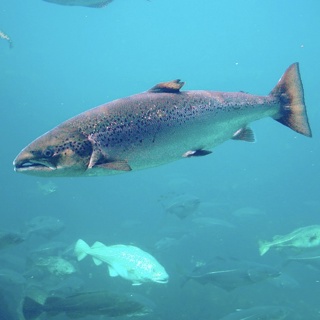
Image caption: An Atlantic salmon. In the U.S., the Washington state legislature banned farming of Atlantic salmon in 2018. A state official banned all commercial finfish aquaculture. Alaska and California have similar bans. Image by Hans-Petter Fjeld via Wikimedia Commons (CC BY-SA 2.5).

---

Timecodes

(00:00) Aquaculture and its impacts

(15:32) How values shape environmental policy

(32:56) The tragedy of the commons

(35:52) Ecological empathy

(45:07) Credits

Det här avsnittet är hämtat från ett öppet RSS-flöde och publiceras inte av Podme. Det kan innehålla reklam.

Avsnitt(360)

A 'coalition of the willing' to urge the world to drop fossil fuels

A 'coalition of the willing' to urge the world to drop fossil fuels

A group of 57 nations mostly from the Global South, describing themselves as "coalition of the willing" intent on making the Transition Away From Fossil Fuels, or TAFF, convened in the Colombian city ...

2 Juni 33min

Australia claims it's 'on track' to meet its environment targets. Scientists disagree

Australia claims it's 'on track' to meet its environment targets. Scientists disagree

Australia is one of 17 "megadiverse" countries that account for 70% of Earth's biodiversity. However, Australia is unique in having the highest mammalian extinction rate in the world. That makes cons...

26 Maj 42min

The world must address pandemic threats urgently, says former CDC officer

The world must address pandemic threats urgently, says former CDC officer

"[The]cruel irony here [is] that the world cannot get its act together to address these threats … people are dying, animals are suffering, we're losing rainforest … these are all interconnected threat...

19 Maj 35min

Protest works, but it needs your help now more than ever, veteran activists say

Protest works, but it needs your help now more than ever, veteran activists say

"We are experiencing what some people call sort of a shutdown of the public square in the United States and around the world," says veteran environmental activist André Carothers. Along with the forme...

12 Maj 51min

A new Netflix documentary captures rare mountain gorilla behavior

A new Netflix documentary captures rare mountain gorilla behavior

"That might be something that you see in a decade, not in two years of filming," Tara Stoinksi, CEO of the Dian Fossey Gorilla Fund, tells me. The behavior she's referring to occurs in mountain gorill...

5 Maj 38min

Centering an Indigenous approach to forestry through reciprocity, not extraction

Centering an Indigenous approach to forestry through reciprocity, not extraction

Forester and scientist Suzanne Simard is well known for her landmark 1997 paper, which demonstrated that two distinct species of trees could share resources. At the time, it turned traditional Western...

28 Apr 41min

Across oceans, seabird flyways gain recognition — and a chance at protection

Across oceans, seabird flyways gain recognition — and a chance at protection

The routes taken by migratory birds, known as flyways, often cross vast expanses of ocean. Six of these marine flyways have now been formally recognized by the U.N.'s Convention on Migratory Species,...

21 Apr 28min

The coyotes next door: What we get wrong about America's 'song dog'

The coyotes next door: What we get wrong about America's 'song dog'

Coyotes are now present in almost every major urban-metropolitan area in the United States, yet conflicts between the canines and humans are exceptionally low. Between 1960 and 2006, only 146 docume...

14 Apr 44min

Populärt inom Vetenskap

p3-dystopia
dumma-manniskor
allt-du-velat-veta
kapitalet-en-podd-om-ekonomi
rss-ufobortom-rimligt-tvivel
svd-nyhetsartiklar
rss-vetenskapsradion
det-morka-psyket
rss-spraket
paranormalt-med-caroline-giertz
sexet
halsorevolutionen
rss-vetenskapsradion-2
rss-odla
rss-broccolipodden-en-podcast-som-inte-handlar-om-broccoli
medicinvetarna
dumforklarat
rss-ronden
rss-italiensk-dagbok
vetenskapsradion