
Hiatal Hernia
PodcastDX7 Dec 2021

Hiatal Hernia

A hiatal hernia occurs when the upper part of your stomach bulges through the large muscle separating your abdomen and chest (diaphragm).

Your diaphragm has a small opening (hiatus) through which your food tube (esophagus) passes before connecting to your stomach. In a hiatal hernia, the stomach pushes up through that opening and into your chest.

A small hiatal hernia usually doesn't cause problems. You may never know you have one unless your doctor discovers it when checking for another condition.

But a large hiatal hernia can allow food and acid to back up into your esophagus, leading to heartburn. Self-care measures or medications can usually relieve these symptoms. A very large hiatal hernia might require surgery.

As discussed in earlier episodes, Lita has Ehlers Danlos and it turns out this is the cause of her fourth hernia we will talk about today.

"Gastrointestinal (GI) manifestations are found in Ehlers Danlos syndrome (EDS) hypermobility subtype (HM). We aimed to assess associations between EDS HM and other EDS subtypes with GI manifestations. Methods: We reviewed medical records of EDS patients evaluated at Mayo Clinic's Medical Genetics Clinic 1994-2013. We extracted information regarding EDS subtypes, GI manifestations, and treatments. Key Results: We identified 687 patients; 378 (56%) had associated GI manifestations (female 86.8%, diagnosis mean age 29.6 years). Of the patients identified, 58.9% (43/73) had EDS classic, 57.5% (271/471) EDS HM, 47.3% (27/57) EDS vascular subtypes. In addition, 86 patients had EDS that could not be classified in any of those three subtypes. Commonest GI symptoms were: abdominal pain (56.1%), nausea (42.3%), constipation (38.6%), heartburn (37.6%), and irritable bowel syndrome-like symptoms (27.5%). Many GI symptoms were commoner in EDS HM than the other subtypes together. Among 37.8% of the 378 patients who underwent esophagogastroduodenoscopy, the commonest abnormalities were gastritis, hiatal hernia and reflux esophagitis. Abnormal gastric emptying was observed in 22.3% (17/76): 11.8% delayed and 10.5% accelerated. Colonic transit was abnormal in 28.3% (13/46): 19.6% delayed and 8.7% accelerated. Rectal evacuation disorder was confirmed in 18/30 patients who underwent anorectal manometry. Angiography showed aneurysms in abdominal vessels in EDS vascular type. Proton pump inhibitors (38%) and drugs for constipation (23%) were the most commonly used medications. A minority underwent colectomy (2.9%) or small bowel surgery (4%). Conclusions & Inferences: EDS HM and other subtypes should be considered in patients with chronic functional GI symptoms and abdominal vascular lesions." (credits Mayo Clinic)

Det här avsnittet är hämtat från ett öppet RSS-flöde och publiceras inte av Podme. Det kan innehålla reklam.

Avsnitt(441)

Ai and Robotics in Medicine

Ai and Robotics in Medicine

This week on PodcastDX, Dr. Sanjeev Kumar joins Lita, Ron, and Jean Marie to discuss AI and robotics in medicine—from surgical robots and rehabilitation technology to hospital automation, patient safe...

1 Sep 47min

EECP The Most Underutilized Therapy in Medicine

EECP The Most Underutilized Therapy in Medicine

Retired U.S. Coast Guard Master Chief Petty Officer Jack Clifford joins PodcastDX to share how severe chronic angina once limited even everyday activities and left him facing the possibility of triple...

25 Aug 44min

Diary of An Epileptic

Diary of An Epileptic

In this episode of PodcastDX, we speak with Allany Muniz, founder of Diary of an Epileptic, about the realities of living with epilepsy beyond what most people see. Allany shares how her diagnosis cha...

18 Aug 28min

Memory Villages

Memory Villages

Memory Villages explores the promise and the questions surrounding dementia villages—care communities designed to feel more like neighborhoods than institutions. We discuss how familiar surroundings, ...

11 Aug 17min

Ebola

Ebola

In this PodcastDX episode, Lita and Jean Marie unpack Ebola as a severe but not casually spread viral disease, explaining that infection requires direct contact with blood or other body fluids or cont...

4 Aug 23min

Sunscreen

Sunscreen

In this week's episode of PodcastDX, Lita and Jean Marie break down why sunscreen is about far more than avoiding a bad sunburn—it's everyday cancer prevention. They explain how UV damage happens whil...

28 Juli 17min
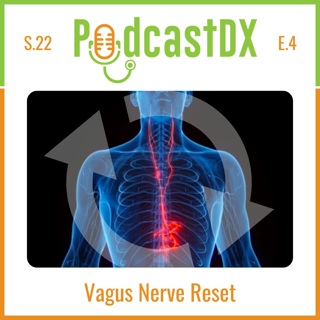
Vagus Nerve Reset

Vagus Nerve Reset

In this solo PodcastDX episode, Lita introduces the concept of the vagus nerve and explains why it has become such a focus in wellness, neurology, psychiatry, and online health spaces. She describes t...

21 Juli 17min

When Seconds Matter

When Seconds Matter

"When Seconds Matter" is a strong, urgent PodcastDX episode.  It is a personal story about emergency response and the critical minutes before help arrives. It's focused on recognizing danger early, ca...

14 Juli 14min

Populärt inom Hälsa

somna-med-henrik
rss-jossan-nina
bullfika
rss-bara-en-till-om-beroende-medberoende
inga-beiga-morsor
rss-vuxna-pa-latsas
not-fanny-anymore
rss-viktmedicinpodden
sexnoveller-deluxe
johannes-hansen-podcast
angestpodden
sa-in-i-sjalen
rss-hos-psykologen
tyngre-traningssnack
sova-med-dan-horning
rss-sjalsligt-avkladd
rss-traningsklubben
halsorevolutionen
sex-pa-riktigt-med-marika-smith
medicinvetarna