

Audrey Tang on the Technology of Democracy
Audrey Tang began reading classical works like the Shūjīng and Tao Te Ching at the age of 5 and learned the programming language Perl at the age of 12. Now, the autodidact and self-described "conservative anarchist" is a software engineer and the first non-binary digital minister of Taiwan. Their work focuses on how social and digital technologies can foster empathy, democracy, and human progress. Audrey joined Tyler to discuss how Taiwan approached regulating Chinese tech companies, the inherent extraterritoriality of data norms, how Finnegans Wake has influenced their approach to technology, the benefits of radical transparency in communication, why they appreciate the laziness of Perl, using "humor over rumor" to combat online disinformation, why Taiwan views democracy as a set of social technologies, how their politics have been influenced by Taiwan's indigenous communities and their oral culture, what Chinese literature teaches about change, how they view Confucianism as a Daoist, how they would improve Taiwanese education, why they view mistakes in the American experiment as inevitable – but not insurmountable, the role of civic tech in Taiwan's pandemic response, the most important remnants of Japanese influence remaining in Taiwan, why they love Magic: The Gathering, the transculturalism that makes Taiwan particularly open and accepting of LGBT lifestyles, growing up with parents who were journalists, how being transgender makes them more empathetic, the ways American values still underpin the internet, what they learned from previous Occupy movements, why translation, rotation, and scaling are important skills for becoming a better thinker, and more. Read a full transcript enhanced with helpful links, or watch the full video. Recorded September 24th, 2020 Other ways to connect Follow us on Twitter and Instagram Follow Tyler on Twitter Follow Audrey on Twitter Email us: cowenconvos@mercatus.gmu.edu Subscribe at our newsletter page to have the latest Conversations with Tyler news sent straight to your inbox.
7 Okt 202053min

Alex Ross on Music, Culture, and Criticism
To Alex Ross, good music critics must be well-rounded and have command of neighboring cultural areas. "When you're writing about opera, you're writing about literature as well as music, you're writing about staging, theater ideas, as well as music," says the veteran music journalist and staff writer for The New Yorker. His most recent book, Wagnerism: Art and Politics in the Shadow of Music, explores the complicated legacy of Wagner, as well as how music shapes and is shaped by its cultural context. Alex joined Tyler to discuss the book, what gets lost in the training of modern opera singers, the effect of recording technology on orchestras, why he doesn't have "guilty pleasures," how we should approach Wagner today, the irony behind most uses of "Ride of the Valkyries" in cinema, his favorite Orson Welles film, his predictions for concert attendance after COVID-19, why artistic life in Europe will likely recover faster than in America, Rothko's influence on composer Morton Feldman, his contender for the greatest pop album ever made, how his Harvard dissertation on James Joyce prepared him for a career writing about music, and more. Read a full transcript enhanced with helpful links, or watch the full video. Recorded August 20th, 2020 Other ways to connect Follow us on Twitter and Instagram Follow Tyler on Twitter Email us: cowenconvos@mercatus.gmu.edu Subscribe at our newsletter page to have the latest Conversations with Tyler news sent straight to your inbox.
22 Sep 20201h 1min
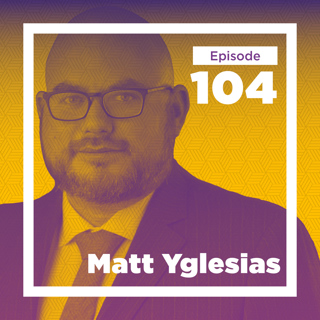
Matt Yglesias on Why the Population is Too Damn Low
Matt Yglesias joined Tyler for a wide-ranging conversation on his vision for a bigger, less politically polarized America outlined in his new book One Billion Americans: The Case for Thinking Bigger. They discussed why it's easier to grow Tokyo than New York City, the governance issues of increasing urban populations, what Tyler got right about pro-immigration arguments, how to respond to declining fertility rates, why he'd be happy to see more people going to church (even though he's not religious), why liberals and conservatives should take marriage incentive programs more seriously, what larger families would mean for feminism, why people should read Robert Nozick, whether the YIMBY movement will be weakened by COVID-19, how New York City will bounce back, why he's long on Minneapolis, how to address constitutional ruptures, how to attract more competent people to state and local governments, what he's learned growing up in a family full of economists, his mother's wisdom about visual design and more. Read a full transcript enhanced with helpful links, or watch the full video. Recorded August 21st, 2020 Other ways to connect Follow us on Twitter and Instagram Follow Tyler on Twitter Follow Matt on Twitter Email us: cowenconvos@mercatus.gmu.edu Subscribe at our newsletter page to have the latest Conversations with Tyler news sent straight to your inbox.
9 Sep 20201h 6min

Jason Furman on Productivity, Competition, and Growth
Note: This conversation was recorded in January 2020. Tyler credits Jason Furman's intellectual breadth, real-world experience, and emphasis on policy for making him the best economist in the world. Furman, despite not initially being interested in public policy, ultimately served as the chair of the Council of Economic Advisors under President Obama thanks to a call from Joe Stiglitz while still in grad school. His perspective is as idiosyncratic as his career trajectory, seeing the world of economic policy as a series of complex tradeoffs rather than something reducible to oversimplified political slogans. Jason joined Tyler for a wide-ranging conversation on how monopolies affect investment patterns, his top three recommendations to improve American productivity, why he's skeptical of place-based development policies, what some pro-immigration arguments get wrong, why he's more concerned about companies like Facebook and Google than he is Walmart and Amazon, the merits of a human rights approach to privacy, whether the EU treats tech companies fairly, having Matt Damon as a college roommate, the future of fintech, his highest objective when teaching economics, what he learned from coauthoring a paper with someone who disagrees with him, why he's a prolific Goodreads reviewer, and more. Read a full transcript enhanced with helpful links. Recorded January 16th, 2020 Other ways to connect Follow us on Twitter and Instagram Follow Tyler on Twitter Follow Jason on Twitter Email us: cowenconvos@mercatus.gmu.edu Subscribe at our newsletter page to have the latest Conversations with Tyler news sent straight to your inbox.
26 Aug 20201h 1min

Nicholas Bloom on Management, Productivity, and Scientific Progress
What might the electrification of factories teach us about how quickly we'll adapt to remote work? What gives American companies an edge over their competitors on the international stage? What value do management consultants really provide? Stanford professor Nick Bloom's research studies how management practices, productivity techniques, and uncertainty shape outcomes across companies and countries. He joined Tyler for a conversation about which areas of science are making progress, the factors that have made research more expensive, why government should invest more in R&D, how lean management transformed manufacturing, how India's congested legal system inhibits economic development, the effects of technology on Scottish football hooliganism, why firms thrive in China, how weak legal systems incentivize nepotism, why he's not worried about the effects of remote work on American productivity (in the short-term), the drawbacks of elite graduate programs, how his first "academic love" shapes his work today, the benefits of working with co-authors, why he prefers periodicals and podcasts to reading books, and more. Read a full transcript enhanced with helpful links, or watch the full video. Recorded July 13th, 2020 Other ways to connect Follow us on Twitter and Instagram Follow Tyler on Twitter Follow Nick on Twitter Email us: cowenconvos@mercatus.gmu.edu Subscribe at our newsletter page to have the latest Conversations with Tyler news sent straight to your inbox.
12 Aug 20201h 3min

Nathan Nunn on the Paths to Development
Nathan Nunn's work history includes automotive stores, a freight company, a paint factory, a ski hill, photography, book publishing, private tutoring, and more. Having grown up in a lower-income Canadian family, he recognizes the importance of having multiple pathways to climb the socioeconomic ladder. Now, as a development economist at Harvard, his research investigates how things like history, culture and contract enforcement shape the development paths of nations. Nathan joined Tyler for a conversation about which African countries a theory of persistence would lead him to bet on, why so many Africans live in harder to settle areas, his predictions for the effects of Chinese development on East Africa, why genetic distance is a strong predictor of bilateral income differences and trade, the pleasant surprises of visiting the Democratic Republic of Congo, the role of the Catholic Church in the development of the West, why Canadian football is underrated, the unique commutes of Ottawans, the lack of Canadian brands, what's missing from most economic graduate programs, the benefits of studying economics outside of the United States, how the plow shaped gender roles in the societies that used it, the cultural values behind South Korea's success, and more. Read a full transcript enhanced with helpful links, or watch the full video. Recorded July 10th, 2020 Other ways to connect Follow us on Twitter and Instagram Follow Tyler on Twitter Follow Nathan on Twitter Email us: cowenconvos@mercatus.gmu.edu Subscribe at our newsletter page to have the latest Conversations with Tyler news sent straight to your inbox.
29 Juli 20201h 1min

Melissa Dell on the Significance of Persistence
Explaining 10 percent of something is not usually cause for celebration. And yet when it comes to economic development, where so many factors are in play—institutions, culture, geography, to name a few—it's impressive indeed. And that's just what Melissa Dell has accomplished in her pathbreaking work. From the impact of the Mexican Revolution to the different development paths of northern and southern Vietnam, her work exploits what are often accidents of history—whether a Peruvian village was just inside or outside a mine's catchment area, for example—to explain persistent differences in outcomes. Her work has earned numerous plaudits, including the John Bates Clark Medal earlier this year. On the 100th episode of Conversations with Tyler, Melissa joined Tyler to discuss what's behind Vietnam's economic performance, why persistence isn't predictive, the benefits and drawbacks of state capacity, the differing economic legacies of forced labor in Indonesia and Peru, whether people like her should still be called a Rhodes scholar, if SATs are useful, the joys of long-distance running, why higher temps are bad for economic growth, how her grandmother cultivated her curiosity, her next project looking to unlock huge historical datasets, and more. Read a full transcript enhanced with helpful links, or watch the full video. Recorded July 30th, 2020 Other ways to connect Follow us on Twitter and Instagram Follow Tyler on Twitter Follow Melissa on Twitter Email us: cowenconvos@mercatus.gmu.edu Subscribe at our newsletter page to have the latest Conversations with Tyler news sent straight to your inbox.
15 Juli 20201h 3min

Annie Duke on Poker, Probabilities, and How We Make Decisions
For Annie Duke, the poker table is a perfect laboratory to study human decision-making — including her own. "It really exposes you to the way that you're thinking," she says, "how hard it is to avoid decision traps, even when you're perfectly well aware that those decision traps exist. And how easy it is for like your mind to slip into those traps." She's spent a lot of time studying human cognition at the poker table and off it — her best-known academic article is about psycholinguistics and her forthcoming book is titled How to Decide: Simple Tools for Making Better Choices. Annie joined Tyler to explore how payoffs aren't always monetary, the benefits and costs of probabilistic thinking, the "magical thinking" behind why people buy fire insurance but usually don't get prenups, the psychology behind betting on shark migrations, how her most famous linguistics paper took on Steven Pinker, how public policy would change if only the top 500 poker players voted, why she wasn't surprised to lose Celebrity Apprentice to Joan Rivers, whether Trump has a tell, the number one trait of top poker players, and more. Read a full transcript enhanced with helpful links, or watch the full video. Recorded June 24th, 2020 Other ways to connect Follow us on Twitter and Instagram Follow Tyler on Twitter Follow Annie on Twitter Email us: cowenconvos@mercatus.gmu.edu Subscribe at our newsletter page to have the latest Conversations with Tyler news sent straight to your inbox.
1 Juli 202054min