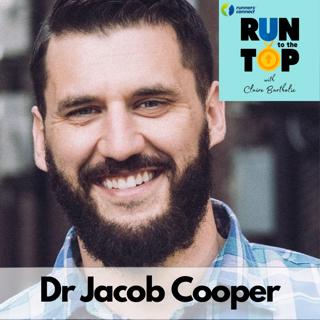

How to Finally Win Your Inner Negative Mental Battle and Become Stronger and Faster: Dr Jacob Cooper

How to Finally Win Your Inner Negative Mental Battle and Become Stronger and Faster: Dr Jacob Cooper

Many runners face constant negative mental battle when the run starts to get hard. If you are frequently struggling with negative thoughts, there is a way to win the mental battle.

Dr. Jacob Cooper has the answers.

Jacob breaks down exactly what you need to do and exactly when you need to do it, to convert your self-talk that's telling you to quit, to an ally that lets the real you triumph. So if you want to perform better at running, or really at anything in life that's challenging, keep listening and be ready to apply Dr Cooper's techniques, and finally win the negative mental battle when running hard.

Jacob is a clinical sport psychologist who serves as the director of sport psychology at Appalachian State University in Western North Carolina. A former college athlete himself, he has worked with professional and amateur athletes, Olympians, and Paralympians. He has an extensive background in mental health and how it ties to performance. Jacob has developed a style of working with athletes that focuses on them holistically, with the goal of performance optimization in the pursuit of excellence.

Jacob Cooper Ph.D. - Full Bio

Dr. Cooper is a clinical sport psychologist who serves as the director of sport psychology at Appalachian State University in addition to his own private practice serving professional and amateur athletes. He is a member of the United States Olympic & Paralympic athlete mental health registry, which consists of a selected group of specialized sports psychologists who are thoroughly vetted by the USOPC and then made available to current U.S. Olympians & Paralympians.

As a former collegiate offensive lineman turned amateur triathlete and runner (Hello Clydesdale Division!), Jacob has worked with athletes at the Olympic, Professional, and Division-1 level over the course of his career. As a sport psychologist, Dr. Cooper brings an extensive background in mental health and performance enhancement. To this end, he has developed a style of working with athletes that focuses on them holistically, across the spectrum of future-oriented performance optimization, current personal barriers/stressors, as well as more significant mental health issues that can inevitably show up in the pursuit of excellence.

As a doctoral student at Boston University, he completed clinical practicums within a variety of settings, including the U.S. Department of Veterans Affairs (VA), the Federal Bureau of Prisons system (BOP) along with multiple D1 college sport medicine teams as a performance consultant. Additionally, he has published scholarly articles and cultivated a unique approach to working with athletes and teams that integrates the latest research, evidence-based strategies, and technology to help them reach their goals.

In addition to high performance populations, he has a unique background and training in the areas of rural mental health, trauma recovery, serving low help-seeking populations, and military psychology. He has provided performance optimization for military personnel prior to their deployments as well as counseling for veterans transitioning back to civilian life throughout Western North Carolina, Indiana, and Boston.

Dr. Jacob Cooper- Ph.D. Clinical Sport Psychologist.

Director of Sport Psychology Services at Appalachian State University

Licensed Clinical Psychologist & Health Service Provider (HSP)

U.S. Olympic & Paralympic Sport Psychology Registry Member

Education Background:

B.A.- (Psychology) Taylor University (Indiana)- 4 year scholarship athlete & team captain (Football)

Dual Masters Degree- Ball State University (Indiana)

M.S.- Sport and Performance Psychology

M.A.- Clinical Psychology

PhD- Counseling Psychology (Sport and Performance Track)- Boston University

Matched Clinical Residency - Charles George Veterans Hospital - Asheville North Carolina.


Questions Jacob is asked:

3:59 I first found out about you from an Instagram post that the folks at ZAP posted. You were working with the elites at ZAP helping them build some mental strength. Can you tell me a little bit about how you worked with them?

5:03 How do elite and regular runners find motivation and purpose when a lot of races have been taken off the board?

6:19 Maybe this pandemic is a silver lining or maybe it's a gift because we can look at our running in a different way because we're all going to get slower as we age and performance is a huge part of why we do it, at least for some people, but once you take those PRs and the clock away, why do we run? That's got to be the most important thing, right?

7:28 We always talk about, "I want to get mentally tough," because clearly it's not just our bodies. We can train our bodies to do certain things but if the brain is not onboard, the train's not going to get all the way to the station. So how do we train our brain to be mentally tougher when things get hard?

8:30 I'm going to use myself as an example. When I'm running really hard or trying for a specific goal, I have the devil and the angel on my shoulder. I have the voice saying, "Go, go, go. You can do this." And then I have a very, very sweet devil saying, "Everybody still loves you no matter what you run. You can slow down. This is really hard." So I'm fighting these two opposing things that are 100% me and I really want to tell the devil to shut up and I really want to keep moving hard. How do I do that?

11:30 So the feelings come and we're supposed to say, "Oh hello, feeling," and let it go on its way. Is that what we're supposed to be doing when we're trying to run that 400 meter repeat really hard?

12:43 Can you give us a few examples of mental tools that we can use? What's in the toolbox?

14:37 What is radical acceptance in your RISE model?

16:32 What does the I in RISE mean?

23:50 What does the S in RISE mean?

25:23 Do you have any hints for people who don't know what their optimal performance cues are?

26:18 When I'm running well in a race or in a group setting, I definitely lock on the dude in front of me. I'm laser focused on him and I pretend that I have a rope attached to him and I pretend that he's pulling me. And I just link up to him like a train like I am not letting this person go. It works for me.

27:13 What does the E in RISE stand for?

29:06 Let's talk about the difference between psychology of teams and the psychology of athletes that are in an individual sport. Can you address that a little bit? Or is it the same just on a different level? Are we all talking to ourselves like we would talk to a bunch of people?

31:58 What about teams of runners? What about groups of runners where they're obviously not always running the same races but they train together? They are in a team environment where they eat, sleep, and work out together and it's been proven that we work differently in a group setting. Can you talk about that?

33:31 Especially with the pandemic, we're seeing more and more runners find support, find a tribe, find a group of people online that they haven't been able to find before, and a lot of people are finding it incredibly helpful. Especially runners are typically Type A, loner, data nerds (or maybe I'm just speaking for myself!), but a group setting isn't typically comfortable for people who love to spend hours alone running, so any advice for that lone runner who maybe shies away from a group?

35:48 You help athletes work on their mental health issues. And we think about elite runners especially as just having these super tough brains that are as tough as their bodies and they are able to do amazing things that the regular people can't do. So we think that they are just some kind of machine when it comes to their minds but I suspect that you find some mental health issues. Can you talk a little bit about that?

39:36 People who drive themselves so hard to be excellent, they're a specific breed of people and you look at them and you wonder if they did have some trauma. Why in the world are they pushing themselves to these extreme limits? Do you find that that is really the case that people that are just absolutely at the top of their game are more likely to have had some kind of trauma in their past?

41:58 One thing I really wanted to talk to you about is the whole concept of balance. When we are striving for something, whether it's athletics, a career, parenting, sacrifice is inevitable and balance is simply not possible (or desired). How can we reach our goals without letting everything else fall apart?

45:21 What is next for you and what questions in sports psychology are you looking to get answered in the future?

Questions I ask everyone:

48:54 If you could go back and talk to yourself when you started running, what advice would you give?

50:04 What is the greatest gift running has given you?

51:33 Where can listeners connect with you?

Quotes by Jacob:

"That 'why' is such a valuable thing and it's very easy in athletics to sometimes lose touch with that."

"I think that it's helpful to have multiple fuel sources because there's costs to them all."

"Your attention is a muscle. It's like a spotlight that allows you to shift to what matters most right now. I call these optimal performance cues or OPCs."

"Anywhere that there's pressure and stress, we're all capable of that impacting us and manifesting in the form of some level of mental distress whether it's just some symptoms of anxiety, depression, eating disorders, trauma, or it's like a full blown chronic disorder and something like that."

"There's going to be times and seasons of life that feel unbalanced. But I believe that in every season of life it is possible and worthwhile to live in a way that reflects our values."


Take a Listen on Your Next Run

Leave a space for libsyn link

Want more awesome interviews and advice? Subscribe to our iTunes channel

Mentioned in this podcast:

ZAP Endurance

Runners Connect Winner's Circle Facebook Community

RunnersConnect Facebook page

RunnersConnect Focus Classes

email Coach Claire

Follow Jacob on:

dr.coopercc@gmail.com

Instagram

Running with Heart


We really hope you've enjoyed this episode of Run to the Top.

The best way you can show your support of the show is to share this podcast with your family and friends and share it on your Facebook, Twitter, or any other social media channel you use.

The more people who know about the podcast and download the episodes, the more I can reach out to and get top running influencers, to bring them on and share their advice, which hopefully makes the show even more enjoyable for you!


Det här avsnittet är hämtat från ett öppet RSS-flöde och publiceras inte av Podme. Det kan innehålla reklam.

Avsnitt(768)

The #1 Easy Pace Mistake That Wrecks Your Fall Marathon Training

The #1 Easy Pace Mistake That Wrecks Your Fall Marathon Training

Welcome back to Run to the Top! After a year-long break, we're back with a new format, a new permanent co-host in Coach Sara, and a lineup of new segments designed to make this show more interactive a...

24 Juni 38min

Learning From Injury Setbacks to Run Smarter & Faster

Learning From Injury Setbacks to Run Smarter & Faster

Pretty much every runner deals with injury setbacks. The silver lining is that the recovery process can teach many important lessons. Coach Andie Cozzarelli joins us on the show to chat about her own ...

25 Juni 20251h 13min

Exploring The AI Running Revolution with Dr. John Holash and Dr. Cody Ray van Rassel

Exploring The AI Running Revolution with Dr. John Holash and Dr. Cody Ray van Rassel

The technological revolution has taken over running. Dr. John Holash and Dr. Cody Ray van Rassel are specialists in exercise physiology at the University of Calgary. We brought them on today's show to...

18 Juni 20251h 31min

How Coach James McKirdy is Bringing the Pro Treatment to Everyday Runners

How Coach James McKirdy is Bringing the Pro Treatment to Everyday Runners

Coach James McKirdy is bringing the pro treatment to non-professional athletes by offering the McKirdy Micro Race series with services like personal pacing and bottle service. We brought James on to ...

11 Juni 20251h

The Science Behind Ketones as Fuel Source with Founder of Ketone IQ Michael Brandt

The Science Behind Ketones as Fuel Source with Founder of Ketone IQ Michael Brandt

Michael Brandt founded Ketone IQ after noticing its high metabolic efficiency to make fueling with ketones easier. We're bringing him on the show to chat all about ketones including: How he got start...

4 Juni 20251h 5min

Interview with Wayne Larden - TCS Sydney Marathon Race Director

Interview with Wayne Larden - TCS Sydney Marathon Race Director

The TCS Sydney Marathon is the newest Abbot World Marathon Major and we're joined by race director Wayne Larden to learn more about it. We'll answer questions like: How did the Sydney Marathon become...

28 Maj 202532min

How to Run with your Slower (or Much Faster) Friends

How to Run with your Slower (or Much Faster) Friends

Running in groups adds a social element to training but it can be tricky finding a pace that works for everyone involved. Today's show is all about getting the most out of training in groups and we'll...

21 Maj 202552min

Running News: Marathon Results Roundup, Grand Slam Track Debut, NCAA Paying Athletes Directly and More

Running News: Marathon Results Roundup, Grand Slam Track Debut, NCAA Paying Athletes Directly and More

We're covering the top news stories in running on today's show, including a roundup of headlines including: Top American performances at the Boston Marathon Women's course records at both the London ...

14 Maj 20251h 19min

Populärt inom Hälsa

somna-med-henrik
rss-bara-en-till-om-beroende-medberoende
rss-jossan-nina
inga-beiga-morsor
rss-vuxna-pa-latsas
bullfika
rss-viktmedicinpodden
rss-i-skallen-pa
not-fanny-anymore
johannes-hansen-podcast
sexnoveller-deluxe
rss-ronden
sa-in-i-sjalen
angestpodden
tyngre-traningssnack
rss-basta-livet
rss-traningsklubben
halsoveckan-by-tyngre
sova-med-dan-horning
dodsdomar