The Environmental Impact of Artificial Intelligence: Energy, Water, and Sustainability

The Environmental Impact of Artificial Intelligence: Energy, Water, and Sustainability

Meteorology Matters is testing episodes in English and Spanish.

  • Seasons 1–100: English Episodes
  • Temporadas 101–200: Episodios en Español

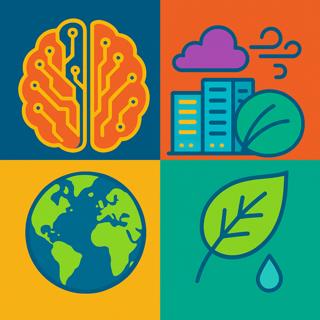
The rapid integration of Artificial Intelligence (AI) into daily life is driving an unprecedented and escalating demand for computational resources, resulting in a significant and growing environmental footprint. This briefing synthesizes key data on AI's consumption of energy and water, its contribution to carbon emissions and e-waste, and the emerging strategies for mitigating these impacts.

The core of AI's environmental burden lies in the vast data centers required to train and operate its models. These facilities consumed 4.4% of U.S. electricity in 2023, a figure projected to triple by 2028. Globally, data center electricity consumption is on track to double between 2022 and 2026, reaching a level comparable to the entire nation of Japan. This surge is primarily fueled by generative AI, which requires constant, reliable power, thereby increasing dependence on fossil fuels and locating data centers in regions with higher-carbon energy grids.

Beyond electricity, AI's thirst for water to cool its hardware is creating acute, localized crises. Reports indicate that major tech companies' water usage has increased by as much as 34% in a single year, straining municipal supplies, impacting local communities, and sparking protests in regions from the U.S. to South America.

A critical challenge in addressing these issues is the pervasive lack of transparency from technology companies, which treat their resource consumption data as trade secrets. This "black box" approach hinders effective regulation, research, and public accountability. In response, legislative and standardization efforts are beginning to emerge in the U.S. and E.U. to mandate reporting.

While the energy cost of training models like GPT-4 is immense—estimated at over 50 gigawatt-hours—the majority of AI's energy demand (80-90%) now comes from "inference," the day-to-day use of these models by billions of users. The future trajectory points toward even greater consumption, with the development of AI "agents" and "reasoning models" that could require orders of magnitude more energy. Proposed solutions focus on a multi-pronged strategy: developing more efficient AI models and hardware, transitioning data centers to renewable energy sources, and fostering interdisciplinary research to guide sustainable development.

Det här avsnittet är hämtat från ett öppet RSS-flöde och publiceras inte av Podme. Det kan innehålla reklam.

Avsnitt(241)

Europe’s Deadliest Weather Disaster Is Happening Right Now

Europe’s Deadliest Weather Disaster Is Happening Right Now

A powerful early-season heat dome is pushing temperatures above 40°C across parts of Europe, threatening records from Spain and France to the United Kingdom. In this episode of Meteorology Matters, me...

24 Juni 53min

Twenty Years Later: What Scientists Got Right

Twenty Years Later: What Scientists Got Right

Twenty years after An Inconvenient Truth, how well have scientific warnings held up?In this episode of Meteorology Matters, we examine the lessons of the past two decades, from the recovery of the ozo...

19 Juni 32min

America is Going Ocean Blind: Critical Sensors Are Being Removed

America is Going Ocean Blind: Critical Sensors Are Being Removed

Another major setback to US Ocean research policy due to the Trump Administration’s attack on science.The federal government is dismantling much of the Ocean Observatories Initiative, a vast network o...

5 Juni 26min

The Hurricane Checklist Most People Forget: How to Make Your Home Survive the Storm

The Hurricane Checklist Most People Forget: How to Make Your Home Survive the Storm

Hurricane season is here, but real preparation is about more than buying water and batteries.In this episode of Meteorology Matters, created by meteorologist Rob Jones, we look at what actually helps ...

1 Juni 58min

FEMA’s Breaking Point: Can America Survive the Next Big Disaster?

FEMA’s Breaking Point: Can America Survive the Next Big Disaster?

As the 2026 hurricane season begins, FEMA faces one of the most turbulent periods in its history.More than 5,000 employees have left the agency since 2025. Leadership has changed repeatedly. Disaster-...

29 Maj 27min

Florida Homes Are Being Lifted Into the Sky Before Hurricane Season

Florida Homes Are Being Lifted Into the Sky Before Hurricane Season

Florida is witnessing one of the biggest transformations in coastal housing history.Across the state, homeowners are spending hundreds of thousands of dollars to raise entire homes above floodwaters a...

27 Maj 21min

Better Weather Forecasts, Growing Uncertainty

Better Weather Forecasts, Growing Uncertainty

Weather forecasting has never been more advanced. Yet many scientists say Earth’s atmosphere and oceans may be becoming more interconnected, nonlinear, and difficult to fully model.In this episode of ...

23 Maj 42min

When Politics Turns on Science Globally

When Politics Turns on Science Globally

Weather scientists are increasingly being ignored, censored, arrested, or pushed aside by political movements around the world. From NOAA staffing cuts in the United States to jailed earthquake scient...

15 Maj 45min

Populärt inom Politik & nyheter

aftonbladet-krim
svenska-fall
tv4-nyheterna-story
p3-krim
rss-krimstad
motiv
de-fyras-gang
spar
flashback-forever
aftonbladet-daily
rss-expressen-dok
rss-sanning-konsekvens
rss-krimreportrarna
rss-flodet
rss-vad-fan-hande
politiken
rss-frandfors-horna
krimmagasinet
kungligt
svd-dokumentara-berattelser-2