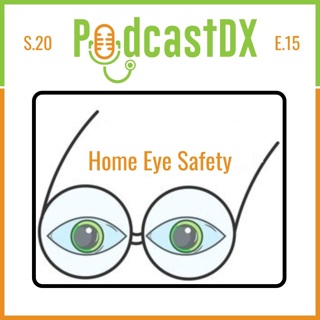

Home Eye Safety
PodcastDX11 Nov 2025

Home Eye Safety

Did you know that about half of all eye injuries happen right at home?

Home activities that can injure your eyes include:

  • Cleaning. Chemicals like bleach in household cleaning products cause 125,000 eye injuries each year.
  • Home Improvement. Screws, nails and hand tools can launch into the air—and into your eyes.
  • Power tools can also send wood chips or other substances flying into the air.
  • Yard Work. Lawn mowers, trimmers and even shovels can throw dirt and debris into the air. Branches, twigs and thorns can also be dangerous.


Unfortunately, only about three out of 10 people wear protective eyewear during home projects that could hurt their eyes. The good news? Simply wearing protective eyewear can reduce your risk for eye injury by 90 percent!

The American Academy of Ophthalmology urges every household to have at least one pair of ANSI-approved protective eyewear. ("ANSI-approved" means the protective eyewear is made to meet safety standards of the American National Standards Institute.)

  • In the house
    • Using dangerous chemicals such as oven cleaner and bleach (accidents involving common household products cause 125,000 eye injuries each year). Read the labels of chemicals and cleaners carefully, and don't mix products.
    • Cooking foods can that can splatter hot grease or oil. Use grease shields on frying pans to protect yourself from splattering.
    • Opening champagne bottles during a celebration. Wrap a towel or cloth around the top of the bottle while unscrewing it to "catch" the cork. Never point a champagne bottle towards another person or yourself when opening it.
    • Drilling or hammering screws or nails into walls or hard surfaces like brick or cement. The screws or nails can fly into the air, or fragments can come off the surface.
    • Using hot objects such as curling irons around your face. Contact with your eyes can cause serious injury.
    • Loose rugs and railings or other hazards that could cause falls or slips. Secure rugs with a non-slip pad underneath. Check to make sure railings are secure and not loose.
    • Put padding on sharp corners and edges if you have children or the elderly in your house.
  • In the yard
    • Mowing the lawn. Check the lawn or the outdoor area first for sticks, rocks or other items that can fly out from under the mower.
    • Using a power trimmer or edger.
    • Clipping hedges and bushes.
    • Playing sports.
  • In the garage or workshop
    • Using power or hand tools. Keep your tools in good condition; damaged tools should be repaired or replaced.
    • Working with solvents or other chemicals. Make sure that all spray nozzles are directed away from you.
    • Doing anything that can cause fragments or dust particles to fly around in the air.
    • Tying down equipment or loads with bungee cords. Bungee cords are a serious danger to eyes when they snap back.

For all of these activities, remember that people nearby also face serious risk. Bystanders should wear eye protection too or leave the area where the chore is being done. This is particularly important for children who watch their parents do chores in and around the home. (CREDITS: American Academy of Ophthalmology)

Det här avsnittet är hämtat från ett öppet RSS-flöde och publiceras inte av Podme. Det kan innehålla reklam.

Avsnitt(440)

EECP The Most Underutilized Therapy in Medicine

EECP The Most Underutilized Therapy in Medicine

Retired U.S. Coast Guard Master Chief Petty Officer Jack Clifford joins PodcastDX to share how severe chronic angina once limited even everyday activities and left him facing the possibility of triple...

25 Aug 44min

Diary of An Epileptic

Diary of An Epileptic

In this episode of PodcastDX, we speak with Allany Muniz, founder of Diary of an Epileptic, about the realities of living with epilepsy beyond what most people see. Allany shares how her diagnosis cha...

18 Aug 28min

Memory Villages

Memory Villages

Memory Villages explores the promise and the questions surrounding dementia villages—care communities designed to feel more like neighborhoods than institutions. We discuss how familiar surroundings, ...

11 Aug 17min

Ebola

Ebola

In this PodcastDX episode, Lita and Jean Marie unpack Ebola as a severe but not casually spread viral disease, explaining that infection requires direct contact with blood or other body fluids or cont...

4 Aug 23min
Sunscreen

Sunscreen

In this week's episode of PodcastDX, Lita and Jean Marie break down why sunscreen is about far more than avoiding a bad sunburn—it's everyday cancer prevention. They explain how UV damage happens whil...

28 Juli 17min
Vagus Nerve Reset

Vagus Nerve Reset

In this solo PodcastDX episode, Lita introduces the concept of the vagus nerve and explains why it has become such a focus in wellness, neurology, psychiatry, and online health spaces. She describes t...

21 Juli 17min
When Seconds Matter

When Seconds Matter

"When Seconds Matter" is a strong, urgent PodcastDX episode.  It is a personal story about emergency response and the critical minutes before help arrives. It's focused on recognizing danger early, ca...

14 Juli 14min

Heart, Brain & Immunity: New Clues After a Heart Attack

Heart, Brain & Immunity: New Clues After a Heart Attack

After a heart attack, the story doesn't end in the arteries. In this episode of PodcastDX, Lita and Jean Marie explore new science showing how the heart, brain, and immune system talk to each other du...

26 Maj 19min

Populärt inom Hälsa

somna-med-henrik
rss-jossan-nina
rss-bara-en-till-om-beroende-medberoende
bullfika
inga-beiga-morsor
rss-vuxna-pa-latsas
not-fanny-anymore
rss-viktmedicinpodden
angestpodden
sexnoveller-deluxe
johannes-hansen-podcast
rss-hos-psykologen
sa-in-i-sjalen
rss-basta-livet
sova-med-dan-horning
tyngre-traningssnack
halsoveckan-by-tyngre
rss-autismandan
rss-angra-inget-3
brottarbroder