The Azure AI Foundry Trap: RAG, Agents, Evaluators & How To Stop Shipping Hallucinations At Scale

The Azure AI Foundry Trap: RAG, Agents, Evaluators & How To Stop Shipping Hallucinations At Scale

You clicked because the title called Azure AI Foundry a trap—and in a way, it is, but not for the reason most people think. Foundry itself is a powerful platform; the real trap is treating it like a magic box instead of an engineering system that needs clean retrieval, hybrid search, and constant evaluation. In this episode, we unpack why multimodal apps and agents fail in real companies: models get fed junk inputs, retrieval is bolted on as an afterthought, and nobody is watching groundedness, relevance, or coherence before users are thrown into production pilots. You’ll get a survival playbook built from real‑world scars—not just slides—including how to wire RAG correctly with Azure AI Search, how to instrument evaluators, and how to stop your AI budget turning into a very expensive hallucination machine.

WHY MULTIMODAL APPS COLLAPSE OUTSIDE DEMOS

On stage, multimodal looks untouchable: clean inputs, crisp charts, flawless summaries. Inside your tenant, the story breaks—smudged IDs, fifth‑generation PDFs, shaky invoice photos, and CSVs that haven’t seen a data steward in years. We walk through why “garbage in, garbage out” hits multimodal even harder than text‑only apps, and why RAG is supposed to be the fix: models don’t invent policy from the internet, they answer against indexed, permission‑aware data from your own systems. But RAG only works if your retrieval is strong. That’s where Azure AI Search comes in with hybrid keyword + vector search plus semantic re‑ranking: it lets you combine literal matches with semantic meaning so the right context sits at the top of the pile instead of random wiki pages or the wrong contract version. We use real examples—like Carvana’s self‑service AI—to show how tuned retrieval and observability turn “AI demo toy” into something customers actually trust.

HELPFUL AGENT OR CHAOS AMPLIFIER?

Agents are where things really go off the rails. A copilot waits for you; an agent acts for you—and that difference is exactly where projects succeed or blow up. We break down why vague job descriptions like “optimize processes and provide insights” are deadly: unsupervised agents invent work, misclassify tickets, loop on the same errors, and quietly torch credibility. You’ll learn how to scope agents tightly around specific workflows (for example, triaging ServiceNow incidents or routing finance approvals), how to layer validation and human‑in‑the‑loop steps, and how to use telemetry so you see what the agent is doing before it floods your queues. We connect Copilot Studio (where makers define flows and prompts) with Azure AI Foundry’s Agent Service (where you actually monitor, evaluate, and govern agents) so you stop treating them like interns with admin rights and start treating them like production systems with SLAs.

STOP GUESSING – USE EVALUATORS AND TELEMETRY

Most Foundry failures share one thing: zero evaluation. Teams obsess over prompts and model sizes but never measure groundedness, truth‑to‑source, or output quality. In this episode, we show how Azure AI Foundry’s built‑in evaluators and observability tools are meant to be used as your standard operating procedure, not as optional add‑ons. You’ll see how to set up evaluation runs for key use cases, how to monitor drift as your data and prompts change, and how to feed these signals back into prompt design, retrieval tuning, and agent scope. We also talk concretely about cost and risk: the difference between a monitored RAG app that occasionally needs tuning and an unmanaged system that quietly starts giving wrong answers at scale. Once metrics are in place, AI moves from guesswork to something you can actually govern.

WHAT YOU’LL LEARN
  • Why multimodal apps look flawless in demos but fail on messy real‑world inputs.
  • How to design RAG with Azure AI Search using hybrid keyword + vector search and semantic re‑ranking.
  • The difference between copilots and agents—and how vague agent scope turns them into chaos amplifiers.
  • How to use Azure AI Foundry’s Agent Service, observability, and evaluators to keep agents grounded and accountable.
  • How to read groundedness, relevance, and coherence metrics and turn them into concrete fixes.
  • A practical checklist to decide if your Azure AI Foundry setup is a real platform or just an expensive experiment.
THE CORE INSIGHT

The core insight of this episode is that Azure AI Foundry is not the trap—treating it like a demo‑grade black box is. Multimodal models and agents only become reliable when you design retrieval, observability, and evaluation as first‑class architecture, not afterthoughts. Once you ground outputs with hybrid search, scope agents like production systems, and watch quality metrics as closely as uptime, AI shifts from “shiny risk” to a controlled part of your operating system—not a bonfire for budget and trust.

WHO THIS EPISODE IS FOR
  • AI and platform architects responsible for Azure AI Foundry and enterprise AI strategy.
  • Product and engineering leads shipping multimodal or agentic AI into real business workflows.
  • Security, risk, and compliance teams worried about hallucinations, drift, and uncontrolled automation.
  • Data and ML engineers who need a practical pattern to move from demo pilots to monitored, grounded AI systems.
ABOUT THE AUTHOR / HOST

Mirko Peters is a Microsoft 365 and AI governance consultant and host of the M365.FM podcast, helping organizations treat Microsoft 365, Azure, and their AI layer as one integrated operating system instead of scattered bots and experiments. He works with companies running on Microsoft 365, Azure, and Fabric to design architectures, security models, and AI governance that make copilots, agents, and Foundry projects auditable, grounded, and actually useful in production.


Become a supporter of this podcast: https://www.spreaker.com/podcast/m365-fm-modern-work-security-and-productivity-with-microsoft-365--6704921/support.

Det här avsnittet är hämtat från ett öppet RSS-flöde och publiceras inte av Podme. Det kan innehålla reklam.

Avsnitt(789)

Azure Virtual Desktop - Simply Explained

Azure Virtual Desktop - Simply Explained

Azure Virtual Desktop (AVD) is Microsoft's cloud-based desktop virtualization platform that delivers a complete Windows desktop and business applications securely from Azure to virtually any device. I...

17 Juli 18min
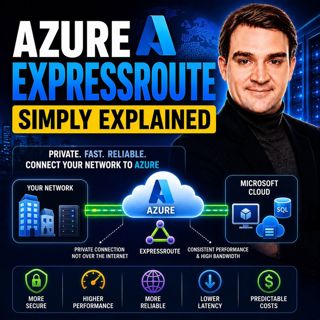
Azure ExpressRoute - Simply Explained

Azure ExpressRoute - Simply Explained

Azure ExpressRoute is Microsoft's private network connection service that links your on-premises infrastructure directly to Microsoft's global cloud network without using the public internet. Instead ...

17 Juli 13min
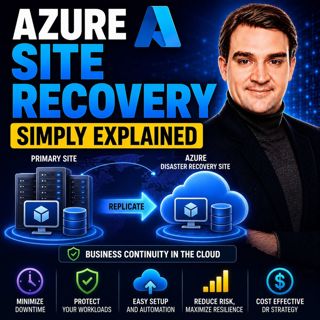
Azure Site Recovery - Simply Explained

Azure Site Recovery - Simply Explained

Azure Site Recovery (ASR) is Microsoft's disaster recovery service designed to keep your business running when an entire server, data center, or Azure region becomes unavailable. Instead of simply bac...

17 Juli 14min
Azure Backup - Simply Explained

Azure Backup - Simply Explained

Azure Backup is Microsoft's fully managed cloud backup service that protects your virtual machines, databases, file shares, disks, and even on-premises servers without requiring backup servers, tapes,...

17 Juli 16min
Azure NetApp Files - Simply Explained

Azure NetApp Files - Simply Explained

Azure NetApp Files (ANF) is Microsoft's enterprise-grade, ultra-high-performance file storage service built directly into Azure. Powered by NetApp's industry-leading storage technology, ANF delivers s...

17 Juli 15min

AI, Power Platform & Developer Experience: The Next Frontier with Reza Niroomand [MVP]

AI, Power Platform & Developer Experience: The Next Frontier with Reza Niroomand [MVP]

Artificial intelligence is transforming software development faster than ever before. Low-code platforms are becoming more powerful, professional developers are embracing AI-assisted coding, and enter...

17 Juli 1h
Azure Files - Simply Explained

Azure Files - Simply Explained

Azure Files is Microsoft's fully managed cloud file sharing service that allows you to create secure, scalable file shares without maintaining a traditional file server. Instead of purchasing hardware...

17 Juli 15min
Azure Kubernetes Service (AKS) - Simply Explained

Azure Kubernetes Service (AKS) - Simply Explained

Azure Kubernetes Service (AKS) is Microsoft's fully managed Kubernetes platform that makes it easier to deploy, manage, and scale containerized applications in Azure. Instead of building and maintaini...

17 Juli 18min
Populärt inom Politik & nyheter

aftonbladet-krim
svenska-fall
p3-krim
rss-krimstad
tv4-nyheterna-story
aftonbladet-daily
flashback-forever
rss-sanning-konsekvens
motiv
de-fyras-gang
rss-krimreportrarna
mannen-utan-spar
rss-vad-fan-hande
rss-frandfors-horna
spar
rss-flodet
rss-aftonbladet-krim
politiken
olyckan-inifran
krimmagasinet