
DH Ep:45 The Dust Bowl Migration

DH Ep:45 The Dust Bowl Migration

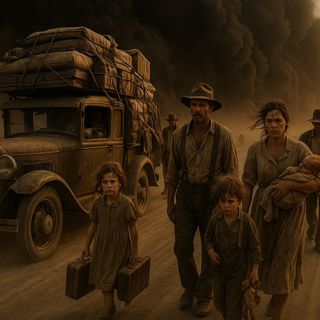
On April fourteenth, 1935, a wall of darkness seven thousand feet high and two hundred miles wide tore across the Great Plains at sixty miles per hour. Black Sunday wasn’t just a storm—it was the moment the Dust Bowl stopped being a hardship and became a breaking point. For hundreds of thousands of families already living in an apocalyptic landscape of dust, failed crops, and dying livestock, that day crushed whatever hope they had left.

What followed should have been a story of American compassion and resilience. Instead, it became one of the ugliest chapters of organized exploitation in our history. This episode of Disturbing History plunges into the Dust Bowl migration of the 1930s, when roughly three to four hundred thousand desperate people fled the Plains for California, believing they were chasing survival and a fresh start. But the promised land waiting at the edge of the map was built to profit from desperation.

California’s booming agricultural empire had perfected a system that depended on an endless supply of hungry labor. Corporate farms flooded the country with handbills advertising work, deliberately recruiting three times more people than they needed so wages could be driven below starvation levels. Families who had escaped one catastrophe arrived only to find another—one engineered by human hands.

Through survivor testimony and contemporary investigation, we step into the ditch camps where families slept under bridges, along drainage canals, and in makeshift shelters pieced together from tin, cardboard, canvas, and palm fronds. We walk through company camps that charged rent for dirt-floor shacks without plumbing or windows, and contractor camps where workers could labor for weeks and still end up in debt.

The economics of this system were brutal and clear: cotton-picking wages collapsed from a dollar fifty per hundred pounds to forty cents, even as growers claimed poverty while continuing to pay dividends to shareholders. Behind it all stood the Associated Farmers, a soothing name masking a corporate-backed anti-union machine that used vigilantes, spies, bought law enforcement, and intimidation to crush any hint of organizing.

The violence exploded into the open during the 1933 cotton strike in Pixley, California, when armed growers fired on unarmed workers, killing Mexican strikers and injuring many more. Sheriffs deputized hundreds of farm owners and loyalists, police broke peaceful picket lines with clubs and tear gas, and organizers were beaten, jailed, and driven out on manufactured charges. The terror was so widespread that the La Follette Committee’s congressional investigation later compared California’s farm labor system to fascist regimes rising in Europe.Some of the most devastating consequences fell on children.

In the camps, child mortality soared to more than double the state average. Schooling barely existed for many, with half never making it past third grade, and children as young as five or six working long days in the fields. Women suffered not only hunger and disease but predation from foremen who coerced sexual favors for work. Men who had once owned farms and fed their families were reduced to lining up for jobs, inspected like livestock, living under a humiliation that hollowed out entire communities. When federal intervention finally arrived, it exposed the truth California growers tried to deny. Clean government camps with running water and medical care proved the misery in the fields was never inevitable—it was chosen, because it was profitable.

National attention cracked open when The Grapes of Wrath and Dorothea Lange’s photographs, including the iconic “Migrant Mother,” forced the country to look directly at what was happening. Even after the La Follette Committee documented a coordinated assault on civil rights and echoed the warning signs of European fascism, the architects of the system faced no meaningful consequences.

World War Two eased the immediate crisis by creating labor shortages, but the machinery of exploitation didn’t stop—it simply found new bodies. The Bracero Program brought Mexican workers into the same fields under conditions often worse than what Dust Bowl migrants endured. And today, agricultural labor in the United States, carried largely by Latin American immigrants, still reflects that legacy: poverty wages, substandard housing, intimidation, and discrimination that feel hauntingly familiar.

The Dust Bowl migration reveals a truth that remains hard to face—American capitalism has repeatedly relied on someone being desperate enough to exploit, and when one group escapes the grinder, another is pulled in to replace them.

Have a forgotten historical mystery, disturbing event, unsolved crime, or hidden conspiracy you think deserves investigation?

Send your suggestions to brian@paranormalworldproductions.com.

Disturbing History is a dark history podcast exploring unsolved mysteries, secret societies, historical conspiracies, lost civilizations, and the shadowy stories buried beneath the surface of the past.

Follow the show and enable automatic downloads so you never miss a deep dive into history’s most unsettling secrets.

Because sometimes the truth is darker than fiction.

Avsnitt(91)

Diamonds Are Forever

Diamonds Are Forever

For most of human history, diamonds were genuinely rare. Then in 1867, on a sheep farm near the Orange River in South Africa, a fifteen-year-old boy picked up a shiny pebble that turned out to be a 21...

29 Apr 1h 8min

Who Found America First: Columbus or the Vikings?

Who Found America First: Columbus or the Vikings?

A thousand years before Christopher Columbus saw a light on a Bahamian beach, a small band of Norse settlers stood on the northern tip of Newfoundland, swinging iron axes against fir and juniper trees...

26 Apr 1h 3min

The American Gold Rush

The American Gold Rush

Most of us learned a version of the Gold Rush that was cheerful, portable, and mostly wrong. In this episode we set that version aside and go looking for what actually happened — the history that didn...

25 Apr 1h 7min

The 1857 Mountain Meadows Massacre

The 1857 Mountain Meadows Massacre

In September 1857, a wagon train of roughly one hundred and forty men, women, and children from Arkansas made camp in a remote valley in southwestern Utah Territory. They were headed to California. Th...

22 Apr 1h 19min

The Aurora Texas Alien Crash

The Aurora Texas Alien Crash

In this episode of Disturbing History, we step away from the dark corridors of government experiments and serial killers to explore one of the strangest and most enduring mysteries in American history...

19 Apr 1h 18min

Eugenics in America

Eugenics in America

This episode traces the full history of eugenics in America from its origins in Francis Galton's Victorian-era theories through the establishment of Charles Davenport's Eugenics Record Office at Cold ...

17 Apr 1h 22min

The Battle of Blair Mountain

The Battle of Blair Mountain

The Battle of Blair Mountain stands as the largest armed insurrection on American soil since the Civil War, yet for nearly a century it was virtually absent from the nation's textbooks and public memo...

10 Apr 1h 14min

The Horror of Holmesburg Prison

The Horror of Holmesburg Prison

For more than two decades, incarcerated men inside Philadelphia's Holmesburg Prison were used as human test subjects in experiments that sound like something out of a dystopian novel. Beginning in 195...

8 Apr 1h 18min

Populärt inom Samhälle & Kultur

podme-dokumentar
aftonbladet-krim
gynning-berg
en-mork-historia
p3-dokumentar
creepypodden-med-jack-werner
svenska-fall
skaringer-nessvold
spar
killradet
hor-har
aftonbladet-daily
kod-katastrof
mardromsgasten
flashback-forever
rss-brottsutredarna
vad-blir-det-for-mord
historiska-brott
rysarpodden
rss-mer-an-bara-morsa