
Why New Year Resolutions Often Fail
PodcastDX28 Joulu 2025

Why New Year Resolutions Often Fail

By the end of the first week of the new year, nearly 77% of New Year's resolutions have already failed (Norcross, 1988). That's discouraging—but it doesn't mean you should stop trying.

It means most of us are setting resolutions in ways that don't work.

You aren't weak or lazy. More often, the problem is a misaligned system—one that relies too heavily on willpower and short-lived motivation. Motivation naturally fades over time, even when our intentions are good.

Think about how often you enthusiastically agree to plans weeks in advance, only to feel tired or unmotivated when the day arrives. Or how many times you've started a project—cleaning a room, taking a course, planning a trip—only to watch your early excitement slowly disappear. We're excellent at strong intentions; follow-through is harder.

The good news? Not all resolutions fail. That same research found that 19% of resolutions are still maintained two years later (Norcross, 1988). We just don't spend enough time learning from what does work.

Three DON'Ts 1. Don't make life-changing, all-or-nothing resolutions

Resolutions that try to overhaul everything at once are overwhelming and fragile.

Examples:

  • "New year, new me—I'll reinvent my career, relationships, and lifestyle."

  • "I'll work out every single day this year."

  • "I'll triple my income or eliminate all my debt."

Why this fails:
One setback can feel like total failure, making it easy to quit entirely.

2. Don't set shame-driven goals

Goals rooted in self-criticism, embarrassment, or self-loathing undermine motivation.

Examples:

  • "I need to get my life together."

  • "I have to lose weight so I don't look bad."

  • "This year I'll stop being lazy."

Why this fails:
Shame erodes self-belief and increases anxiety, making lasting change harder—not easier.

3. Don't set vague resolutions

Unclear goals are difficult to act on.

Examples:

  • "I want to be healthier."

  • "I'll work on myself."

  • "I need better boundaries."

Why this fails:
Without clear actions or markers of success, procrastination takes over and goals fade.

Three DOs Meaning

Choose one small, consistent practice that reflects what truly matters to you.

Examples:

  • "Every Sunday evening, I'll spend an hour writing, painting, or making music."

  • "Once a week, I'll take a phone-free walk to reflect."

Purpose

Connect your resolution to generativity—contributing beyond yourself (Erikson, 1950).

Examples:

  • "I'll volunteer or mentor through an organization like SCORE or Rotary."

Connection

Create simple, recurring rituals with others.

Example:

  • "I'll schedule a weekly call, walk, or shared meal and treat it as a real commitment."

Traditional New Year's resolutions don't fail because people lack discipline. They fail because they're poorly designed—too big, too vague, or rooted in shame.

When resolutions focus on "fixing what's wrong," they often lead to self-criticism once early motivation fades. In contrast, resolutions grounded in meaning, purpose, and connection are more sustainable.

If you're among the 77% whose resolution didn't stick, don't fall into the shame trap. A broken resolution isn't failure—it's feedback. Reset your expectations, adjust your strategy, and start again with something manageable.

Move away from punishment and toward practices that bring joy, meaning, and connection. That shift alone can make the difference between another abandoned resolution and one that truly lasts.

May your year be filled with meaning, purpose, and connections that sustain you.

(CREDITS: PSYCHOLOGY TODAY)

Tämä jakso on lisätty Podme-palveluun avoimen RSS-syötteen kautta eikä se ole Podmen omaa tuotantoa. Siksi jakso saattaa sisältää mainontaa.

Jaksot(447)

L.A.T.E. A New Dementia (take two)

L.A.T.E. A New Dementia (take two)

This week on PodcastDX, we're talking about L.A.T.E., which stands for Limbic-predominant Age-related TDP-43 Encephalopathy. It's a type of dementia that many people have never heard of, but it's comm...

27 Loka 34min
L.A.T.E.L.A.T.E., Limbic-predominant-Age-related-TDP-43-Encephalopathy

L.A.T.E.L.A.T.E., Limbic-predominant-Age-related-TDP-43-Encephalopathy

This week on PodcastDX, we're talking about L.A.T.E., which stands for Limbic-predominant Age-related TDP-43 Encephalopathy. It's a type of dementia that many people have never heard of, but it's comm...

27 Loka 34min

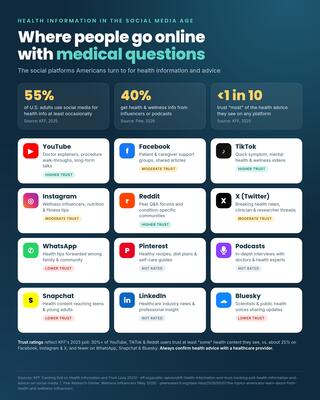
Social Media Health Advice- How Do You Vet It?

Social Media Health Advice- How Do You Vet It?

Welcome to PodcastDx, the show that helps you make sense of your health. I'm Jean Marie McNamara.  I'm joining you today with Lita Tomas, our Production Manager and of our co-hosts, Ron Rispoli (our t...

20 Loka 18min

Fatigue in Ehlers Danlos

Fatigue in Ehlers Danlos

Fatigue is more than feeling tired—for many people living with Ehlers-Danlos syndromes (EDS), it can mean overwhelming physical and mental exhaustion that affects even the simplest daily tasks. Chroni...

13 Loka 16min
Product Recalls (AGAIN!) and Your Health

Product Recalls (AGAIN!) and Your Health

This week we will discuss product recalls and your health.  According to WEBMD: A product safety recall happens when a consumer watch group or a manufacturer finds problems with a product. Lots of ite...

15 Syys 15min
Stage 4 Cancer as an ER Doc

Stage 4 Cancer as an ER Doc

Our guest today is a physician, author and activist.  The topic this week is "Stage 4 Cancer as an ER Doc".   Dr. James Maskalyk practices emergency medicine at St. Michael's, Toronto's inner-city tr...

8 Syys 1h 3min

Ai and Robotics in Medicine

Ai and Robotics in Medicine

This week on PodcastDX, Dr. Sanjeev Kumar joins Lita, Ron, and Jean Marie to discuss AI and robotics in medicine—from surgical robots and rehabilitation technology to hospital automation, patient safe...

1 Syys 47min

EECP The Most Underutilized Therapy in Medicine

EECP The Most Underutilized Therapy in Medicine

Retired U.S. Coast Guard Master Chief Petty Officer Jack Clifford joins PodcastDX to share how severe chronic angina once limited even everyday activities and left him facing the possibility of triple...

25 Elo 44min

Suosittua kategoriassa Terveys ja hyvinvointi

unicast
aamukahvilla
psykopodiaa-podcast
meditaatiot-suomeksi
tiedenaiset-podcast
vakeva-elama-viisaampi-mieli-vahvempi-keho
rss-pt-paahtio
katilon-kahvitunti
rss-hereilla
rss-uplevel-by-sonja-hannus
voi-hyvin-meditaatiot-2
rss-rampaseksia
rss-adama-mindful-hetki
rss-rentoudu-podcast-rentoutumiseen-hanna-viljanmaa
hippokrateen-vastaanotolla
rss-mighty-finland-podcast
rss-vapaudu-voimaasi
rss-kuumilla-aalloilla
rss-sanelunpurku-podcast
terapiassa