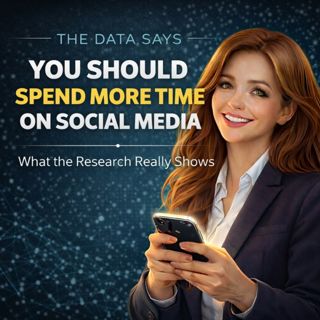
E178: Social Media Isn’t Toxic: Here’s What the Data Says - Dr. Jeff Hall
El Podcast13 Tammi

E178: Social Media Isn’t Toxic: Here’s What the Data Says - Dr. Jeff Hall

Social media isn’t “crack for your brain” for most people—Jeffrey Hall argues the best evidence shows tiny average effects on wellbeing, lots of measurement mess, and a bigger story about relationships, leisure, and moral panic.

Guest bio (short)

Dr. Jeffrey Hall is Professor and Chair of Communication Studies at the University of Kansas and Director of the Relationships and Technology Labs, researching social media, communication, and how relationships shape wellbeing.

Topics discussed (in order)
  • Why “social media is toxic” became the default story (and why it may be a moral panic)
  • What the research actually finds: effects near zero for most users
  • The 0.4% figure and why context (baseline mental health, home life, SES) matters more
  • The measurement problem: “screen time” vs “social media time” vs “everything a phone replaces”
  • Media displacement: social media time often replaces TV time more than it replaces relationships
  • Myth: social media addiction is widespread—why self-diagnosis ≠ clinical addiction
  • Teen mental health: social media as a minor factor compared to home, school, money, support
  • “Potatoes and glasses” comparison: putting effect sizes in perspective
  • Content quality debates (TikTok vs Jerry Springer) and why taste ≠ wellbeing outcomes
  • Social bandwidth: why people decompress differently based on work and social demands
  • Real risks (fraud, cyberbullying, nonconsensual content) without treating them as the whole story
  • Tech leaders restricting kids’ tech: privilege, parenting, and “perfectly curated” childhoods
  • Has teaching changed? Jeff’s take: pandemic disruption mattered more than phones
  • Practical takeaway: prioritize relationships; be forgiving about media; align leisure with values
Main points
  • Most studies find tiny average links between social media use and wellbeing; context explains far more.
  • “Screen time” is a blunt instrument because phones replaced many older activities (TV, music, news, books, calls).
  • “Addiction” is often used casually; clinically, we lack strong standards/tools to diagnose “smartphone addiction” the way we do substance use.
  • Social time may be declining for some, but heavy media use often concentrates among people with fewer social anchors (work, family, community).
  • Digital detox results vary—benefits tend to show up when people replace media with chosen, value-aligned activities.
  • Relationships remain the most reliable wellbeing lever: face-to-face is great, calls are strong, texts can help—staying connected matters.
Top 3 quotes (from the conversation)
  • “Social media has become almost like a vortex that pours in every other conversation that we're having right now.”
  • “Study after study basically says the effect is close to zero or approximate zero.”
  • “It is really, really good evidence that relationships are good for you… prioritize relationships in your life.”
Subscribe➡️Review➡️share

If you liked this episode, subscribe for more conversations that cut through moral panics with data. Leave a review (it helps new listeners find the show), and share this episode with one friend who’s convinced social media is “destroying society”—especially if you want a calmer, more evidence-based take.

🎙 The Pod is hosted by Jesse Wright
💬 For guest suggestions, questions, or media inquiries, reach out at https://elpodcast.media/
📬 Never miss an episode – subscribe and follow wherever you get your podcasts.
⭐️ If you enjoyed this episode, please rate and review the show. It helps others find us.

Thanks for listening!

Jaksot(188)

E164: The Real Reason You Can Speak: Explained by Evolutionary Biologist - Dr. Madeleine Beekman

E164: The Real Reason You Can Speak: Explained by Evolutionary Biologist - Dr. Madeleine Beekman

How human babies, big brains, and social life likely forced Homo sapiens to invent precise speech ~150–200k years ago—and what that means for learning, tech, and today’s kids.Guest Bio:Madeleine Beekm...

29 Loka 20251h 10min
E163: Why AI Still Loses to Humans: Renowned Psychologist Explains - Dr. Gerd Gigerenzer

E163: Why AI Still Loses to Humans: Renowned Psychologist Explains - Dr. Gerd Gigerenzer

A candid conversation with psychologist Gerd Gigerenzer on why human judgment outperforms AI, the “stable world” limits of machine intelligence, and how surveillance capitalism reshapes society.Guest ...

25 Loka 20251h 3min

E162: He Built a Billion-View Empire: Now He Warns Social Media Rewires Your Brain - Richard Ryan

E162: He Built a Billion-View Empire: Now He Warns Social Media Rewires Your Brain - Richard Ryan

How a tech insider who helped build billion-view machines explains the attention economy’s playbook—and how to guard your mind (and data) against it.Guest bio:Richard Ryan is a software developer, med...

22 Loka 20251h 12min

E161: From Rome to Right Now: What History Gets Wrong About Collapse - Dr. Luke Kemp

E161: From Rome to Right Now: What History Gets Wrong About Collapse - Dr. Luke Kemp

Dr. Luke Kemp, an Existential Risk Researcher at the University of Cambridge shows how today’s plutocracy and tech-fueled surveillance imperil society—and what we can do to build resilience.Guest bio:...

15 Loka 20251h 17min

E160: How North Korea’s Dictatorship Endures: Historian Fyodor Tertitskiy Explains

E160: How North Korea’s Dictatorship Endures: Historian Fyodor Tertitskiy Explains

A deep dive with historian Dr. Fyodor Tertitskiy on how North Korea’s dynasty survives—through isolation, terror, and nukes—and why collapse or unification is far from inevitable.Guest bio:Fyodor Tert...

11 Loka 202558min
E159: Laziness Is a Myth: How Hustle Culture Hijacked Your Life

E159: Laziness Is a Myth: How Hustle Culture Hijacked Your Life

Dr. Devon Price unpacks “the laziness lie,” how AI and “bullshit jobs” distort work and higher ed, and why centering human needs—not output—leads to saner lives.Guest bio: Devon Price, PhD, is a Clini...

4 Loka 202559min
E158: Post-Plagiarism University: Replacing Humans with AI—Belonging Dips, GPAs Slide, Integrity Erodes

E158: Post-Plagiarism University: Replacing Humans with AI—Belonging Dips, GPAs Slide, Integrity Erodes

Dr. Joseph Crawford unpacks how AI is reshaping higher education - eroding student belonging, redefining assessment in a post-plagiarism era, and raising the stakes for soft skills.Guest bioDr. Joseph...

27 Syys 20251h 19min
E157: Have We Got Happiness Wrong? Eric Weiner on Bliss in Age of AI

E157: Have We Got Happiness Wrong? Eric Weiner on Bliss in Age of AI

Author Eric Weiner argues that happiness depends less on wealth or location than on relationships, meaning, trust, and realistic expectations—while tech and social media often push the other way.Guest...

24 Syys 202554min

Suosittua kategoriassa Liike-elämä ja talous

sijotuskasti
mimmit-sijoittaa
rss-rahapodi
psykopodiaa-podcast
rss-sisalto-kuntoon
rss-rahamania
rss-lahtijat
taloudellinen-mielenrauha
ostan-asuntoja-podcast
pomojen-suusta
rss-h-asselmoilanen
rss-seuraava-potilas
inderespodi
rss-startup-ministerio
rss-20-30-40-podcast
rss-vaikuttavan-opettajan-vierella
rss-siksi-viestinta
juristipodi
rss-bisnesta-bebeja
rss-inspiroivat-naiset