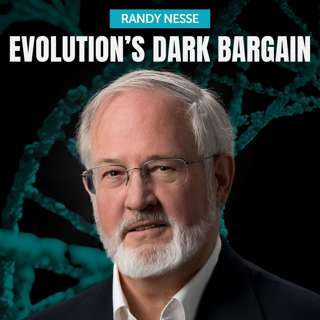
#179 Classic episode – Randy Nesse on why evolution left us so vulnerable to depression and anxiety

#179 Classic episode – Randy Nesse on why evolution left us so vulnerable to depression and anxiety

Mental health problems like depression and anxiety affect enormous numbers of people and severely interfere with their lives. By contrast, we don’t see similar levels of physical ill health in young people. At any point in time, something like 20% of young people are working through anxiety or depression that’s seriously interfering with their lives — but nowhere near 20% of people in their 20s have severe heart disease or cancer or a similar failure in a key organ of the body other than the brain.

From an evolutionary perspective, that’s to be expected, right? If your heart or lungs or legs or skin stop working properly while you’re a teenager, you’re less likely to reproduce, and the genes that cause that malfunction get weeded out of the gene pool.

So why is it that these evolutionary selective pressures seemingly fixed our bodies so that they work pretty smoothly for young people most of the time, but it feels like evolution fell asleep on the job when it comes to the brain? Why did evolution never get around to patching the most basic problems, like social anxiety, panic attacks, debilitating pessimism, or inappropriate mood swings? For that matter, why did evolution go out of its way to give us the capacity for low mood or chronic anxiety or extreme mood swings at all?

Today’s guest, Randy Nesse — a leader in the field of evolutionary psychiatry — wrote the book Good Reasons for Bad Feelings, in which he sets out to try to resolve this paradox.

Rebroadcast: This episode originally aired in February 2024.

Links to learn more, video, and full transcript: https://80k.info/rn

In the interview, host Rob Wiblin and Randy discuss the key points of the book, as well as:

  • How the evolutionary psychiatry perspective can help people appreciate that their mental health problems are often the result of a useful and important system.
  • How evolutionary pressures and dynamics lead to a wide range of different personalities, behaviours, strategies, and tradeoffs.
  • The missing intellectual foundations of psychiatry, and how an evolutionary lens could revolutionise the field.
  • How working as both an academic and a practicing psychiatrist shaped Randy’s understanding of treating mental health problems.
  • The “smoke detector principle” of why we experience so many false alarms along with true threats.
  • The origins of morality and capacity for genuine love, and why Randy thinks it’s a mistake to try to explain these from a selfish gene perspective.
  • Evolutionary theories on why we age and die.
  • And much more.

Chapters:

  • Cold Open (00:00:00)
  • Rob's Intro (00:00:55)
  • The interview begins (00:03:01)
  • The history of evolutionary medicine (00:03:56)
  • The evolutionary origin of anxiety (00:12:37)
  • Design tradeoffs, diseases, and adaptations (00:43:19)
  • The tricker case of depression (00:48:57)
  • The purpose of low mood (00:54:08)
  • Big mood swings vs barely any mood swings (01:22:41)
  • Is mental health actually getting worse? (01:33:43)
  • A general explanation for bodies breaking (01:37:27)
  • Freudianism and the origins of morality and love (01:48:53)
  • Evolutionary medicine in general (02:02:42)
  • Objections to evolutionary psychology (02:16:29)
  • How do you test evolutionary hypotheses to rule out the bad explanations? (02:23:19)
  • Striving and meaning in careers (02:25:12)
  • Why do people age and die? (02:45:16)

Producer and editor: Keiran Harris
Audio Engineering Lead: Ben Cordell
Technical editing: Dominic Armstrong
Transcriptions: Katy Moore

Jaksot(318)

#52 - Glen Weyl on uprooting capitalism and democracy for a just society

#52 - Glen Weyl on uprooting capitalism and democracy for a just society

Pro-market economists love to wax rhapsodic about the capacity of markets to pull together the valuable local information spread across all of society about what people want and how to make it. But wh...

8 Helmi 20192h 44min

#51 - Martin Gurri on the revolt of the public & crisis of authority in the information age

#51 - Martin Gurri on the revolt of the public & crisis of authority in the information age

Politics in rich countries seems to be going nuts. What's the explanation? Rising inequality? The decline of manufacturing jobs? Excessive immigration? Martin Gurri spent decades as a CIA analyst and...

29 Tammi 20192h 31min

#50 - David Denkenberger on how to feed all 8b people through an asteroid/nuclear winter

#50 - David Denkenberger on how to feed all 8b people through an asteroid/nuclear winter

If an asteroid impact or nuclear winter blocked the sun for years, our inability to grow food would result in billions dying of starvation, right? According to Dr David Denkenberger, co-author of Feed...

27 Joulu 20182h 57min

#49 - Rachel Glennerster on a year's worth of education for 30c & other development 'best buys'

#49 - Rachel Glennerster on a year's worth of education for 30c & other development 'best buys'

If I told you it's possible to deliver an extra year of ideal primary-level education for under $1, would you believe me? Hopefully not - the claim is absurd on its face. But it may be true nonetheles...

20 Joulu 20181h 35min

#48 - Brian Christian on better living through the wisdom of computer science

#48 - Brian Christian on better living through the wisdom of computer science

Please let us know if we've helped you: Fill out our annual impact survey Ever felt that you were so busy you spent all your time paralysed trying to figure out where to start, and couldn't get much ...

22 Marras 20183h 15min

#47 - Catherine Olsson & Daniel Ziegler on the fast path into high-impact ML engineering roles

#47 - Catherine Olsson & Daniel Ziegler on the fast path into high-impact ML engineering roles

After dropping out of a machine learning PhD at Stanford, Daniel Ziegler needed to decide what to do next. He’d always enjoyed building stuff and wanted to shape the development of AI, so he thought a...

2 Marras 20182h 4min

#46 - Hilary Greaves on moral cluelessness & tackling crucial questions in academia

#46 - Hilary Greaves on moral cluelessness & tackling crucial questions in academia

The barista gives you your coffee and change, and you walk away from the busy line. But you suddenly realise she gave you $1 less than she should have. Do you brush your way past the people now waitin...

23 Loka 20182h 49min

#45 - Tyler Cowen's case for maximising econ growth, stabilising civilization & thinking long-term

#45 - Tyler Cowen's case for maximising econ growth, stabilising civilization & thinking long-term

I've probably spent more time reading Tyler Cowen - Professor of Economics at George Mason University - than any other author. Indeed it's his incredibly popular blog Marginal Revolution that prompted...

17 Loka 20182h 30min

Suosittua kategoriassa Koulutus

rss-murhan-anatomia
psykopodiaa-podcast
voi-hyvin-meditaatiot-2
rss-niinku-asia-on
kesken
rss-liian-kuuma-peruna
rss-narsisti
adhd-podi
ihminen-tavattavissa-tommy-hellsten-instituutti
rss-duodecim-lehti
rss-psykalab
aamukahvilla
aloita-meditaatio
psykologia
rahapuhetta
rss-elamankoulu
rss-valo-minussa-2
rss-arkijarki
rss-honest-talk-with-laurrenna
rss-mental-race