Origins of the kiss
Many Minds12 Helmi

Origins of the kiss

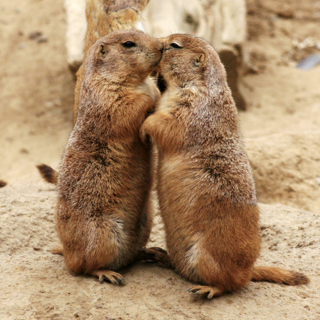
Humans do some pretty weird things. Some of us will sit in searingly hot rooms or jump into icy ponds. Others risk their lives trying to climb to new heights or dive to new depths. And every once in a while, two otherwise normal-seeming humans will lean in close to each other, open mouths, lock lips, and swap a hearty helping of microbes. You may even know people who've done this. But why? Are we the only animals who kiss? What could be the deeper origins of this truly bizarre behavior?

My guest today is Dr. Matilda Brindle. Matilda is an Evolutionary Biologist at the University of Oxford. She's interested in understanding the origins of behaviors and traits across the animal kingdom. But it's not just any traits she's interested in—she tends to favor those that are a bit risque.

Here, Matilda and I talk about the puzzle at the heart of human kissing behavior. We discuss the possible adaptive functions of kissing—and of romantic kissing in particular. We walk through her recent paper in which—drawing on observations across primates species—she and her colleagues reconstructed the phylogeny of kissing behavior. They found that kissing is present in almost all the Great Apes—and also in several species of monkeys—and that it may go back around 20 million years. We sketch different proposals for how kissing may have evolved, such as the idea that it originally grew out of "premastication"—the practice of chewing up food for infants and transferring that food by mouth. And, of course, we consider the cultural side of kissing—and how to make sense of the fact that, despite these ancient roots in the primate lineage, romantic kissing is by no means universal to all human groups.

Hope you enjoy this one, friends—offered in spirit of Valentine's Day, of course. Kissing may seem like a light-hearted or frivolous topic, but—as I hope you'll appreciate—it opens up some big, thorny, compelling questions. And, in fact, it's finally attracting serious attention from scholars of all kinds interested in the different dimensions of social behavior.

Without further ado, here's my interview with Dr. Matilda Brindle.

Notes

3:00 – Dr. Brindle's paper, 'A comparative approach to the phylogeny of kissing,' coauthored with Dr. Catherine Talbot and Dr. Stuart West.

10:00 – An academic review of "postcopulatory sexual selection."

15:45 – The study examining the convergence of oral microbiota in kissing couples. The same study quantified the amount of microbial transfer during kissing.

18:00 – For more on the "grass-in-ear" phenomenon among chimpanzees and other such arbitrary-seeming animal behaviors, see our earlier episode about animal cultures. For the more recent "grass-in-bum" phenomenon, see here.

21:30 – For Dr. Brindle's work on the adaptive functions of masturbation in primates, see here.

32:00 – For popular coverage of Dr. Brindle's work, highlighting the likelihood that humans and Neanderthals kissed, see here.

39:00 – The book, Biological Exuberance, by Bruce Bagemihl.

43:00 – For the study on the presence of romantic kissing across cultures, see here.

47:00 – For indirect (linguistic) evidence for the prevalence of "smell-kissing" across Southeast Asia, see here. For more on this style of greeting, see Kensy's post here.

50:00 – For the proposal that kissing is rooted in "oral grooming," see here.

58:00 – For the larger special issue on the origins of kissing, of which Dr. Brindle's paper is part, see here.

1:00:30 – For Dr. Brindle's work on "bacula" (aka "penis bones"), see here.

Recommendations

The Handshake, by Ella Al-Shamahi

Eve, by Cat Bohannon

Primate Sexuality, by Alan Dixson

Many Minds is a project of the Diverse Intelligences Summer Institute, which is made possible by a generous grant from the John Templeton Foundation to Indiana University. The show is hosted and produced by Kensy Cooperrider, with help from Assistant Producer Urte Laukaityte and with creative support from DISI Directors Erica Cartmill and Jacob Foster. Our artwork is by Ben Oldroyd.

Subscribe to Many Minds on Apple, Stitcher, Spotify, Pocket Casts, Google Play, or wherever you listen to podcasts. You can also now subscribe to the Many Minds newsletter here!

We welcome your comments, questions, and suggestions. Feel free to email us at: manymindspodcast@gmail.com.

For updates about the show, visit our website or follow us on Bluesky (@manymindspod.bsky.social).

Tämä jakso on lisätty Podme-palveluun avoimen RSS-syötteen kautta eikä se ole Podmen omaa tuotantoa. Siksi jakso saattaa sisältää mainontaa.

Jaksot(162)

Babies, dogs, and the riddles of word learning

Babies, dogs, and the riddles of word learning

It's kind of astonishing, really, that kids ever learn words. Each one poses a little riddle. Does this sound string refer to a person? A category of things? Or maybe some other feature of the bloomin...

22 Touko 1h 18min

The inner life of the hand

The inner life of the hand

Newton saw in the human hand proof of the divine; Darwin saw a key to our species' success. Many others, too, have described the hand in hyperbolic terms, as a paragon of design, a cornerstone of huma...

7 Touko 1h 10min

From the archive: The cuttlefish and its coat of many colors

From the archive: The cuttlefish and its coat of many colors

Hi friends! We're skipping a beat to take care of some spring housekeeping tasks. We will be back in May! In the meanwhile, enjoy this listener favorite from our archives! ----- [originally aired Apri...

22 Huhti 1h 33min

Illuminating cave art

Illuminating cave art

Deep in our past, in the dark depths of caves, our ancestors did something strange and beautiful. Working by firelight, some doodled little designs. Others made hand stencils. Some saw a bulge of rock...

9 Huhti 1h 25min

What can AI teach us about the mind?

What can AI teach us about the mind?

Everyone is talking about AI these days. Often these conversations are about how AI might upend education, or work, or social life, or maybe civilization itself. But among cognitive scientists and psy...

26 Maalis 1h 21min

Mutualisms all the way down

Mutualisms all the way down

No one is an island. We all depend on each other in critical, often tangled ways. And when I say "we" and "each other" I don't just mean humans. Yes, we humans rely on other humans. But we also rely o...

11 Maalis 1h 8min

Seven metaphors for AI

Seven metaphors for AI

If you wanted a petri dish for understanding metaphors—how they emerge and evolve and jostle with each other—it would be hard to do better than the world of AI. We talk about AI systems variously as c...

26 Helmi 55min

Suosittua kategoriassa Koulutus

rss-murhan-anatomia
psykopodiaa-podcast
voi-hyvin-meditaatiot-2
kesken
rss-valo-minussa-2
rss-liian-kuuma-peruna
rss-narsisti
rss-niinku-asia-on
rss-rahamania
adhd-podi
psykologia
rss-vapaudu-voimaasi
aamukahvilla
rss-laadukasta-ensihoitoa
rss-mentalrace
rss-arkea-ja-aurinkoa-podcast-espanjasta
rss-hereilla
rahapuhetta
puhutaan-koiraa
ihminen-tavattavissa-tommy-hellsten-instituutti